Uncategorized

What to Do If You Disagree With a School Evaluation

What to Do If You Disagree With a School Evaluation

If you disagree with a school evaluation, start by reviewing the report carefully, identifying what feels incomplete or inaccurate, asking clarifying questions, requesting a meeting, documenting your concerns, and considering whether an Independent Educational Evaluation may be appropriate. Parents often have concerns about reading, writing, math, attention, ADHD, autism, executive function, anxiety, processing speed, school

What to Do If You Disagree With a School Evaluation Read More »

ADHD vs Anxiety in Children: Why Testing Can Help Clarify the Pattern

ADHD vs Anxiety in Children: Why Testing Can Help Clarify the Pattern

ADHD and anxiety can look similar in children because both can affect attention, homework, classroom participation, emotional regulation, sleep, school performance, and behavior. ADHD often involves difficulty regulating attention, impulses, activity level, and executive function, while anxiety often involves worry, fear, avoidance, perfectionism, reassurance-seeking, physical complaints, or distress in specific situations. Parents may notice distractibility,

ADHD vs Anxiety in Children: Why Testing Can Help Clarify the Pattern Read More »

Executive Function Challenges at School: Signs Parents Should Notice

Executive Function Challenges at School: Signs Parents Should Notice

Executive function challenges at school often appear as unfinished work, forgotten assignments, weak organization, slow homework, emotional frustration, poor time management, and difficulty starting or completing multi-step tasks. One messy backpack, one late assignment, or one difficult week does not mean a child needs testing, but repeated patterns may justify a closer look. For San

Executive Function Challenges at School: Signs Parents Should Notice Read More »

Autism vs ADHD in Children: Assessment Guide

Autism vs ADHD in Children: Why Assessment Matters

Autism and ADHD can both affect attention, behavior, emotions, school performance, and social relationships, but they are not the same. ADHD often involves inattention, impulsivity, hyperactivity, and regulation concerns, while autism often involves social communication differences, restricted or repetitive behaviors, sensory needs, and developmental patterns. Some children have ADHD, some have autism, some have both,

Autism vs ADHD in Children: Why Assessment Matters Read More »

Dyslexia & Learning Differences: Signs Your Child May Need a Psychoeducational Evaluation

Signs Your Child May Need Learning Disability Testing

Learning disability testing may be helpful when a child’s struggles with reading, writing, math, attention, memory, homework, or school confidence continue despite effort and support. One difficult grade or one hard school year does not automatically mean a child has a learning disability, but repeated patterns can be a sign that deeper evaluation is needed.

Signs Your Child May Need Learning Disability Testing Read More »

Learning Disability Evaluation in San Francisco: Dyslexia, Dysgraphia, Dyscalculia & More (Middle + High School)

Learning Disability Evaluation in San Francisco: Dyslexia, Dysgraphia, Dyscalculia & More (Middle + High School)

If your middle or high schooler is bright but school is getting harder—reading is slow, writing takes hours, or math breaks down in multi-step work—a learning disability evaluation can clarify what’s happening and what supports will actually help. Here’s the core idea: “Learning disability” often refers to Specific Learning Disorder, which involves persistent difficulty in

Learning Disability Evaluation in San Francisco: Dyslexia, Dysgraphia, Dyscalculia & More (Middle + High School) Read More »

Adult IQ & Cognitive Testing in the Bay Area: When It Helps with Career, College, or Self-Understanding

Adult IQ & Cognitive Testing in the Bay Area: When It Helps with Career, College, or Self-Understanding

Adult IQ & Cognitive Testing in the Bay Area: When It Helps with Career, College, or Self-Understanding If you’re considering adult IQ/cognitive testing in the Bay Area, the best reason to do it is not “to find out your number.” It’s to get a usable cognitive profile—strengths and bottlenecks—so you can make concrete decisions about

Adult IQ & Cognitive Testing in the Bay Area: When It Helps with Career, College, or Self-Understanding Read More »

Understanding Your Child’s IQ Report: Verbal, Nonverbal, Working Memory & Processing Speed Explained

Understanding Your Child’s IQ Report: Verbal, Nonverbal, Working Memory & Processing Speed Explained

If you’re staring at your child’s IQ report and thinking “What does this actually mean?”—you’re not alone. The biggest mistake parents make is treating IQ as one number instead of a profile. Here’s the fast way to read the report: Verbal scores describe language-based reasoning and how your child thinks with words. Nonverbal (often visual-spatial

Understanding Your Child’s IQ Report: Verbal, Nonverbal, Working Memory & Processing Speed Explained Read More »

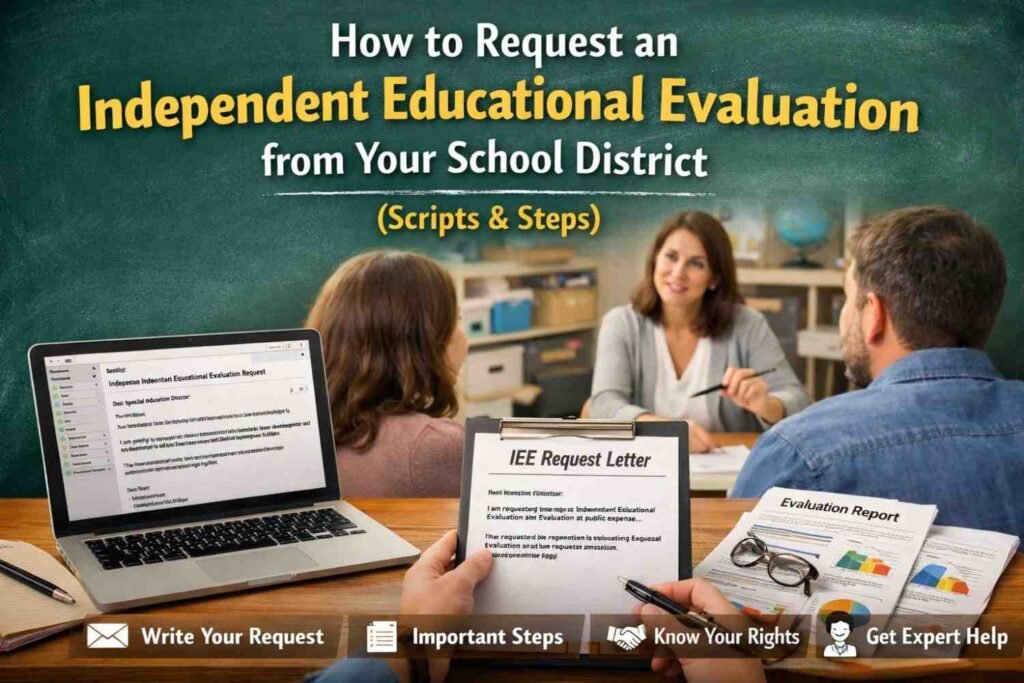
How to Request an Independent Educational Evaluation from Your School District (Scripts & Steps)

How to Request an Independent Educational Evaluation from Your School District (Scripts & Steps)

At a glance: how to ask for an IEE in one clear email If you disagree with your child’s school evaluation, you may have the right to an Independent Educational Evaluation (IEE)—a second opinion from a qualified evaluator who is not employed by the school district. Under the Individuals with Disabilities Education Act (IDEA), when

How to Request an Independent Educational Evaluation from Your School District (Scripts & Steps) Read More »

Dyslexia & Learning Differences: Signs Your Child May Need a Psychoeducational Evaluation

Dyslexia & Learning Differences: Signs Your Child May Need a Psychoeducational Evaluation

Dyslexia and other learning differences often show up as consistent struggles with reading, writing, or spelling that don’t match your child’s intelligence or effort. Warning signs include slow, effortful reading, frequent letter/word reversals, big homework battles, and growing frustration or low confidence.  A psychoeducational evaluation is a comprehensive assessment of your child’s thinking, learning, and

Dyslexia & Learning Differences: Signs Your Child May Need a Psychoeducational Evaluation Read More »

Get Ready for Private School Admissions

Give your child a strong start with a professional IQ evaluation for school applications.