
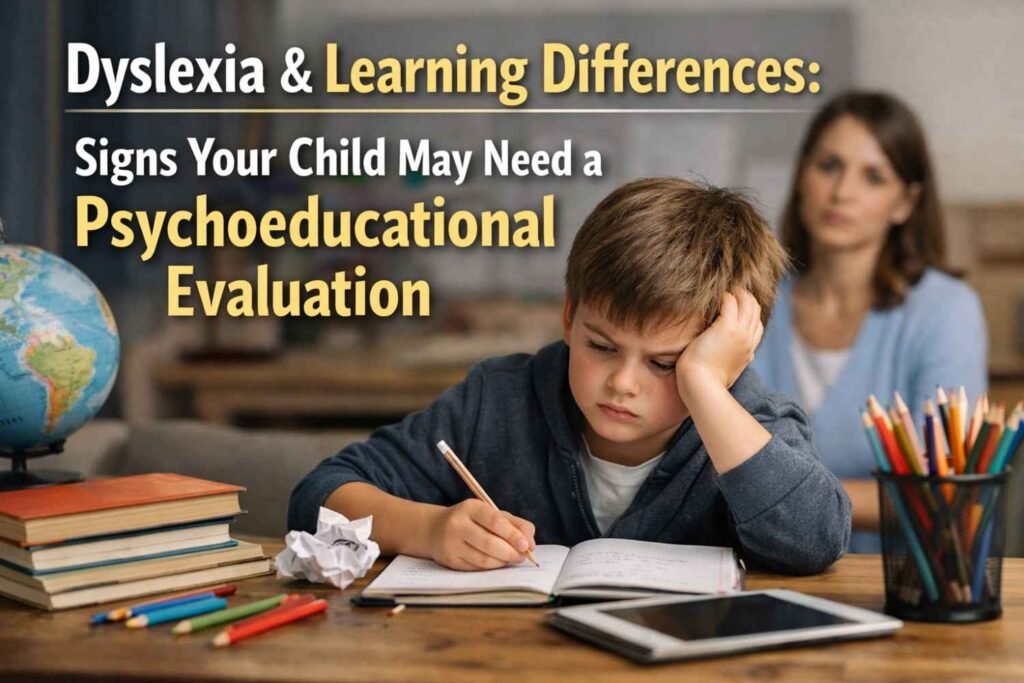
- Dyslexia and other learning differences often show up as consistent struggles with reading, writing, or spelling that don’t match your child’s intelligence or effort.
- Warning signs include slow, effortful reading, frequent letter/word reversals, big homework battles, and growing frustration or low confidence.
- A psychoeducational evaluation is a comprehensive assessment of your child’s thinking, learning, and emotional functioning that can identify dyslexia or other learning disorders and guide targeted support (school plans, tutoring, accommodations).
When “Something Feels Off” With Your Child’s Learning
You know your child is bright. Maybe they ask deep questions, tell complex stories, or have amazing ideas—but reading and writing are a constant struggle. Homework takes forever. Spelling tests are a nightmare. They might even say things like, “I’m dumb,” even though you know that’s not true.
If this sounds familiar, you’re not alone—and you’re not imagining things.
This is often the point where parents start Googling dyslexia, learning differences, and psychoeducational evaluations. This article will help you:
- Recognize common signs of dyslexia and learning differences.
- Tell the difference between “normal struggle” and red flags.
- Understand what a psychoeducational evaluation is and how it can help your child at school and at home.
What Are Dyslexia and “Learning Differences,” Really?
Dyslexia is a specific learning disability that mainly affects how the brain processes written language—especially word reading, spelling, and decoding. Kids with dyslexia are just as intelligent as their peers, but they struggle with reading and related skills because of how their brain processes sounds and letters.
Common features include:
- Trouble linking letters and sounds
- Slow, effortful reading
- Persistent spelling mistakes
- Difficulty sounding out unfamiliar words
When we say “learning differences,” we’re usually talking about a broader group of challenges that can affect how a child learns, such as:
- Dyslexia (reading)
- Dysgraphia (writing)
- Dyscalculia (math)
- Attention and executive functioning difficulties (often related to ADHD)
The key idea: your child’s intelligence and effort may be there, but the way their brain handles language, memory, or processing makes learning harder than it should be.
Early Signs by Age: When to Pay Attention
Every child is different, and no single sign automatically means “dyslexia.” But patterns over time matter.
Preschool & Early Years (Before Age 7)
Some early clues can appear before formal reading instruction:
- Late talking compared with peers
- Trouble learning nursery rhymes or rhyming words
- Difficulty remembering the names of letters, colors, or days of the week
- Struggling to recognize letters in their own name
- Confusing left/right or directional words
- Avoiding activities that involve letters or simple books
Again: one or two of these alone isn’t a diagnosis. But several together, especially with a family history of dyslexia or learning issues, are worth watching.
Early Elementary (Grades 1–3)
This is often when dyslexia becomes more obvious because children are expected to read independently. Common signs include:
- Reading much more slowly than classmates
- Struggling to sound out simple words; guessing based on the first letter or picture
- Skipping, adding, or changing small words (e.g., from → for, said → and)
- Persistent spelling errors, even for high-frequency words
- Avoiding reading aloud; getting upset when asked to read
- Losing their place on the page or using a finger to track every word
Upper Elementary and Older
As the work gets harder, problems may show up in more subtle ways:
- Slow, effortful reading that makes long assignments exhausting
- Good listening comprehension but poor reading comprehension
- Written work that seems far below their spoken language level
- Difficulty remembering what they just read, especially with dense text
- Growing frustration, anxiety, or low self-esteem around school
Sometimes these students are labelled “lazy,” “unmotivated,” or “not trying”—when in reality, they’re working twice as hard just to keep up.
Normal Struggle vs. Red Flags: When to Consider a Psychoeducational Evaluation
All kids have off days at school. So how do you know when it’s time to look deeper?
You might consider a psychoeducational evaluation if:
- The struggles are persistent. Problems with reading, writing, or spelling have been going on for at least several months or school years, not just during a move, illness, or tough unit.
- There’s a big gap between ability and performance. Your child seems bright and curious in conversation but their reading and written work lag far behind.
- Extra help isn’t closing the gap. You’ve tried tutoring, extra reading practice, or school interventions, and they’re still struggling more than expected.
- Schools or teachers are also concerned. Teacher comments like “works hard but isn’t making expected progress” or “still behind grade level in reading” keep appearing.
- You’re seeing emotional fallout. Your child avoids homework, complains of stomachaches before school, or calls themselves “stupid” or “bad at everything.”
If several of these fit your situation, it doesn’t mean something is “wrong” with your child—but it does mean it’s time to get more information.
What Is a Psychoeducational Evaluation?
A psychoeducational evaluation is a comprehensive assessment of your child’s:
- Cognitive abilities (how they think, reason, remember, and process information)
- Academic skills (reading, writing, spelling, math)
- Processing skills (like phonological processing, visual-motor skills, working memory)
- Social-emotional and behavioral functioning (anxiety, attention, motivation, behaviour)
It is usually carried out by a licensed psychologist or educational psychologist who specializes in learning and neurodevelopment.
What’s typically included
While each practice has its own approach, most psychoeducational evaluations involve:
- Detailed history and intake
- Parent interview about development, health, school history, and current concerns
- Questionnaires from parents and often teachers
- Standardized cognitive testing
- Tasks that measure verbal abilities, visual–spatial reasoning, working memory, and processing speed
- Academic testing
- Standardized tests of reading (decoding, fluency, comprehension), writing, and math
- Processing and attention measures
- Assessments of phonological skills, rapid naming, executive functioning, and attention
- Social-emotional screening
- Questionnaires or interviews to check for anxiety, mood issues, or behavior concerns that affect learning
- Comprehensive report
- A written document summarizing results, any diagnoses, and clear recommendations for home and school
- Feedback meeting
- A session where the evaluator walks you through the findings, explains what they mean, and answers questions
The goal isn’t just to hand you a set of scores. It’s to give you a clear roadmap for how to support your child’s learning and emotional well-being.
How a Psychoeducational Evaluation Helps Your Child
A good evaluation doesn’t just name the problem; it opens doors.
1. You get answers, not guesses
Instead of “maybe dyslexia, maybe not,” you get:
- Clear information about whether your child meets criteria for a specific learning disorder like dyslexia
- Insight into which skills are strong (for example, verbal reasoning) and which are weaker (like phonological processing or working memory)
This helps reframe the story from “you’re not trying hard enough” to “your brain processes language differently—and there are strategies for that.”
2. School support and accommodations
Psychoeducational reports are often used to support:
- Special education services (IEPs)
- 504 plans or similar accommodation plans
- Adjustments such as:
- Extra time on tests
- Reduced reading load
- Access to audiobooks or text-to-speech
- Explicit, structured reading instruction
Schools and colleges usually rely on recent standardized testing when deciding what support they can legally and practically offer.
3. Targeted intervention, not one-size-fits-all
With specific data, you can:
- Choose reading interventions that match your child’s profile (for example, structured literacy for dyslexia).
- Prioritize what matters most: decoding, fluency, comprehension, writing, or executive skills.
- Avoid spending time and money on generic tutoring that doesn’t address the root issue.
4. Protecting self-esteem and mental health
Research shows that ongoing, unexplained learning struggles can seriously affect self-esteem and anxiety.
An evaluation can:
- Give your child a language for their experiences (“My brain needs more practice with sounds and words; that’s different from being lazy”).
- Help adults around them adjust expectations and support, so school feels more manageable and less like a constant failure test.
- Open up conversations about strengths, talents, and accommodations, not just deficits.
How to Start the Process
You usually have two main paths: school-based and private evaluation.
1. Start with your child’s school
If your child is in a public or state-funded school, you often have a legal right to request an evaluation for learning difficulties.
You can:
- Email or write to the principal, special education coordinator, or SENCO (depending on your system).
- Describe the concerns you see at home and any teacher feedback you’ve received.
- Ask for a meeting to discuss evaluation options.
School-based evaluations:
- Are typically free for families
- Focus on whether your child qualifies for special education or accommodations
- May be narrower or slower than private evaluations, depending on resources
2. Seek a private psychoeducational evaluation
Many families also turn to private educational psychologists or neuropsychologists for a more detailed, flexible assessment.
Advantages can include:
- Shorter wait times
- More in-depth testing and longer reports
- Time for extended feedback and consultation with parents
- Detailed recommendations that you can bring back to school
If you go this route, good questions to ask a potential provider are:
- “How much experience do you have evaluating children with suspected dyslexia or learning disorders?”
- “What tests do you typically use?”
- “Will you meet with us to explain the results and help with school planning?”
Some families choose to do both: use the private evaluation for clarity and a detailed plan, and then work with the school to translate it into services and accommodations.
How to Talk to Your Child About Getting Tested
Many kids worry that an evaluation is about finding out “what’s wrong with me.” You can ease some of that pressure by framing it differently:
- “We want to understand how your brain learns best.”
- “This isn’t a test you pass or fail; it’s a way to figure out what kinds of help actually work for you.”
- “Lots of kids and teens do this when school feels harder than it should. We’re doing it because we care about you, not because you’re in trouble.”
You can also:
- Ask what they’re worried about and answer honestly.
- Explain what the day might look like: puzzles, questions, reading, breaks.
- Reassure them that it’s okay to say “I need a break” or “I’m stuck” during testing.
Final Thoughts: Trust Your Gut, Then Get Data
If you keep wondering whether your child’s struggles with reading, writing, or learning are “normal” or something more—your instincts are worth listening to.
Dyslexia and other learning differences are common, real, and highly manageable when they’re identified early and supported properly.
A psychoeducational evaluation doesn’t define your child—it simply gives you:
- A clearer picture of how their brain works
- A shared language for talking with teachers and professionals
- A concrete plan to help them feel more capable and confident at school
If you’re seeing several of the signs described in this article and homework has turned into a constant battle, it might be time to move from worry to action and explore an evaluation with a qualified professional.