Author name: Marisa Ramia Bacon, M.A., LEP

Autism vs ADHD in Children: Assessment Guide

Autism vs ADHD in Children: Why Assessment Matters

Autism and ADHD can both affect attention, behavior, emotions, school performance, and social relationships, but they are not the same. ADHD often involves inattention, impulsivity, hyperactivity, and regulation concerns, while autism often involves social communication differences, restricted or repetitive behaviors, sensory needs, and developmental patterns. Some children have ADHD, some have autism, some have both, […]

Autism vs ADHD in Children: Why Assessment Matters Read More »

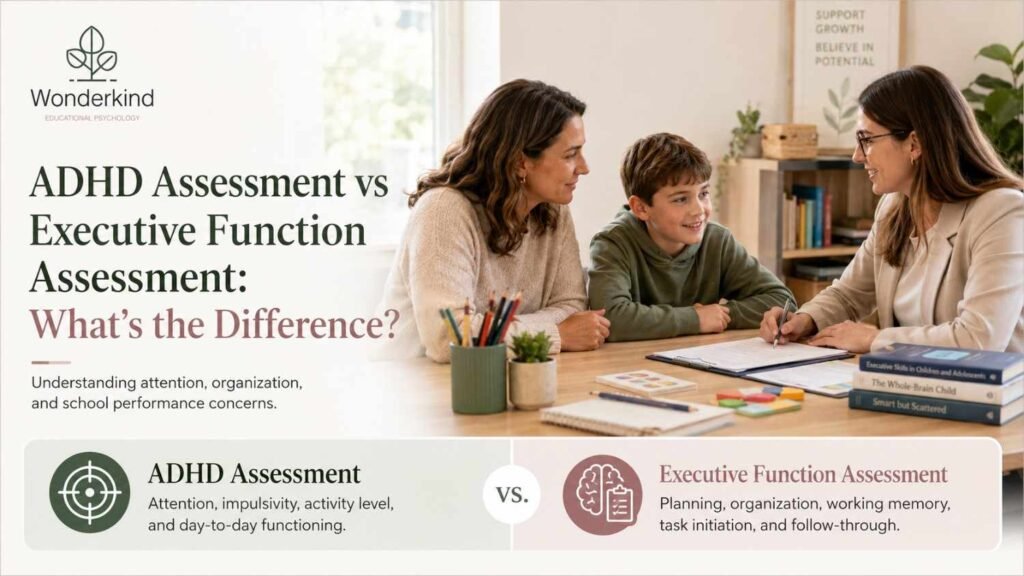
ADHD Assessment vs Executive Function Assessment: What’s the Difference?

An ADHD assessment looks at whether a child’s attention, impulsivity, activity level, and day-to-day functioning fit an ADHD profile, while an executive function assessment looks more closely at skills like planning, organization, working memory, task initiation, time management, flexibility, and follow-through. Many children with ADHD also have executive function challenges, but executive function difficulties can

ADHD Assessment vs Executive Function Assessment: What’s the Difference? Read More »

Psychoeducational Assessment vs Neuropsychological Evaluation

Psychoeducational Assessment vs Neuropsychological Evaluation

A psychoeducational assessment usually focuses on how a child learns in school, while a neuropsychological evaluation looks more broadly at how brain-based functions affect learning, behavior, attention, memory, and daily life. For many families, a psychoeducational assessment is the right starting point when the main concerns involve reading, writing, math, processing speed, school performance, learning

Psychoeducational Assessment vs Neuropsychological Evaluation Read More »

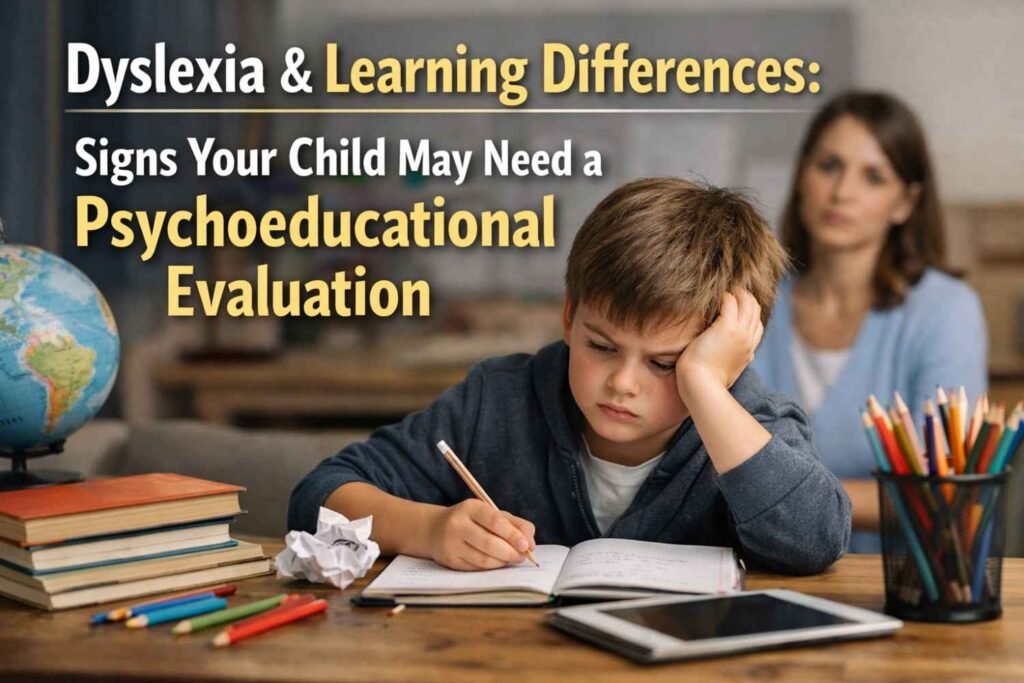
Dyslexia & Learning Differences: Signs Your Child May Need a Psychoeducational Evaluation

Signs Your Child May Need Learning Disability Testing

Learning disability testing may be helpful when a child’s struggles with reading, writing, math, attention, memory, homework, or school confidence continue despite effort and support. One difficult grade or one hard school year does not automatically mean a child has a learning disability, but repeated patterns can be a sign that deeper evaluation is needed.

Signs Your Child May Need Learning Disability Testing Read More »

Dyslexia Testing vs Psychoeducational Assessment: What Parents Should Know

Dyslexia Testing vs Psychoeducational Assessment: What Parents Should Know

Dyslexia testing focuses mainly on reading, spelling, decoding, and related language-based skills, while a psychoeducational assessment looks at the child’s broader learning profile. For many parents, the real question is not only “Does my child have dyslexia?” but “What is causing the reading struggle, and what support does my child need at school?” This guide

Dyslexia Testing vs Psychoeducational Assessment: What Parents Should Know Read More »

What Can You Diagnose With a Psychoeducational Assessment? A Parent Guide to Learning, ADHD, and School Supports

What Can You Diagnose With a Psychoeducational Assessment? A Parent Guide to Learning, ADHD, and School Supports

Parents usually ask this question because they’re trying to solve one of three problems: My child is struggling in school and I don’t know why. The school says “not eligible” but the struggle is real. Someone mentioned ADHD/autism/dyslexia and I need clarity. Here’s the honest answer (the one most competitor posts avoid): A psychoeducational assessment

What Can You Diagnose With a Psychoeducational Assessment? A Parent Guide to Learning, ADHD, and School Supports Read More »

Slow Processing Speed at School: When to Consider a Psychoeducational Assessment (Middle + High School)

Slow Processing Speed at School: When to Consider a Psychoeducational Assessment (Middle + High School)

If your middle or high schooler seems to understand the material but can’t finish—tests, essays, homework, or note-taking—slow processing speed may be part of the picture. The key is that “slow” usually shows up as slow output, not low intelligence. Here’s what to know upfront: Slow processing speed often looks like accuracy without completion (they

Slow Processing Speed at School: When to Consider a Psychoeducational Assessment (Middle + High School) Read More »

Learning Disability Evaluation in San Francisco: Dyslexia, Dysgraphia, Dyscalculia & More (Middle + High School)

Learning Disability Evaluation in San Francisco: Dyslexia, Dysgraphia, Dyscalculia & More (Middle + High School)

If your middle or high schooler is bright but school is getting harder—reading is slow, writing takes hours, or math breaks down in multi-step work—a learning disability evaluation can clarify what’s happening and what supports will actually help. Here’s the core idea: “Learning disability” often refers to Specific Learning Disorder, which involves persistent difficulty in

Learning Disability Evaluation in San Francisco: Dyslexia, Dysgraphia, Dyscalculia & More (Middle + High School) Read More »

Adult IQ & Cognitive Testing in the Bay Area: When It Helps with Career, College, or Self-Understanding

Adult IQ & Cognitive Testing in the Bay Area: When It Helps with Career, College, or Self-Understanding

Adult IQ & Cognitive Testing in the Bay Area: When It Helps with Career, College, or Self-Understanding If you’re considering adult IQ/cognitive testing in the Bay Area, the best reason to do it is not “to find out your number.” It’s to get a usable cognitive profile—strengths and bottlenecks—so you can make concrete decisions about

Adult IQ & Cognitive Testing in the Bay Area: When It Helps with Career, College, or Self-Understanding Read More »

Understanding Your Child’s IQ Report: Verbal, Nonverbal, Working Memory & Processing Speed Explained

Understanding Your Child’s IQ Report: Verbal, Nonverbal, Working Memory & Processing Speed Explained

If you’re staring at your child’s IQ report and thinking “What does this actually mean?”—you’re not alone. The biggest mistake parents make is treating IQ as one number instead of a profile. Here’s the fast way to read the report: Verbal scores describe language-based reasoning and how your child thinks with words. Nonverbal (often visual-spatial

Understanding Your Child’s IQ Report: Verbal, Nonverbal, Working Memory & Processing Speed Explained Read More »