

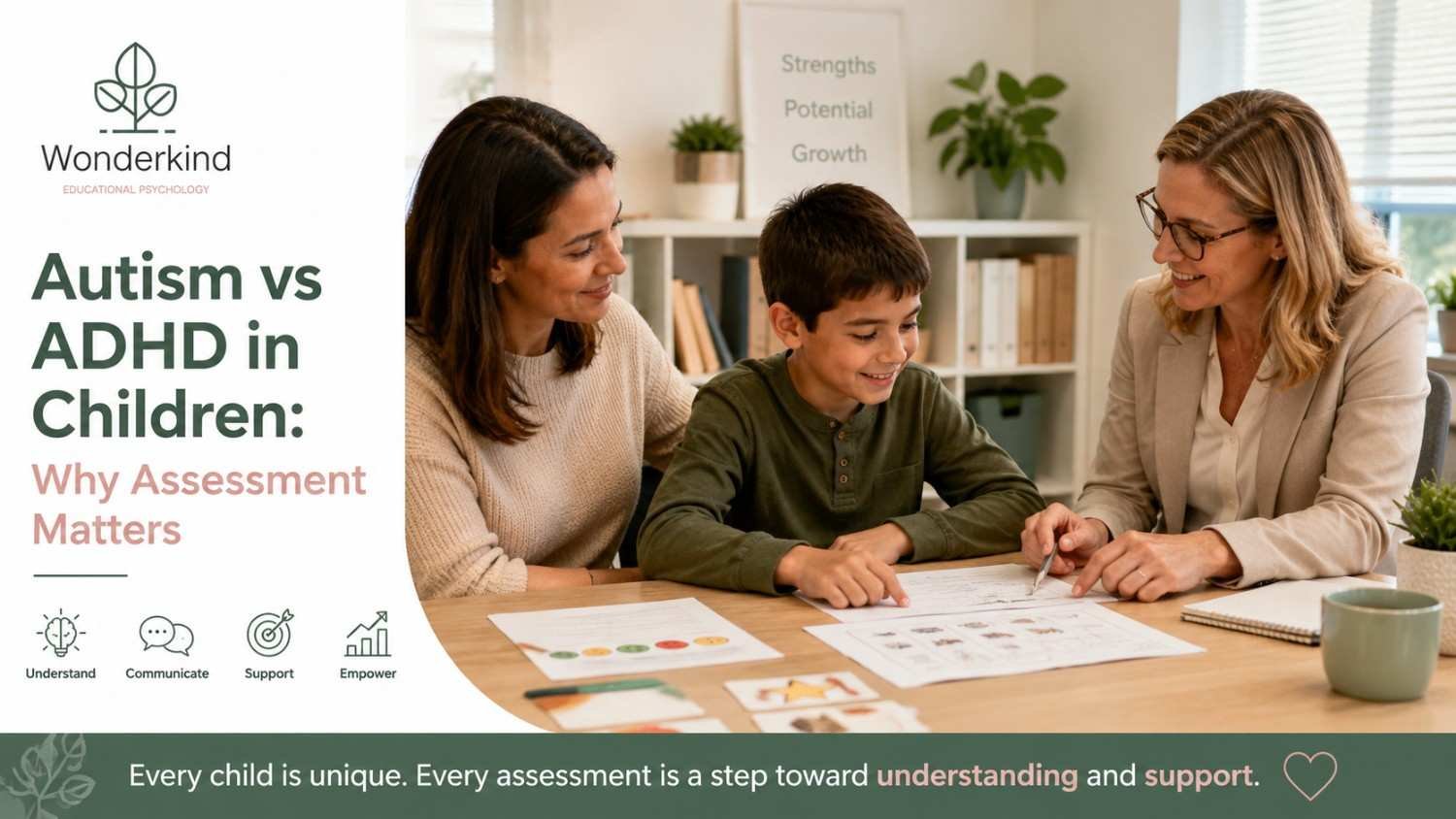
Autism and ADHD can both affect attention, behavior, emotions, school performance, and social relationships, but they are not the same. ADHD often involves inattention, impulsivity, hyperactivity, and regulation concerns, while autism often involves social communication differences, restricted or repetitive behaviors, sensory needs, and developmental patterns. Some children have ADHD, some have autism, some have both, and some have learning, anxiety, or executive function concerns that can look similar from the outside. For San Francisco and Bay Area parents noticing attention problems, social difficulty, sensory overwhelm, meltdowns, routines, school struggles, teacher concerns, or IEP/504 questions, Wonderkind Educational Psychology can help clarify whether a neurodevelopmental assessment, psychoeducational assessment, or related evaluation path may fit the child’s needs.
Quick Answer
Autism and ADHD can overlap, but they often affect children for different reasons.
A child with ADHD may struggle because attention, impulse control, activity level, or self-regulation makes it hard to stay focused, wait, finish work, or manage daily demands. A child with autism may struggle because social communication, sensory processing, flexibility, routines, or developmental differences make certain environments harder to navigate.
The same behavior can have different causes. A child who does not follow directions may be distracted, overwhelmed, confused by language, stuck in a routine, anxious, or struggling with executive function. Assessment matters because support should be based on the child’s actual pattern, not only the behavior adults see.
Why Autism and ADHD Can Look Similar
Autism and ADHD can both affect daily life at home and school. From the outside, parents and teachers may notice similar concerns:
- Difficulty paying attention
- Trouble with transitions
- Emotional outbursts or shutdowns
- Social challenges
- Sensory sensitivity or sensory seeking
- Inconsistent school performance
- Homework battles
- Problems with organization and follow-through
- Strong reactions to change
- Teacher concerns about behavior or participation
The overlap can be confusing. For example, a child may interrupt others because of impulsivity related to ADHD. Another child may interrupt because they are unsure how conversation timing works. A child may avoid noisy group work because they are distracted. Another may avoid it because the sensory environment is overwhelming.
That difference matters. The right support depends on understanding the reason behind the behavior.
What Is ADHD in Children?
ADHD is a neurodevelopmental condition that affects attention, impulse control, activity level, and self-regulation. According to the CDC’s ADHD signs and symptoms guidance, ADHD symptoms may present as mostly inattentive, mostly hyperactive-impulsive, or a combined presentation.
In children, ADHD may look like:
- Difficulty sustaining attention
- Forgetting assignments or directions
- Losing materials
- Rushing through work
- Interrupting or acting before thinking
- Restlessness or high activity level
- Difficulty waiting
- Trouble finishing tasks
- Inconsistent performance
Some children with ADHD are not obviously hyperactive. They may seem quiet, dreamy, distracted, slow to begin, or mentally elsewhere. Others may be visibly restless, impulsive, or emotionally reactive.
ADHD can affect school because children are expected to sit, listen, remember directions, shift tasks, organize materials, complete work, and manage time. Those demands require attention and executive function.
Parents comparing ADHD and planning/organization concerns may also find ADHD Assessment vs Executive Function Assessment helpful.
What Is Autism in Children?
Autism is also a neurodevelopmental condition, but it is not simply an attention issue. According to the CDC’s autism signs and symptoms page, people with autism often have differences in social communication and interaction, along with restricted or repetitive behaviors or interests.
The National Institute of Mental Health describes autism spectrum disorder as a neurological and developmental disorder that affects how people interact, communicate, learn, and behave.
In children, autism may involve:
- Differences in social communication
- Difficulty reading social cues
- Trouble with reciprocal conversation
- Strong preference for routines
- Distress when plans change
- Restricted or intense interests
- Repetitive behaviors or movements
- Sensory sensitivities or sensory seeking
- Uneven learning or developmental patterns
Autism is a spectrum. That means children can have very different strengths, needs, communication styles, and support profiles. Some children speak fluently but struggle with social interpretation. Some do well academically but become overwhelmed by sensory demands or transitions. Some mask their struggles at school and then melt down at home.
Autism vs ADHD in Children: Key Differences
| Parent Question | ADHD May Look Like | Autism May Look Like | Why Assessment Matters |
| Attention | Distractibility, daydreaming, rushing, unfinished work | Deep focus on preferred topics but difficulty shifting attention | The reason behind attention difficulty may differ |
| Social behavior | Interrupting, missing cues because of impulsivity, difficulty waiting | Difficulty reading social cues, reciprocal conversation, or social expectations | Social challenges may come from different developmental patterns |
| Routines and flexibility | Difficulty transitioning because attention shifts poorly | Strong need for sameness, distress with changes, rigid routines | Support depends on whether the issue is regulation, predictability, or flexibility |
| Sensory needs | Restlessness, movement seeking, distractibility from noise | Sensory sensitivity or sensory seeking tied to overwhelm or regulation | Sensory patterns may affect school and daily functioning |
| Emotional regulation | Quick frustration, impulsive reactions, difficulty pausing | Meltdowns or shutdowns from overload, change, or communication demands | Assessment can clarify triggers and support needs |
| School impact | Incomplete work, forgotten assignments, poor follow-through | Social stress, sensory overload, communication demands, uneven learning profile | The right school supports depend on the profile |
When a Child May Have Both Autism and ADHD
Some children have both autism and ADHD. This can make the picture more complex because attention, sensory needs, emotional regulation, social communication, and executive function may all interact.
For example, a child may have strong interests and sensory sensitivities associated with autism, while also struggling with impulsivity, distractibility, or task completion associated with ADHD. Another child may have social communication differences and also lose assignments, forget directions, and struggle to start homework.
Assessment matters because one label may not explain the whole child. A broad evaluation can help families understand which needs are most affecting school, home routines, peer relationships, and emotional well-being.
It is also important not to assume that every overlapping sign means autism or ADHD. Anxiety, sleep problems, learning differences, trauma, stress, language differences, giftedness, and school mismatch can also affect behavior and performance.
Common Signs Parents Notice
Parents often seek autism and ADHD assessment when concerns appear across more than one setting, such as home, school, homework time, social situations, or transitions.
Attention and Focus Signs
A child may:
- Drift off during homework
- Need repeated reminders
- Forget directions quickly
- Start but not finish tasks
- Focus intensely on preferred interests
- Struggle to shift away from preferred activities
- Rush through assignments
- Seem inconsistent from day to day
Attention problems can happen for different reasons. ADHD may affect sustained focus and impulse control. Autism may affect flexibility, transitions, sensory load, or engagement with non-preferred tasks. Learning differences can also make attention worse when the work is too difficult.
Social Communication Signs
A child may:
- Miss social cues
- Interrupt conversations
- Talk at length about preferred topics
- Struggle with back-and-forth conversation
- Have difficulty joining groups
- Seem socially interested but unsure how to connect
- Misread tone, facial expression, or body language
- Become exhausted after social demands
With ADHD, social difficulty may come from impulsivity, missing details, or acting before thinking. With autism, social difficulty may reflect differences in social communication, perspective-taking, or interpreting unwritten social rules.
Sensory and Routine Signs
A child may:
- Cover ears in noisy places
- Avoid certain clothing textures
- Seek movement, pressure, or sensory input
- Become upset when routines change
- Struggle with transitions
- Need advance warning before changes
- Prefer predictable schedules
- Become overwhelmed in busy classrooms or social settings
Sensory concerns can appear in both ADHD and autism, but the pattern may differ. Some children seek movement to regulate attention. Others become overwhelmed by sound, light, touch, smell, or crowded environments.
Emotional Regulation Signs
A child may:
- Melt down after school
- Shut down when overwhelmed
- React strongly to small changes
- Become frustrated quickly
- Avoid difficult tasks
- Argue during transitions
- Say school is too hard or too loud
- Seem calm at school but distressed at home
Emotional regulation is not simply behavior. It can be a sign that the child’s demands exceed their current coping capacity. Assessment can help clarify whether emotional reactions are tied to attention, sensory overload, anxiety, learning difficulty, communication demands, or a combination.
School Performance Signs
A child may:
- Have uneven grades
- Perform well orally but poorly on written work
- Forget to submit assignments
- Avoid group work
- Struggle with reading, writing, or math
- Need frequent adult support
- Fall apart during homework
- Have teacher concerns that do not match what parents see at home
If attention or social concerns appear alongside reading, writing, math, processing speed, or school-performance challenges, a psychoeducational assessment may help explain the broader learning profile.
Parents may also find these related Wonderkind articles useful:
- Signs Your Child May Need Learning Disability Testing
- Dyslexia Testing vs Psychoeducational Assessment
- Psychoeducational Assessment vs Neuropsychological Evaluation
What Assessment Can Clarify
A strong assessment should not simply ask, “Is this autism or ADHD?” It should ask, “What is driving this child’s pattern of strengths and challenges?”
Assessment can help clarify:
- Whether attention concerns fit an ADHD profile
- Whether social communication differences suggest autism-related needs
- Whether sensory patterns are affecting school or daily life
- Whether executive function challenges are part of the picture
- Whether reading, writing, or math difficulties are contributing
- Whether anxiety, stress, or emotional overwhelm is affecting behavior
- Whether school demands are mismatched with the child’s current supports
- Whether additional assessment or referrals may be helpful
According to the CDC’s ADHD diagnosis guidance, there is no single test to diagnose ADHD, and other concerns such as anxiety, depression, sleep problems, and certain learning disabilities can have similar symptoms. This is exactly why careful assessment matters.
The goal is not to rush toward a label. The goal is to understand the child well enough to choose supports that actually fit.
School Support, IEP, and 504 Planning
Autism, ADHD, executive function challenges, sensory needs, and learning differences can all affect school access and performance. Assessment may help families and schools discuss supports more clearly.
Depending on the child’s needs, school supports may include:
- Written directions
- Visual schedules
- Transition warnings
- Breaks or sensory supports
- Reduced distractions
- Preferential seating
- Executive function coaching or systems
- Social communication support
- Modified workload when appropriate
- Assistive technology
- IEP evaluation support
- 504 plan support
An IEP generally involves special education eligibility and services. A 504 Plan generally focuses on accommodations that help a student access school more fairly. Assessment does not guarantee either one, but clear documentation can help parents communicate more effectively with the school team.
The U.S. Department of Education’s IDEA evaluation procedures state that school evaluations should use a variety of assessment tools and strategies and gather relevant functional, developmental, and academic information.
If parents disagree with a school evaluation or feel the results do not match what they see at home, they may want to learn about Independent Educational Evaluations.
How Wonderkind Educational Psychology Can Help
Wonderkind Educational Psychology helps San Francisco and Bay Area families understand the learning, attention, developmental, and school-support patterns behind a child’s behavior.
When attention, social communication, sensory needs, routines, or broader developmental questions are part of the picture, Wonderkind’s neurodevelopmental assessments may help clarify what is affecting the child’s school and daily functioning.
When developmental concerns appear alongside reading, writing, math, memory, processing speed, or academic performance issues, a psychoeducational assessment may provide a broader view of the child’s learning profile.
For some children, IQ testing may help clarify cognitive strengths, giftedness, or uneven ability patterns. Wonderkind also provides K–12 assessment services for schools and districts needing educational evaluation support.
If autism, ADHD, learning, or executive function concerns are becoming harder to separate, Wonderkind Educational Psychology can help clarify which assessment path may fit your child’s needs. Families can contact Wonderkind Educational Psychology to ask about next steps.
Parent Checklist Before Requesting Assessment
Before requesting an autism or ADHD-related assessment, gather:
- Teacher comments or emails
- Recent report cards
- Examples of attention concerns
- Examples of social communication concerns
- Sensory or routine concerns
- Homework examples
- Emotional regulation patterns
- Sleep or stress factors
- Previous evaluations
- IEP or 504 documents, if applicable
- Reading, writing, or math samples
- Developmental history
- Notes about peer relationships
- Questions you want the assessment to answer
Then ask:
Are we seeing one concern, or a pattern across attention, social communication, sensory needs, learning, and regulation?
That question often points families toward the right evaluation path.
FAQs
Can autism and ADHD look similar in children?
- Yes. Autism and ADHD can both affect attention, emotional regulation, transitions, school performance, and social relationships. The same behavior can have different causes. A child may appear distracted because of ADHD, sensory overload, anxiety, learning difficulty, or difficulty shifting away from a preferred activity.
Can a child have both autism and ADHD?
- Yes. Some children have both autism and ADHD. When both are present, a child may show attention concerns, executive function difficulties, sensory needs, social communication differences, and emotional regulation challenges. Assessment can help clarify which patterns are most affecting daily life and school functioning.
What is the main difference between autism and ADHD?
- ADHD is often associated with inattention, impulsivity, hyperactivity, and self-regulation challenges. Autism is more closely associated with social communication differences, restricted or repetitive behaviors, sensory differences, and developmental patterns. Children vary widely, so assessment should look at the whole pattern rather than one symptom.
When should parents consider assessment?
- Parents may consider assessment when attention, social communication, sensory, emotional, or school-performance concerns become repeated patterns. One difficult week does not automatically mean a child needs testing. But concerns across home, school, homework, peer interactions, or routines may justify a closer look.
Can autism or ADHD affect school performance?
- Yes. Autism and ADHD can affect school performance in different ways. ADHD may affect attention, homework completion, organization, and impulse control. Autism may affect social communication, sensory tolerance, transitions, flexibility, and classroom participation. Some children also have learning differences that need separate attention.
Can assessment help with IEP or 504 planning?
- Assessment can provide useful documentation and recommendations for school conversations, but it does not guarantee an IEP or 504 Plan. Results may help parents and schools understand how attention, sensory needs, social communication, executive function, or learning factors affect access and performance.
What should parents bring before assessment?
- Parents should bring teacher comments, report cards, schoolwork samples, previous evaluations, IEP or 504 documents, developmental history, and examples of attention, social, sensory, or emotional regulation concerns. Specific examples help the evaluator understand what is happening across settings.
When should parents contact Wonderkind?
- Parents may contact Wonderkind when autism, ADHD, learning, executive function, or school-support concerns are becoming hard to separate. Wonderkind can help families consider whether a neurodevelopmental assessment, psychoeducational assessment, IQ testing, or IEE may fit the child’s needs.