

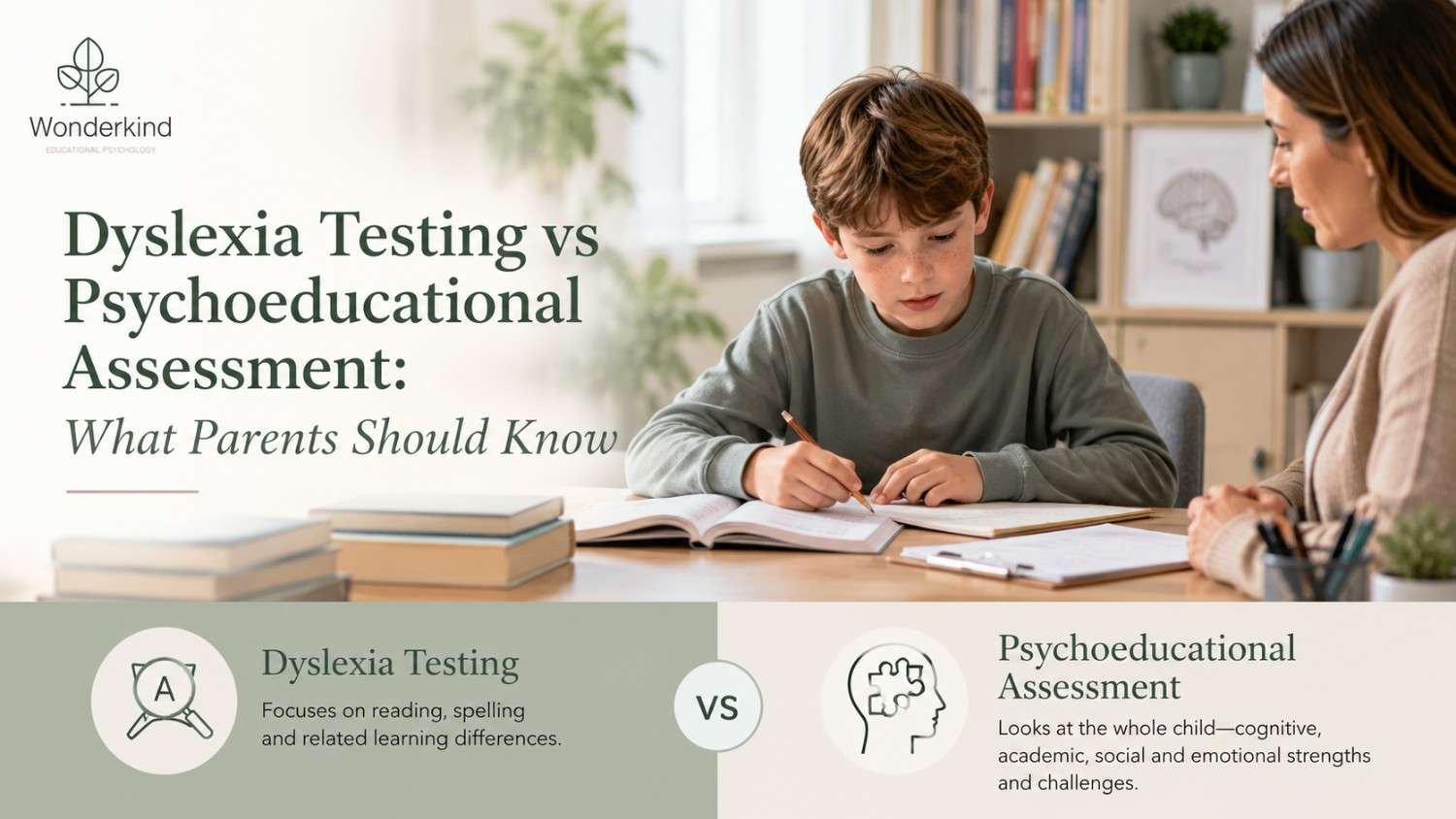
Dyslexia testing focuses mainly on reading, spelling, decoding, and related language-based skills, while a psychoeducational assessment looks at the child’s broader learning profile. For many parents, the real question is not only “Does my child have dyslexia?” but “What is causing the reading struggle, and what support does my child need at school?” This guide is for San Francisco and Bay Area parents noticing slow reading, poor spelling, homework frustration, school avoidance, attention concerns, or mixed academic performance. Wonderkind Educational Psychology helps families understand whether targeted dyslexia testing, broader psychoeducational testing for dyslexia, or another assessment path may be the right fit.
Quick Answer
Dyslexia testing is usually narrower. It looks closely at reading accuracy, decoding, phonological awareness, spelling, reading fluency, and sometimes reading comprehension.
A psychoeducational assessment is broader. It may include dyslexia-related testing, but it also evaluates cognitive skills, academic achievement, attention, executive function, processing speed, working memory, writing, math, and social-emotional factors.
In simple terms:
- Dyslexia testing asks: “Is this a reading disability or dyslexia-related pattern?”
- Psychoeducational assessment asks: “How does this child learn, where are the breakdowns, and what support may help?”
For many families, a comprehensive psychoeducational assessment is more useful when reading struggles appear alongside writing, math, attention, organization, slow work completion, or school-support questions.
What This Means for Parents
Parents often start with one visible problem: reading is hard. A child may avoid books, guess at words, spell inconsistently, read slowly, or become upset when asked to read aloud. Those signs may point toward dyslexia, but reading struggles can also overlap with attention, anxiety, language development, processing speed, working memory, or broader learning differences.
That is why choosing the right evaluation matters. A narrow reading disability evaluation may answer whether dyslexia is likely. A broader psychoeducational assessment can explain whether reading is the only concern or part of a larger learning pattern.
According to the International Dyslexia Association, dyslexia is a specific learning disability involving difficulties with word reading and/or spelling accuracy, speed, or both. According to the NIH/NICHD, reading disorder symptoms may include trouble sounding out words, poor spelling, slow reading, difficulty reading aloud with expression, and problems understanding what was read.
The practical takeaway: if the concern is only reading and spelling, dyslexia testing may be enough. If the concern includes reading plus attention, writing, math, school anxiety, slow processing, or IEP/504 planning, a psychoeducational assessment is usually the stronger starting point.
What Is Dyslexia Testing?
Dyslexia testing is a focused evaluation of reading-related skills. It helps identify whether a child’s reading and spelling difficulties fit a dyslexia or reading disability profile.
A dyslexia-focused evaluation may look at:
- Word reading accuracy
- Decoding unfamiliar words
- Reading fluency
- Spelling
- Phonological awareness
- Rapid naming
- Reading comprehension
- Written language, when relevant
This type of testing can be helpful when a child is bright, verbally strong, or otherwise capable but continues to struggle with reading and spelling despite instruction and practice.
A common misconception is that dyslexia only means reversing letters. That is too narrow. Many children with dyslexia do not simply “see letters backward.” The deeper issue often involves how the child processes the sounds and structure of language.
What Is a Psychoeducational Assessment?
A psychoeducational assessment is a more complete evaluation of how a child learns. It can include reading disability evaluation, but it does not stop there.
A full psychoeducational assessment may evaluate:
- Cognitive abilities
- Academic achievement in reading, writing, and math
- Working memory
- Processing speed
- Attention and executive function
- Written expression
- Math reasoning and calculation
- Social-emotional factors affecting school performance
- Patterns of strengths and weaknesses
- Possible school-support needs
This broader view matters because children rarely fit into neat boxes. A child may have dyslexia and ADHD. Another may have slow processing speed but not dyslexia. Another may read accurately but struggle with comprehension, writing organization, or working memory.
According to the NIH/NICHD, signs of learning disabilities can include problems with reading, writing, math, memory, attention, following directions, and organization. A psychoeducational assessment helps connect those concerns into a clearer learning profile.
Dyslexia Testing vs Psychoeducational Assessment
| Parent Concern | Dyslexia Testing May Clarify | Psychoeducational Assessment May Clarify |
| Slow reading | Whether decoding, fluency, or spelling patterns suggest dyslexia | Whether slow reading is related to dyslexia, processing speed, attention, comprehension, or broader learning needs |
| Poor spelling | Whether spelling weaknesses fit a dyslexia profile | Whether spelling is part of a wider written-language, working-memory, or academic concern |
| Avoids reading | Whether reading skills are unusually difficult | Whether avoidance is connected to reading, anxiety, attention, fatigue, or school frustration |
| Strong verbal skills but weak reading | Whether a reading disability may be present | How verbal reasoning, memory, processing speed, and academics interact |
| Trouble with reading and writing | May explain the reading side | Can evaluate reading, spelling, written expression, and school output |
| Trouble with reading and math | Usually too narrow by itself | Can evaluate reading, math, cognitive skills, and academic patterns |
| IEP or 504 questions | May support reading-specific documentation | May provide broader school-support recommendations |
| Unclear school struggles | May miss non-reading factors | Usually better for complex, mixed, or inconsistent academic concerns |
Common Signs or Scenarios Parents Notice
Parents may consider dyslexia testing San Francisco services or broader learning disability testing when they notice patterns like these:
- Reading takes much longer than expected.
- The child guesses at words instead of sounding them out.
- Spelling remains weak despite practice.
- The child avoids reading aloud.
- Homework causes frequent frustration or tears.
- Teachers mention fluency, decoding, or comprehension concerns.
- The child understands stories when listening but struggles when reading independently.
- Writing assignments are short, disorganized, or avoided.
- The child seems bright but underperforms on written schoolwork.
- Reading struggles are affecting confidence or school motivation.
The key issue is pattern, not one bad grade. If reading problems continue across time, settings, or interventions, assessment can help clarify what is happening.
What an Assessment Can Clarify
A strong evaluation should do more than name a concern. It should explain why the concern is happening and what kind of support may help.
For dyslexia-related concerns, assessment can clarify:
- Whether the child’s reading difficulty is mainly decoding, fluency, spelling, or comprehension
- Whether reading weaknesses are unexpected compared with other cognitive strengths
- Whether writing problems are connected to reading and spelling weaknesses
- Whether attention, working memory, or processing speed is contributing
- Whether the child may need school accommodations or intervention
- Whether a broader assessment path may be more appropriate
For example, two children may both read slowly. One may have dyslexia. Another may have ADHD-related attention issues. A third may have strong decoding but weak comprehension. These children may need different support, even if the surface problem looks similar.
According to the CDC, many children with ADHD also have other concerns, including learning disorders, anxiety, depression, or behavior difficulties. This is why a broader evaluation can be helpful when attention and reading concerns appear together.
When Dyslexia Testing May Be Enough
Targeted dyslexia testing may be appropriate when:
- Reading and spelling are the main concerns.
- Math, attention, organization, and behavior are not major concerns.
- The family wants specific clarity about decoding, fluency, and spelling.
- A tutor or school professional has specifically suggested reading disability testing.
- The child’s difficulties are mostly limited to literacy skills.
This can be a practical choice when the question is focused: “Does my child’s reading profile fit dyslexia?”
However, families should be careful not to confuse a quick screener with a full evaluation. A short screening tool may identify risk, but it may not provide the depth needed for school planning or individualized recommendations.
When a Full Psychoeducational Assessment May Be Better
A full psychoeducational assessment may be the better choice when:
- Reading is one of several concerns.
- The child also struggles with writing, math, attention, or organization.
- Homework takes unusually long across subjects.
- Teachers describe inconsistent performance.
- Parents are considering IEP or 504 support.
- Previous tutoring has helped only partially.
- The child is bright but underperforming.
- Emotional stress or school avoidance is increasing.
- The family needs detailed documentation for school planning.
This is often the stronger route when the question is not only “Is this dyslexia?” but “What is my child’s full learning profile?”
If attention, executive function, autism-related questions, or broader developmental concerns are also present, families may also benefit from neurodevelopmental assessments.
School Support, IEP, and 504 Connection
Assessment results can help parents communicate more clearly with schools. Depending on the findings, an evaluation may support conversations about reading intervention, classroom accommodations, an IEP, a 504 Plan, or additional school-based evaluation.
An IEP is generally connected to special education eligibility and services. A 504 Plan usually focuses on accommodations that help a student access school more fairly. The right path depends on the child’s needs, school impact, and eligibility criteria.
According to the U.S. Department of Education’s IDEA regulations, school evaluations should use a variety of assessment tools and strategies and should not rely on one measure as the only criterion for determining disability or educational programming. This supports the idea that complex learning concerns often need more than one data point.
If parents disagree with a school evaluation, they may want to learn about Independent Educational Evaluations. Under IDEA, parents have the right to obtain an independent educational evaluation, subject to specific conditions.
Practical Parent Checklist Before Requesting an Assessment
Before deciding between dyslexia testing and psychoeducational testing for dyslexia, gather:
☐ Recent report cards
☐ Teacher comments or emails
☐ Reading, spelling, writing, and math samples
☐ Standardized test scores, if available
☐ Notes from tutors or intervention providers
☐ Previous school evaluations
☐ IEP or 504 documents, if applicable
☐ A short list of your top concerns
☐ Examples of homework struggles
☐ Family history of dyslexia, ADHD, or learning differences
☐ Questions your child asks about school or reading
Then ask one important question:
Do we need to understand one reading problem, or do we need to understand the full learning profile?
That question often points families toward the right evaluation.
How Wonderkind Educational Psychology Can Help
Wonderkind Educational Psychology provides assessment services for families in the San Francisco Bay Area who want clearer answers about learning, reading, attention, development, IQ, and school-support needs.
For reading concerns, Wonderkind can help families consider whether targeted dyslexia-related testing, a broader psychoeducational assessment, or another evaluation path may fit the child’s needs. When the concern includes attention, executive function, or broader developmental questions, neurodevelopmental assessments may also be relevant.
Families considering school-based support, disagreement with prior testing, or IEP/504 planning may also want to review Wonderkind’s Independent Educational Evaluations services. For students needing cognitive testing for gifted, school, or planning purposes, IQ testing may be another useful service path.
If your child’s school challenges are becoming a pattern, Wonderkind Educational Psychology can help clarify which assessment may fit your child’s needs. Parents can reach out through the contact page to ask about the next step.
FAQs
Is dyslexia testing the same as a psychoeducational assessment?
- No. Dyslexia testing is usually focused on reading, spelling, decoding, phonological processing, and fluency. A psychoeducational assessment is broader and may include dyslexia-related testing along with cognitive, academic, attention, working memory, processing speed, writing, math, and social-emotional measures.
Can a psychoeducational assessment identify dyslexia?
- A psychoeducational assessment can identify patterns consistent with dyslexia or a specific learning disability in reading when the evaluation includes appropriate reading, spelling, phonological processing, fluency, and academic measures. It can also show whether reading problems are connected to attention, processing speed, writing, or broader learning needs.
When should parents consider dyslexia testing?
- Parents may consider dyslexia testing when a child has ongoing difficulty with reading accuracy, decoding, spelling, or reading fluency despite instruction and practice. Testing may also be useful when reading struggles are affecting confidence, homework, school participation, or progress in other academic areas.
When is a full psychoeducational assessment better?
- A full psychoeducational assessment is usually better when reading is not the only concern. If a child also struggles with writing, math, attention, organization, processing speed, anxiety, or IEP/504 planning, a broader assessment can provide a more complete picture.
Can dyslexia look like ADHD?
- Sometimes. Dyslexia and ADHD can both affect school performance, homework completion, reading stamina, and confidence. A child with dyslexia may avoid reading because it is hard. A child with ADHD may avoid reading because sustained attention is difficult. Some children have both, which is why careful assessment matters.
Will an outside assessment automatically qualify my child for an IEP or 504 Plan?
- No. An outside evaluation can provide helpful documentation and recommendations, but schools make eligibility decisions through their own processes and legal criteria. A strong evaluation can still help parents understand their child’s needs, ask better questions, and communicate more clearly with the school team.
What if the school already evaluated my child?
- If the school already completed an evaluation but the results do not match what parents see at home, in tutoring, or in daily schoolwork, families may consider a private evaluation or ask about an Independent Educational Evaluation. This can provide another professional view of the child’s learning profile.
Does Wonderkind offer dyslexia testing in San Francisco?
- Wonderkind Educational Psychology provides assessment services in the San Francisco Bay Area for learning, reading, attention, neurodevelopmental, IQ, and school-support concerns. Parents worried about dyslexia can contact Wonderkind to discuss whether targeted reading testing or a broader psychoeducational assessment may be the better fit.