
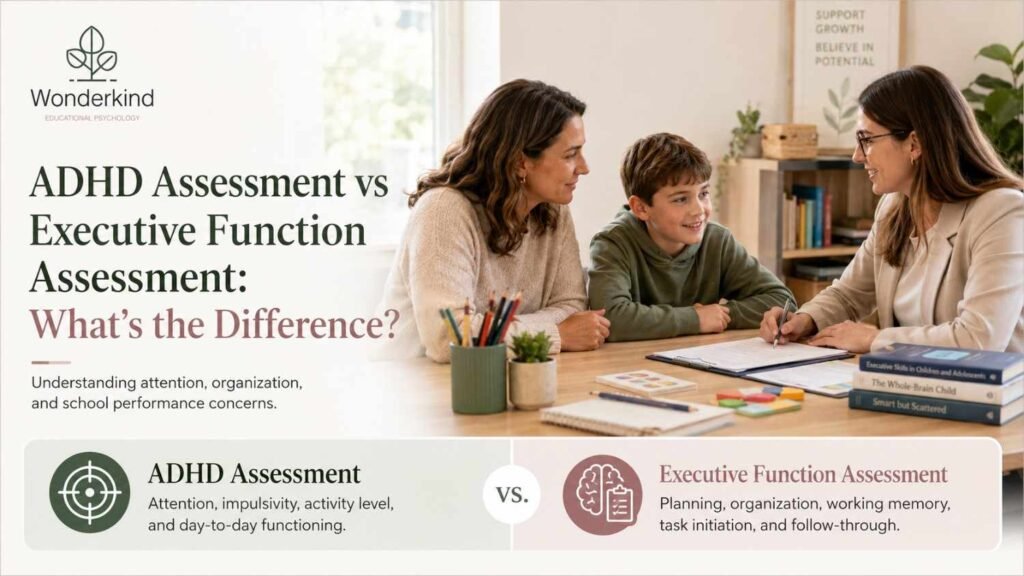
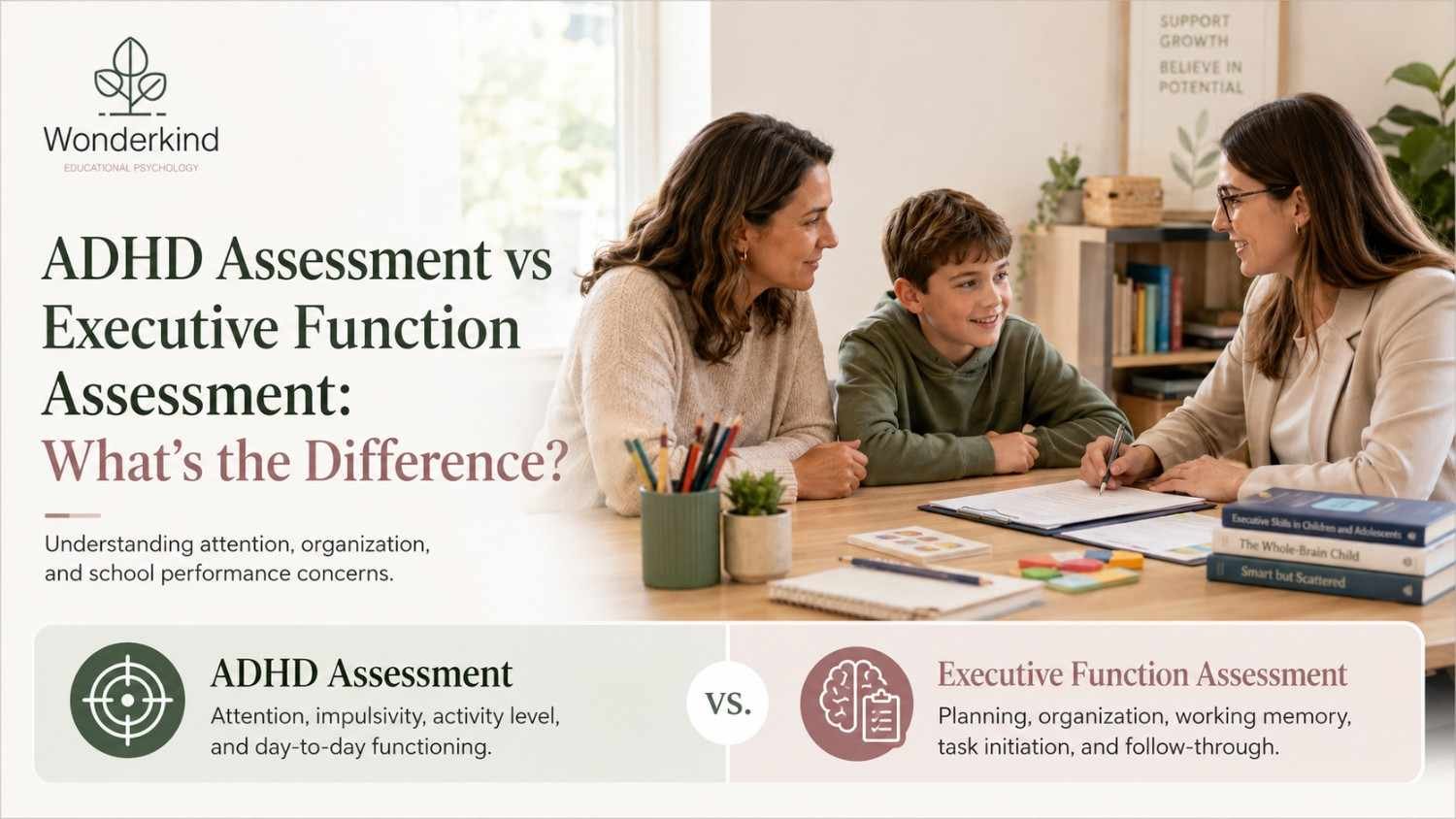
An ADHD assessment looks at whether a child’s attention, impulsivity, activity level, and day-to-day functioning fit an ADHD profile, while an executive function assessment looks more closely at skills like planning, organization, working memory, task initiation, time management, flexibility, and follow-through. Many children with ADHD also have executive function challenges, but executive function difficulties can also appear without an ADHD diagnosis. This guide is for San Francisco and Bay Area parents noticing homework battles, lost assignments, repeated reminders, emotional frustration, slow work completion, teacher concerns, or inconsistent school performance. Wonderkind Educational Psychology helps families understand whether a neurodevelopmental assessment, psychoeducational assessment, or broader evaluation path may fit their child’s needs.
Quick Answer
ADHD assessment and executive function assessment are closely related, but they are not the same.
An ADHD assessment asks whether a child’s symptoms fit an ADHD pattern and whether those symptoms affect school, home, relationships, or daily functioning. An executive function assessment looks at the mental skills that help a child manage schoolwork and daily demands, including planning, organization, memory, emotional control, and task completion.
In many cases, the strongest evaluation does not treat these as separate questions. It looks at both attention and executive function, while also considering learning, processing speed, anxiety, sleep, academic skill gaps, and school-support needs.
When attention, organization, and school performance concerns overlap, a neurodevelopmental assessment or psychoeducational assessment may help clarify the pattern.
What Is an ADHD Assessment?
An ADHD assessment evaluates whether a child’s attention, impulsivity, activity level, and self-regulation patterns are consistent with ADHD. It does not rely on one behavior, one difficult homework night, or one teacher comment. A careful assessment looks for patterns across time, settings, and demands.
An ADHD assessment may include:
- Parent interviews
- Teacher input
- Developmental history
- Rating scales
- School-performance information
- Attention and behavior observations
- Review of learning, emotional, and environmental factors
- Consideration of whether symptoms affect functioning at home, school, or with peers
ADHD can look different from child to child. Some children are visibly restless and impulsive. Others are quiet, distracted, forgetful, or mentally “elsewhere.” Some children show both patterns.
According to the CDC’s ADHD symptoms guidance, ADHD symptoms may present as mostly inattentive, mostly hyperactive-impulsive, or a combined presentation. The CDC also notes that talking with a healthcare provider is the first step when ADHD is suspected.
For parents, the practical question is not just “Does my child have ADHD?” It is also: “How are attention, self-regulation, learning, and school demands interacting?”
What Is an Executive Function Assessment?
Executive function refers to the mental skills that help a child manage tasks, goals, emotions, time, and information. These skills are central to school success because students are constantly expected to remember directions, plan assignments, shift between tasks, start work, stay organized, and finish what they begin.
Executive function includes skills such as:
- Working memory
- Planning
- Organization
- Task initiation
- Time management
- Emotional regulation
- Flexible thinking
- Self-monitoring
- Inhibitory control
- Follow-through
Working memory means holding information in mind long enough to use it. For example, a child may need to remember multi-step directions while completing a worksheet.
Task initiation means getting started. A child may understand the assignment but feel stuck at the first step.
Flexible thinking means shifting strategies when something changes. A child may become upset when a teacher changes instructions or when a math problem requires a new approach.
According to Understood’s explanation of executive function, executive function includes mental skills such as working memory, flexible thinking, and self-control. These skills help children pay attention, get organized, plan, and complete tasks.
ADHD Assessment vs Executive Function Assessment: Key Differences
| Parent Question | ADHD Assessment | Executive Function Assessment |
| Main focus | Whether attention, impulsivity, and/or hyperactivity fit an ADHD profile | How the child plans, organizes, remembers, starts tasks, manages time, shifts attention, and follows through |
| Common signs | Distractibility, impulsivity, restlessness, difficulty sustaining attention, inconsistent behavior across settings | Lost assignments, poor planning, weak working memory, slow task initiation, emotional overwhelm, difficulty completing multi-step work |
| Skills reviewed | Attention, impulse control, activity level, behavior patterns, impairment across settings, developmental history | Working memory, planning, organization, time management, task initiation, flexibility, self-monitoring, emotional regulation |
| School impact | May affect focus, class participation, homework completion, behavior, and learning consistency | May affect long-term projects, written work, studying, time management, independent learning, and assignment completion |
| What it can clarify | Whether ADHD may explain attention and regulation patterns | Which executive skills are creating daily school friction |
| When broader assessment may be needed | When attention concerns appear with learning, anxiety, processing speed, writing, reading, math, or developmental questions | When executive function problems may be connected to ADHD, anxiety, learning differences, giftedness, processing speed, or emotional factors |
How ADHD and Executive Function Overlap
ADHD and executive function are deeply connected. Many children with ADHD struggle with executive function skills because ADHD affects self-regulation, attention control, task persistence, and goal-directed behavior.
A child with ADHD may know what to do but struggle to do it consistently. That difference is important.
For example:
- The child knows homework is due but forgets to turn it in.
- The child understands the math lesson but rushes and skips steps.
- The child wants to start a project but cannot organize the first step.
- The child promises to remember materials but leaves them at school.
- The child becomes overwhelmed when a task has too many parts.
According to the Child Mind Institute’s article on ADHD and executive function, executive functions can be understood as self-control capacities that support goal-directed problem solving and persistence. This helps parents understand why ADHD often affects follow-through, not just attention.
A child may not be refusing to cooperate. The child may be struggling to coordinate the mental steps required to act on what they know.
Can a Child Have Executive Function Challenges Without ADHD?
Yes. A child can have executive function challenges without meeting criteria for ADHD.
Executive function difficulties can appear with:
- Anxiety
- Sleep problems
- Stress
- Learning differences
- Dyslexia or written-language challenges
- Slow processing speed
- Autism-related differences
- Giftedness with uneven skill development
- Academic demands that exceed current support
- Changes in school structure or workload
This is why an executive function concern should not automatically become an ADHD assumption. A child who avoids homework may have ADHD. But the child may also be overwhelmed by reading difficulty, weak writing organization, anxiety, perfectionism, slow processing speed, or unclear instructions.
The right assessment should separate these possibilities rather than collapse them into one label.
If attention concerns appear alongside reading, writing, math, memory, or processing speed challenges, a comprehensive psychoeducational assessment can help explain the broader learning profile.
For related reading, parents may also find these Wonderkind articles helpful:
- Dyslexia Testing vs Psychoeducational Assessment
- Signs Your Child May Need Learning Disability Testing
- Psychoeducational Assessment vs Neuropsychological Evaluation
Common Signs Parents Notice
Parents often seek ADHD assessment for children or executive function assessment when daily school routines become unusually difficult.
Attention Signs
A child may:
- Seem distracted during homework
- Need repeated reminders
- Miss details in instructions
- Daydream during class
- Start work but drift away from it
- Forget what they were just asked to do
- Perform inconsistently from day to day
Organization Signs
A child may:
- Lose papers, books, or assignments
- Have a messy backpack or desk
- Forget to write down homework
- Turn in incomplete work
- Struggle to track long-term projects
- Need adults to manage materials and deadlines
Homework Signs
A child may:
- Take much longer than expected to start
- Become overwhelmed before beginning
- Complete the work but forget to submit it
- Rush through assignments carelessly
- Avoid multi-step tasks
- Melt down when work feels too big
Emotional Regulation Signs
A child may:
- Become upset quickly during schoolwork
- Shut down after small mistakes
- Argue when asked to transition
- Avoid difficult tasks with humor, anger, or refusal
- Say, “I can’t do this,” before trying
- Seem more capable verbally than in completed work
These signs do not automatically mean ADHD is present. But they do suggest that attention, executive function, emotional regulation, or learning demands may need a closer look.
What Assessment Can Clarify
A strong assessment should not simply ask, “Is this ADHD?” It should ask, “What is making school harder than expected?”
Assessment can help clarify whether concerns are related to:
- ADHD
- Executive function weakness
- Working memory
- Processing speed
- Anxiety or emotional stress
- Reading, writing, or math difficulty
- Dyslexia or another learning difference
- Autism-related developmental differences
- Giftedness with uneven skill development
- School demands, workload, or unclear supports
This matters because different patterns need different supports.
A child with ADHD may benefit from routines, reminders, environmental supports, behavior strategies, and possibly medical consultation. A child with weak working memory may need shorter instructions, written steps, repetition, and reduced memory load. A child with dyslexia may need structured reading intervention. A child with anxiety may need emotional support and carefully paced demands.
The surface problem may look the same: unfinished work. The cause may be very different.
When parents are unsure whether the main issue is attention, learning, executive function, or cognitive profile, Wonderkind may recommend considering a neurodevelopmental assessment, psychoeducational assessment, or IQ testing, depending on the child’s needs.
School Support, IEP, and 504 Planning
ADHD and executive function challenges can affect school performance in practical ways. A child may understand the lesson but fail to complete assignments, remember directions, organize materials, manage time, or demonstrate what they know.
Assessment results may help parents and schools discuss supports such as:
- Written instructions
- Assignment checklists
- Reduced copying demands
- Preferential seating
- Extended time when appropriate
- Chunked assignments
- Planner or organizational systems
- Teacher check-ins
- Homework tracking support
- Testing accommodations
- IEP or 504 Plan considerations
According to the CDC’s ADHD classroom guidance, school supports may include collaboration between families, healthcare providers, and teachers, as well as behavior plans and classroom strategies.
An IEP generally involves special education eligibility and services. A 504 Plan generally focuses on accommodations that help a student access learning more fairly. Testing does not guarantee either one, but clear documentation can help families understand the child’s needs and communicate more effectively with the school team.
The U.S. Department of Education’s IDEA evaluation procedures state that school evaluations should use a variety of assessment tools and strategies and gather relevant functional, developmental, and academic information.
If parents disagree with a school evaluation or need another professional perspective, Wonderkind also provides Independent Educational Evaluations.
How Wonderkind Educational Psychology Can Help
Wonderkind Educational Psychology helps San Francisco and Bay Area families understand the learning, attention, and developmental patterns behind school struggles.
When attention, task initiation, organization, emotional regulation, or developmental questions are part of the picture, Wonderkind’s neurodevelopmental assessments may help clarify what is affecting the child’s functioning. When attention concerns appear alongside reading, writing, math, memory, processing speed, or school-support needs, a psychoeducational assessment may provide a broader view.
For some children, IQ testing may help clarify cognitive strengths, giftedness, or uneven ability patterns. For families navigating disagreement with a school evaluation, Independent Educational Evaluations may provide another professional perspective.
Wonderkind also provides K–12 assessment services for schools and districts that need educational evaluation support.
The goal is not to rush toward a label. The goal is to understand the pattern clearly enough to make better decisions at home and school.
If attention, organization, or homework struggles are becoming a repeated pattern, Wonderkind Educational Psychology can help clarify which assessment path may fit your child’s needs. Families can contact Wonderkind Educational Psychology to ask about the next step.
Parent Checklist Before Requesting Assessment
Before requesting an ADHD assessment or executive function assessment, gather:
- Teacher comments or emails
- Recent report cards
- Homework examples
- Notes about attention or impulsivity
- Examples of lost assignments or forgotten directions
- Writing, math, or reading samples
- Notes about emotional regulation concerns
- Sleep, stress, or routine changes
- Previous evaluations
- IEP or 504 documents, if applicable
- Tutoring or intervention records
- A list of your top questions
- Examples of when your child does better and worse
Then ask:
Is the main concern attention, executive function, learning, emotional regulation, or a combination?
That question often points families toward the right type of assessment.
FAQs
Is ADHD assessment the same as executive function assessment?
- No. ADHD assessment looks at whether a child’s attention, impulsivity, activity level, and impairment fit an ADHD profile. Executive function assessment looks more specifically at planning, organization, working memory, task initiation, time management, flexibility, and follow-through. Many evaluations consider both.
Can a child have executive function problems without ADHD?
- Yes. Executive function challenges can appear without ADHD. They may be related to anxiety, learning differences, dyslexia, slow processing speed, autism-related differences, sleep, stress, or school demands. This is why assessment should look at the full pattern rather than assume ADHD immediately.
What does executive function mean for school?
- Executive function affects how a child manages school demands. It helps with starting homework, remembering directions, organizing materials, planning projects, managing time, shifting between tasks, and controlling frustration. A child may understand the work but still struggle to complete it independently.
Can ADHD affect homework and organization?
- Yes. ADHD can affect sustained attention, follow-through, impulse control, working memory, and organization. A child may forget assignments, lose materials, avoid long tasks, rush through work, or need repeated reminders. Assessment can help clarify whether ADHD, executive function, learning, or emotional factors are contributing.
Which assessment is better if my child is bright but disorganized?
- A bright but disorganized child may need a broader evaluation rather than a narrow answer. A neurodevelopmental assessment can clarify attention and executive function concerns, while a psychoeducational assessment can also examine learning, processing speed, memory, and academic skills. The best fit depends on the questions parents need answered.
Can assessment help with IEP or 504 planning?
- Assessment can provide useful documentation and recommendations for school conversations, but it does not automatically guarantee an IEP or 504 Plan. Results may help explain how attention, executive function, processing speed, or learning factors affect school access and performance.
When should parents contact Wonderkind?
- Parents may contact Wonderkind when attention, organization, homework, emotional regulation, or school-performance concerns are becoming a repeated pattern. Wonderkind can help families consider whether a neurodevelopmental assessment, psychoeducational assessment, IQ testing, or IEE may fit the child’s needs.
What should I bring before an assessment?
- Bring teacher notes, report cards, homework examples, work samples, previous evaluations, IEP or 504 documents, tutoring records, and a list of your main concerns. Specific examples help the evaluator understand what is happening across school, home, and daily routines.