

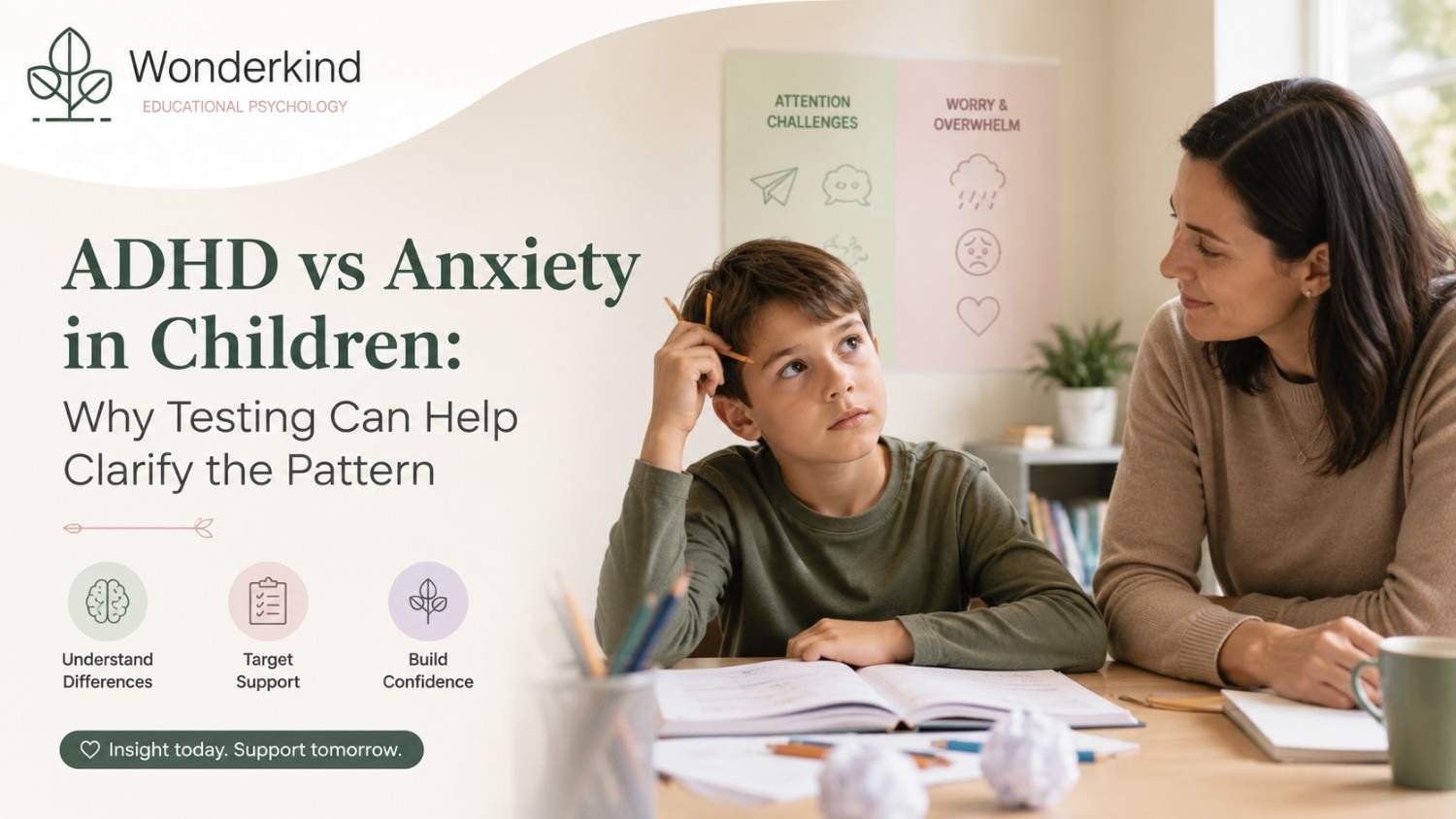
ADHD and anxiety can look similar in children because both can affect attention, homework, classroom participation, emotional regulation, sleep, school performance, and behavior. ADHD often involves difficulty regulating attention, impulses, activity level, and executive function, while anxiety often involves worry, fear, avoidance, perfectionism, reassurance-seeking, physical complaints, or distress in specific situations. Parents may notice distractibility, restlessness, school avoidance, test anxiety, homework battles, emotional outbursts, teacher concerns, learning differences, or IEP/504 planning questions. For San Francisco and Bay Area families, Wonderkind Educational Psychology can help clarify whether a neurodevelopmental assessment, psychoeducational assessment, or related testing path may fit the child’s needs.
Quick Answer
ADHD vs anxiety in children can be difficult to separate because both may cause attention problems, restlessness, avoidance, homework struggles, emotional reactions, and inconsistent school performance.
ADHD often affects attention regulation, impulse control, activity level, working memory, task initiation, and executive function. Anxiety often affects focus because worry, fear, perfectionism, physical tension, or fear of mistakes takes up mental energy.
Testing can help clarify whether the pattern is mainly attention-based, anxiety-based, learning-related, executive-function-related, or a combination. The goal is not to rush toward a label. The goal is to understand what is making school and daily life harder than expected.
Why ADHD and Anxiety Can Look Similar
Parents often ask, “Is my child distracted because of ADHD, or because they are anxious?” That is a reasonable question.
A child with ADHD may miss directions because attention shifts quickly. A child with anxiety may miss directions because they are worried about a test, a social situation, or making a mistake. From the outside, both children may look like they are “not listening.”
ADHD and anxiety can both show up as:
- Trouble focusing in class
- Homework taking too long
- Avoidance of difficult tasks
- Emotional outbursts
- Restlessness or fidgeting
- Trouble sleeping
- Teacher concerns
- Inconsistent grades
- Difficulty starting work
- Frequent reassurance-seeking
- Stomachaches or headaches before school
- Freezing during tests or presentations
This overlap is why testing can be helpful. The same behavior can have different causes, and the right support depends on the reason behind the struggle.
What ADHD May Look Like in Children
ADHD is a neurodevelopmental condition that can affect attention, impulse control, activity level, and executive function. According to the CDC’s ADHD overview, children with ADHD may have trouble paying attention, controlling impulsive behavior, or being overly active.
In children, ADHD may look like:
- Daydreaming or drifting off
- Losing or forgetting materials
- Difficulty finishing assignments
- Rushing through work
- Interrupting or acting before thinking
- Trouble waiting
- Restlessness or fidgeting
- Difficulty starting tasks
- Weak time management
- Inconsistent school performance
ADHD does not always look like obvious hyperactivity. Some children with ADHD are quiet but mentally distracted. Others seem capable but cannot consistently organize, start, complete, or turn in work.
Parents comparing attention, planning, and follow-through concerns may also find ADHD Assessment vs Executive Function Assessment helpful.
What Anxiety May Look Like in Children
Anxiety is not just “worrying too much.” In children, anxiety can affect thinking, behavior, body sensations, sleep, school participation, and emotional regulation.
According to the National Institute of Mental Health’s anxiety disorders information, anxiety disorder symptoms can interfere with daily activities such as schoolwork and relationships.
In children, anxiety may look like:
- Frequent worry
- Fear of making mistakes
- Perfectionism
- Avoiding schoolwork, tests, or presentations
- Reassurance-seeking
- Stomachaches or headaches
- Difficulty sleeping
- Irritability or tearfulness
- Freezing under pressure
- Avoiding social or classroom participation
- Becoming upset when routines change
A worried child may seem distracted because their attention is pulled toward “what if” thoughts. A perfectionistic child may take a long time on homework because they are afraid of being wrong. A child who avoids schoolwork may not be lazy; the task may feel emotionally overwhelming.
ADHD vs Anxiety in Children: Key Differences
| Parent Question | ADHD May Look Like | Anxiety May Look Like | Why Testing Matters |
| Why is my child distracted? | Difficulty sustaining attention, losing track, shifting focus often | Worry thoughts interrupt focus or the child is preoccupied with fears | Testing can clarify whether attention or worry is driving the pattern |
| Why does homework take so long? | Task initiation, working memory, organization, or time-management difficulty | Perfectionism, fear of mistakes, avoidance, or reassurance-seeking | The support plan differs depending on the cause |
| Why does my child avoid schoolwork? | The task feels hard to start, organize, or finish | The task feels threatening, embarrassing, or overwhelming | Testing can identify academic, executive-function, or emotional factors |
| Why is my child restless? | Hyperactivity, impulsivity, or need for movement | Nervous energy, tension, or physical anxiety | Similar behavior may have different roots |
| Why does my child melt down? | Quick frustration, impulse control, emotional regulation difficulty | Fear, panic, pressure, or worry about failure | Testing can clarify triggers and support needs |
| Why are grades inconsistent? | Attention, follow-through, or executive-function challenges | Test anxiety, perfectionism, avoidance, or stress | Assessment can show whether learning, attention, or anxiety is affecting performance |
Can a Child Have Both ADHD and Anxiety?
Yes. A child can have both ADHD and anxiety.
ADHD may make school harder because attention, organization, working memory, task initiation, and impulse control are difficult. Over time, a child may become anxious because they are frequently corrected, behind on assignments, worried about mistakes, or unsure whether they can keep up.
Anxiety can also make ADHD harder to see. A child may appear cautious, quiet, or perfectionistic, while still struggling with attention and executive function underneath.
The CDC’s ADHD diagnosis guidance explains that diagnosing ADHD involves several steps and that other concerns can have similar symptoms. This is one reason a careful assessment process matters.
Common Signs Parents and Teachers Notice
Attention and Focus Signs
A child may:
- Seem distracted during lessons
- Forget directions
- Miss important details
- Drift off during homework
- Need repeated reminders
- Lose track during multi-step tasks
With ADHD, attention may shift quickly or inconsistently. With anxiety, attention may be pulled toward worry, fear, or self-monitoring.
Homework and Task-Avoidance Signs
A child may:
- Delay starting homework
- Say the work is “too hard”
- Avoid writing, reading, or math
- Ask for repeated reassurance
- Spend too long on small details
- Give up before trying
- Become upset before assignments begin
ADHD may affect task initiation and organization. Anxiety may create avoidance because the child fears mistakes, criticism, embarrassment, or failure.
If homework problems include organization, planning, and time-management concerns, parents may also want to read Executive Function Challenges at School.
Emotional Regulation Signs
A child may:
- Melt down after school
- Cry over mistakes
- Become angry when corrected
- Shut down during homework
- Panic before tests
- Refuse certain assignments
- Become irritable when overwhelmed
Emotional regulation challenges can appear in both ADHD and anxiety. Testing can help clarify whether the reaction is tied to impulsivity, frustration tolerance, worry, perfectionism, sensory overload, learning difficulty, or a combination.
School-Performance Signs
A child may:
- Have uneven grades
- Do better verbally than on written work
- Perform well at home but poorly on tests
- Forget to turn in completed assignments
- Avoid challenging subjects
- Need much more adult support than expected
- Seem bright but inconsistent
When attention or anxiety concerns appear alongside reading, writing, math, memory, or processing-speed challenges, a psychoeducational assessment may provide a broader view of the child’s learning profile.
Parents may also find Signs Your Child May Need Learning Disability Testing helpful if academic skills are part of the concern. If reading or spelling concerns are present, Dyslexia Testing vs Psychoeducational Assessment may help clarify possible next steps.
Social and Classroom Participation Signs
A child may:
- Avoid raising their hand
- Interrupt or speak without waiting
- Seem withdrawn in groups
- Have trouble joining activities
- Fear being wrong in front of others
- Miss social cues
- Avoid presentations or group work
ADHD may affect impulse control, turn-taking, and attention to social cues. Anxiety may lead to withdrawal, silence, avoidance, or fear of judgment. If attention concerns overlap with social communication, sensory needs, or developmental questions, Autism vs ADHD in Children may also be useful.
What Testing Can Clarify
Testing can help answer a more useful question than “Is this ADHD or anxiety?” The better question is:
What pattern best explains the child’s attention, learning, emotional regulation, behavior, and school performance?
Depending on the child’s needs, assessment may look at:
- Attention and impulse control
- Executive function
- Working memory
- Task initiation
- Processing speed
- Academic skills
- Reading, writing, and math
- Emotional symptoms
- Parent and teacher observations
- School history
- Developmental history
- Performance across settings
Testing does not guarantee a diagnosis, and it does not guarantee school services. It can, however, help families understand whether ADHD, anxiety, learning differences, executive function challenges, processing speed, or another factor may be contributing.
ADHD, Anxiety, Executive Function, and Learning Differences
ADHD and anxiety often intersect with executive function. Executive function includes planning, organization, working memory, task initiation, self-monitoring, and emotional regulation.
A child with weak executive function may struggle to begin work, manage time, organize materials, or complete assignments. A child with anxiety may avoid work because it feels threatening. A child with ADHD may avoid work because starting and sustaining effort are hard. A child with a learning difference may avoid work because reading, writing, or math is more difficult than adults realize.
The pattern matters.
For some children, IQ testing may help clarify cognitive strengths, giftedness, or uneven ability patterns. Parents comparing evaluation types may also find Psychoeducational Assessment vs Neuropsychological Evaluation helpful.
How Assessment Can Support IEP or 504 Planning
Assessment can support school conversations by documenting how attention, anxiety, executive function, learning, memory, or processing speed may affect a child’s access to school. It does not automatically qualify a child for an IEP or 504 Plan, but it can help parents and school teams discuss needs more clearly.
The U.S. Department of Education’s IDEA evaluation procedures state that school evaluations should use a variety of assessment tools and strategies and gather relevant functional, developmental, and academic information, including information from parents.
Depending on the child’s needs, school supports may include:
- Written directions
- Reduced-distraction seating
- Checklists
- Teacher check-ins
- Extended time when appropriate
- Breaks for regulation
- Help with planning and organization
- Support for test anxiety
- Chunked assignments
- Assistive technology
- Homework tracking systems
If parents disagree with a school evaluation or feel results do not match what they see at home, they may want to learn about Independent Educational Evaluations.
How Wonderkind Educational Psychology Can Help
Wonderkind Educational Psychology helps San Francisco and Bay Area families understand the learning, attention, emotional, executive-function, and school-support patterns behind a child’s struggles.
When attention, emotional regulation, task initiation, or developmental concerns are part of the picture, a neurodevelopmental assessment can help clarify what may be affecting a child’s school and daily functioning.
If ADHD, anxiety, learning, or executive-function concerns are becoming hard to separate, Wonderkind Educational Psychology can help clarify which assessment path may fit your child’s needs.
Wonderkind also provides K–12 assessment services for schools and districts needing educational evaluation support. Families can contact Wonderkind Educational Psychology to ask about next steps.
Parent Checklist Before Requesting Testing
Before requesting testing, gather:
- Teacher comments or emails
- Recent report cards
- Homework examples
- Examples of distractibility
- Examples of worry or avoidance
- Test-taking concerns
- Emotional regulation patterns
- Sleep or stress factors
- Reading, writing, or math samples
- Examples of unfinished or late work
- Notes about perfectionism or reassurance-seeking
- Previous evaluations
- IEP or 504 documents, if applicable
- Top questions parents want answered
Then ask:
Is the main concern attention, worry, avoidance, learning, executive function, emotional regulation, or a combination?
That question often points families toward the right testing path.
FAQs
Can ADHD and anxiety look similar in children?
- Yes. ADHD and anxiety can both affect attention, homework, restlessness, emotional regulation, sleep, and school performance. A child who appears distracted may be struggling with attention regulation, or they may be preoccupied with worry, fear of mistakes, social judgment, or school pressure.
What is the main difference between ADHD and anxiety?
- ADHD often involves difficulty regulating attention, impulses, activity level, and executive function. Anxiety often involves worry, fear, avoidance, perfectionism, reassurance-seeking, physical complaints, or distress in specific situations. Testing can help clarify which pattern best explains the child’s daily struggles.
Can anxiety cause attention problems?
- Yes. Anxiety can make it hard for a child to focus because worry uses mental energy. A child may seem inattentive when they are actually thinking about mistakes, tests, social concerns, safety, separation, or disappointing others. This is one reason ADHD and anxiety can be confused.
Can a child have both ADHD and anxiety?
- Yes. A child can have both ADHD and anxiety. ADHD may make school tasks harder to manage, while anxiety may increase when a child feels behind, corrected, overwhelmed, or afraid of failing. Testing can help clarify whether one or both concerns are affecting the child.
When should parents consider testing?
- Parents may consider testing when attention, worry, avoidance, homework problems, emotional reactions, or school-performance concerns become repeated patterns across home and school. A single stressful week does not always mean testing is needed, but persistent patterns may justify a closer look.
Can testing help with school accommodations?
- Testing can provide useful documentation and recommendations for school conversations, but it does not guarantee accommodations, an IEP, or a 504 Plan. Results may help explain how attention, anxiety, executive function, processing speed, or learning concerns affect school access and performance.
Does testing guarantee an ADHD or anxiety diagnosis?
- No. Testing does not guarantee an ADHD or anxiety diagnosis. The purpose is to understand the child’s pattern clearly. Assessment may suggest ADHD, anxiety, learning differences, executive-function challenges, processing-speed concerns, or another explanation that better fits the child’s needs.
What should parents bring before assessment?
- Parents should bring teacher comments, report cards, homework examples, work samples, previous evaluations, IEP or 504 documents, and notes about attention, worry, avoidance, sleep, emotional regulation, and test-taking concerns. Specific examples help the evaluator understand what is happening across settings.