

If you’re staring at your child’s IQ report and thinking “What does this actually mean?”—you’re not alone. The biggest mistake parents make is treating IQ as one number instead of a profile.
Here’s the fast way to read the report:
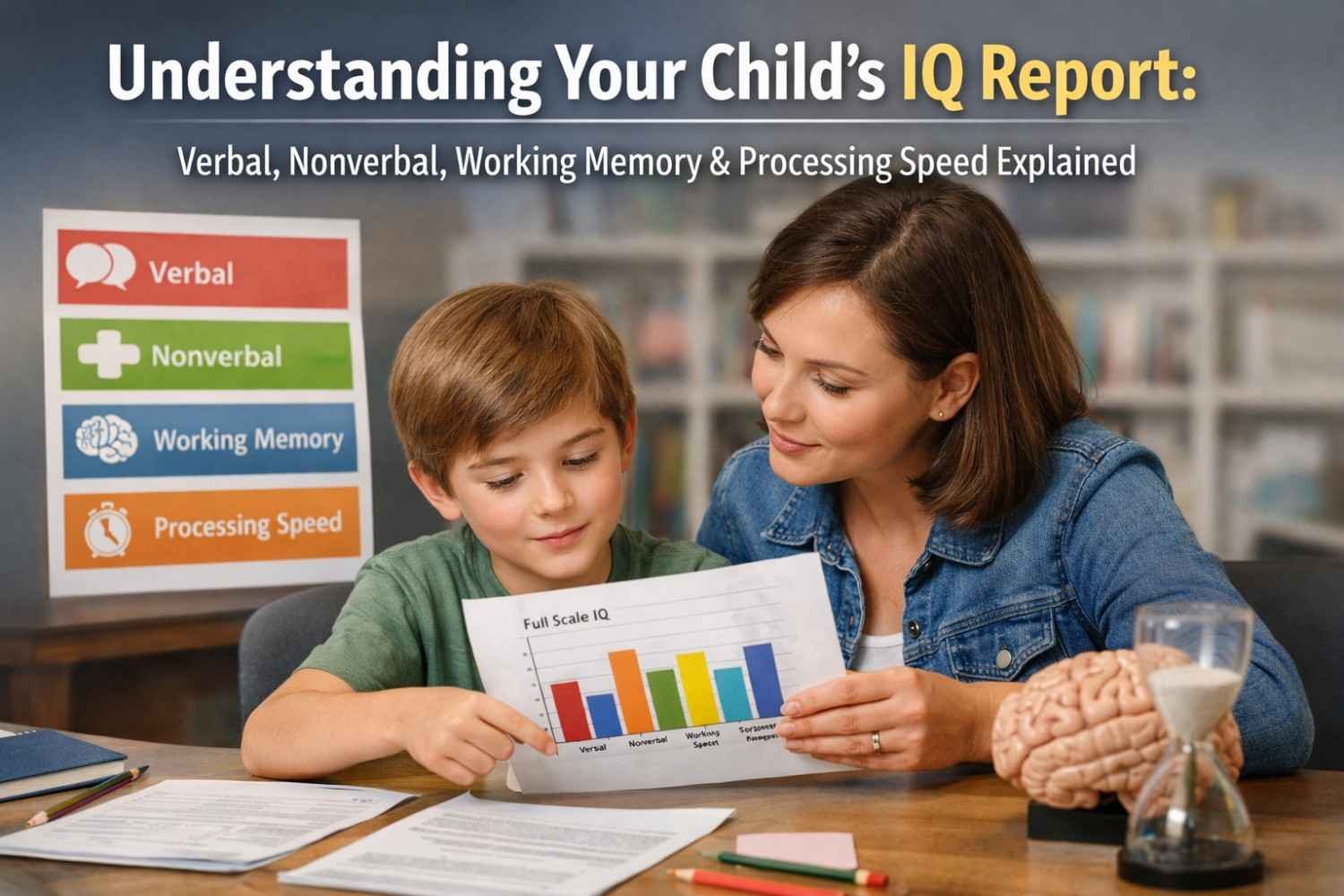
- Verbal scores describe language-based reasoning and how your child thinks with words.
- Nonverbal (often visual-spatial + fluid reasoning) describes pattern-based problem solving and puzzle-type reasoning.
- Working Memory explains “I understand it, but I lose steps.”
- Processing Speed explains “I can do it, but I can’t do it fast.”
Most importantly: IQ scores are standardized so the average is 100, and most people score within about ±15 points of that average.
This guide will help you:
- understand what each score means,
- spot common “misread” patterns (like spiky profiles), and
- turn the profile into practical school supports and next steps.
Read more: How to Prepare Your Child for a Psychoeducational Assessment
Quick answer: how to read your child’s IQ report in 60 seconds
- Don’t start with the Full Scale IQ. Start with index scores (they explain strengths and bottlenecks).
- “Verbal vs nonverbal” often means language reasoning vs visual/pattern reasoning (and those can be very different).
- Working memory + processing speed are the most common reasons bright kids look “inconsistent” in school.
- If index scores are very far apart, the single IQ number may be less representative; reports may reference concepts like GAI (general ability) and CPI (cognitive proficiency/efficiency).
- Your best question isn’t “Is this high enough?” It’s: “What supports match this profile?”
Read more: Dyslexia & Learning Differences: Signs Your Child May Need a Psychoeducational Evaluation
What an IQ score is (and what it is not)
IQ is a standardized score intended to summarize performance on a set of cognitive tasks compared to same-age peers. The APA Dictionary notes the mean IQ is customarily 100, and a large portion of scores fall within ±15 points.
What IQ is not:
- a measure of creativity, motivation, kindness, emotional maturity, or effort
- a guarantee of gifted placement or future success
- proof that a child is “lazy” if school performance is uneven
Your child’s report should be used as a learning map, not a label.
What’s inside an IQ report: the 5 parts that matter
Most IQ reports include a lot of pages. Parents get overwhelmed because they don’t know where to focus. Use this order:
- Full Scale IQ (FSIQ) and often a confidence interval
- Index scores (this is where the real story lives)
- Subtest patterns (what drove each index score)
- Behavioral observations/validity notes (how your child approached testing)
- Recommendations (how to apply results)
For example, Pearson’s WISC-V interpretive report explains that subtests are drawn from five areas of cognitive ability: verbal comprehension, visual spatial, fluid reasoning, working memory, and processing speed.
Verbal vs nonverbal: what those labels really mean
Parents often assume “verbal” equals “smart” and “nonverbal” equals “not language.” That’s not how the report works.
Verbal reasoning
In child IQ tests like the WISC-V, “verbal” typically aligns with Verbal Comprehension—language-based reasoning and concept formation.
In school, strong verbal reasoning often looks like:
- rich vocabulary, strong explanations
- strong listening comprehension
- sophisticated conversation and storytelling
When verbal reasoning is weaker, you might see:
- difficulty defining concepts
- trouble explaining ideas clearly
- challenges with language-heavy tests or complex directions
Nonverbal reasoning
“Nonverbal” often refers to reasoning that relies less on spoken language and more on visual/pattern tasks. On WISC-V, this commonly shows up through Visual Spatial and Fluid Reasoning indices.
On preschool tests like WPPSI-IV, reports may include a Nonverbal Index (NVI) derived from subtests that do not require verbal responses, and it’s drawn from visual-spatial, fluid reasoning, working memory, and processing speed scales.
In school, strong nonverbal reasoning often looks like:
- puzzles, building tasks, pattern-based math
- strong geometry/visual organization
- quick grasp of diagrams and visual models
When nonverbal reasoning is weaker, you might see:
- difficulty organizing visual information
- slower problem solving on new/novel tasks
- challenges with multi-step visual-spatial work
A simple “translation” table
| If this is stronger… | You might see… | Helpful supports |
| Verbal reasoning | strong explanation + discussion | oral responses, rich reading, explicit vocabulary support |
| Nonverbal reasoning | strong puzzles + pattern reasoning | visual models, diagrams, hands-on learning |
Working Memory: the “I know it, but I lose it” score
Working memory is the ability to hold and use information in mind while doing something else—following multi-step directions, doing mental math, keeping track of rules while solving a problem.
WISC-V includes a Working Memory index as a core domain.
What weaker working memory can look like in daily school life
- forgets multi-step instructions unless written down
- loses place mid-problem
- inconsistent performance: “gets it one day, falls apart the next”
- struggles when tasks require holding information while writing/solving
Practical supports that often help
These aren’t “special treatments.” They are load-management strategies.
- Chunk directions into 1–2 steps at a time
- Provide written instructions and checklists
- Ask for teach-back (“Tell me the steps you’ll do first.”)
- Reduce simultaneous demands (don’t combine new content + heavy note-taking)
If you’re aiming for IEP/504 language, the key phrase is:
“Reduce working-memory load and provide external supports for multi-step tasks.”
Processing Speed: speed, not intelligence
Processing speed measures how quickly and accurately a child can complete simple tasks under time pressure. On WISC-V, it’s one of the major index scores.
What weaker processing speed looks like at school
- slow completion of worksheets and timed tests
- handwriting bottlenecks (slow, fatiguing)
- strong thinking but incomplete output
- “knows it but can’t finish”
Common misinterpretation to avoid
Low processing speed does not automatically mean low intelligence.
It often means output is a bottleneck.
Supports that often align with slow processing speed
- extended time on tests (when appropriate)
- reduced timed demands (fewer repetitive items when mastery is clear)
- alternate ways to show knowledge (oral response, keyboarding, structured templates)
If your child has high reasoning but low processing speed, schools sometimes underestimate them because the output doesn’t match the thinking. The IQ profile can help you explain that mismatch.
Read more: Comprehensive Psychoeducational Assessments in the SF Bay Area: When School Testing Isn’t Enough
The “spiky profile” issue: when one IQ number is misleading
A “spiky profile” means your child’s scores vary significantly across indices. That can make a single Full Scale IQ less representative of how your child thinks day-to-day.
This is why many reports discuss alternative interpretive concepts, including:
- GAI (General Ability Index): an estimate of general ability that is less sensitive to working memory and processing speed difficulties than FSIQ.
- CPI (Cognitive Proficiency Index): an estimate of efficiency in processing cognitive information in learning/problem solving, based on working memory and processing speed.
Practical translation:
Some kids have strong reasoning ability but lower “cognitive efficiency.” They may need:
- output accommodations,
- reduced time pressure,
- executive function supports,
—not a different curriculum level.
This is a big reason it’s risky to interpret an IQ report as a single number or a single label.
Read more: ADHD & Executive Function Assessments: When Attention Struggles Go Beyond “Not Trying”
Which test is your child’s report from (WPPSI vs WISC vs WAIS)?
Your report will look different depending on which test was used.
WPPSI-IV (preschool/early childhood)
Often used for younger children; may include a Nonverbal Index and other age-appropriate structures.
WISC-V (school-age)
A widely used child cognitive test where subtests are drawn from five domains: verbal comprehension, visual spatial, fluid reasoning, working memory, processing speed.
WAIS-IV (older teens/adults)
Adult test structure commonly includes indices for verbal comprehension, perceptual reasoning, working memory, and processing speed.
What can influence scores (so you don’t overinterpret one day)
IQ tests are standardized, but performance is still human performance. These factors can meaningfully affect results and should be part of interpretation:
- anxiety/perfectionism
- ADHD symptoms (sustained attention, impulse control)
- sleep deprivation or illness
- fatigue during longer testing
- language demands (especially for multilingual children)
This is why validity notes and behavioral observations in the report matter almost as much as the numbers.
Read more: Gifted Testing & Private School Admissions: How IQ Testing Fits In
Turning the IQ profile into real support
This is where IQ reports become useful rather than stressful.
A “finding → impact → support” map you can bring to school
| Pattern in the IQ report | Likely school impact | Supports to discuss |
| High reasoning + low processing speed | timed work incomplete; slow output | extended time, reduced timed load, keyboarding |
| Low working memory | forgets steps; inconsistent execution | written directions, checklists, chunking |
| High verbal + weaker nonverbal | strong discussion; weaker visual problem solving | visual scaffolds, explicit modeling, step-by-step examples |
| High nonverbal + weaker verbal | strong puzzles; language-heavy tasks harder | visual instruction, vocabulary scaffolds, oral check-ins |
These supports aren’t automatic. The point is to translate “test language” into “school language.”
What to ask the school team (IEP/504-ready questions)
- “Which bottlenecks are we addressing this term—working memory, processing speed, or both?”
- “What accommodations will reduce output pressure so the work reflects understanding?”
- “How will we measure whether these supports are working in 6–8 weeks?”
What to ask in the feedback session: the 10-question checklist
Use this to make the feedback meeting productive.
- Is the Full Scale IQ representative, or is the profile too spiky?
- Which index scores best capture my child’s core strengths?
- Which scores likely reflect “efficiency bottlenecks” (working memory/processing speed)?
- Were there signs of anxiety, attention, or fatigue influenced results?
- Which school tasks will be hardest given this profile (timed tests, writing, multi-step math)?
- What accommodations match the bottlenecks?
- What learning strategies match strengths (verbal supports vs visual supports)?
- What should teachers watch for that might not show up in grades alone?
- Do we need achievement testing to understand school performance (psychoeducational evaluation)?
- What progress metrics should we track over the next 6–8 weeks?
If the report references GAI/CPI concepts, ask how they apply to your child’s profile.
FAQ
What’s the difference between verbal and nonverbal IQ?
- Verbal reasoning reflects language-based thinking and concept formation. Nonverbal reasoning often reflects visual-spatial and pattern-based problem solving. Many child tests report these as separate indices because they can develop unevenly.
Does low processing speed mean low intelligence?
- Not necessarily. Processing speed measures efficiency on simple tasks under time limits. A child can have strong reasoning skills and still be slow to produce work, especially on timed tasks.
Why is working memory important for school?
- Working memory supports multi-step directions, mental math, and staying on track while writing or solving problems. Weaker working memory often shows up as inconsistent performance and difficulty completing complex tasks independently.
What is a “spiky profile”?
- A spiky profile means there are large differences across index scores. In that case, the Full Scale IQ may be less representative, and interpretation may focus more on the pattern of strengths and bottlenecks.
Should we focus on Full Scale IQ or index scores?
- Index scores usually provide the most actionable information because they show strengths and bottlenecks. Full Scale IQ is a summary, but it can be less meaningful when scores across domains differ widely.
Can anxiety or ADHD affect IQ test performance?
- Yes. Anxiety, attention, fatigue, and test-day factors can influence performance and may affect certain indices more than others. That’s why validity notes and observations are important in interpretation.
How can an IQ report help with gifted decisions?
- It can clarify cognitive strengths and learning needs, but best practice for gifted identification uses multiple measures and context rather than a single cutoff number.
When do we need a psychoeducational assessment instead of IQ-only testing?
- When school performance is the core concern—reading, writing, math progress, learning differences, or accommodations—achievement testing and broader evaluation data are often needed alongside cognitive scores.
What’s the difference between WPPSI, WISC, and WAIS?
- WPPSI is designed for younger children, WISC for school-age children, and WAIS for older teens/adults. Reports differ because each test is built for different developmental stages and index structures.
What accommodations commonly align with working memory or processing speed weaknesses?
- Working memory weaknesses often align with written directions, chunking, and checklists. Processing speed weaknesses often align with extended time, reduced timed tasks, and alternate ways to show knowledge (when appropriate).