

If you’re considering gifted testing or private school admissions in the San Francisco Bay Area, IQ testing can be useful—but only when you’re clear about why you’re doing it.
Here’s the practical reality:
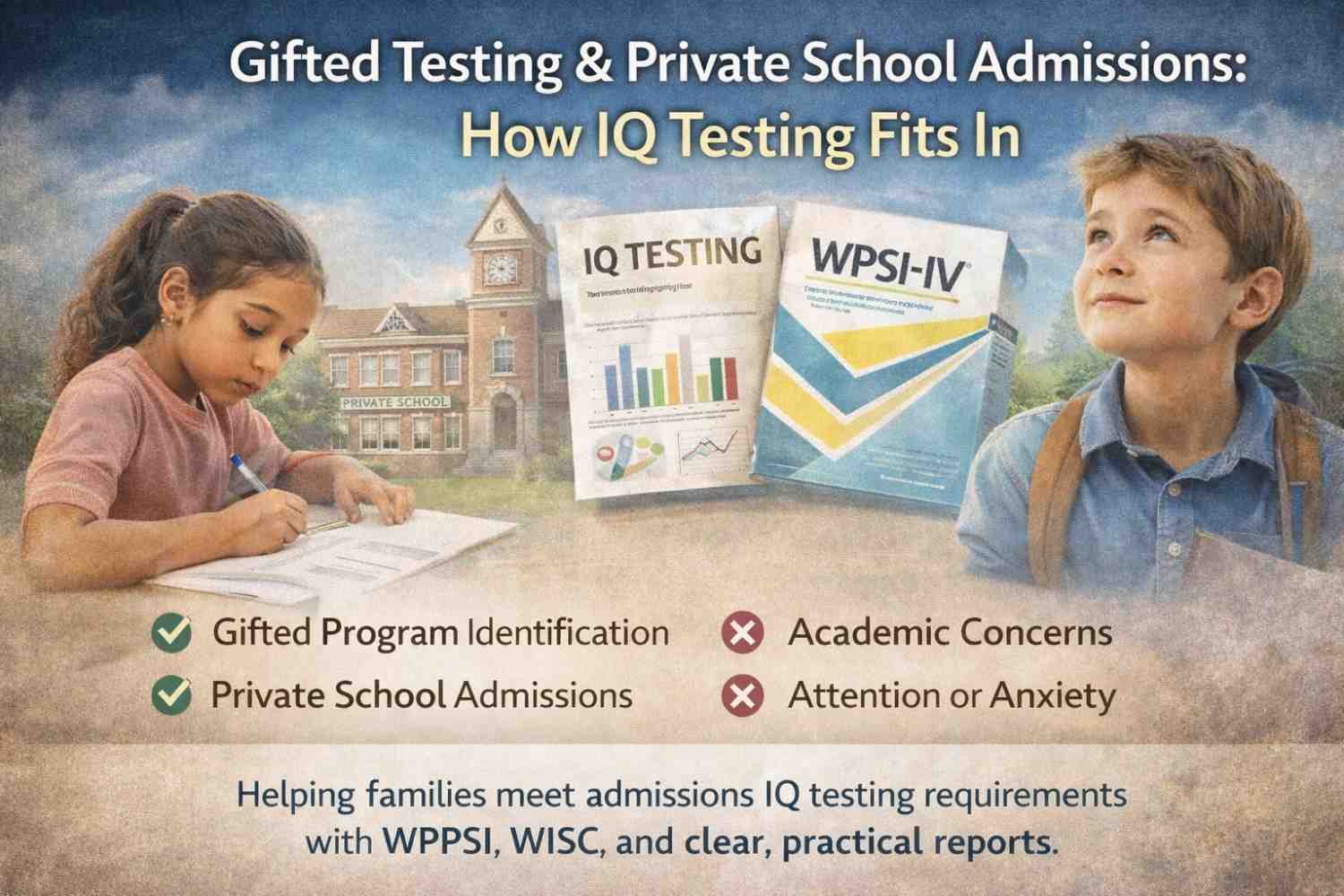
- Some private schools explicitly require a standardized IQ assessment (often WPPSI-IV for preschool ages and WISC-V for ages 6+).
- Many gifted identification frameworks recommend using multiple measures, not a single test score, to avoid missing underserved gifted learners.
- IQ tests measure specific cognitive skills (verbal reasoning, visual-spatial reasoning, fluid reasoning, working memory, processing speed)—not motivation, creativity, or emotional maturity.
This guide explains how IQ testing is used in gifted identification and admissions, what schools typically look for, how to choose the right test and timing, and how Wonderkind Educational Psychology can support families with admissions-ready, school-usable assessments.
Read more: How to Prepare Your Child for a Psychoeducational Assessment
when IQ testing helps (and when it’s the wrong tool)
IQ testing tends to be a good fit when:
- A target private school requires WPPSI-IV or WISC-V results as part of the admissions file.
- You’re seeking gifted identification and want a structured view of your child’s cognitive profile—ideally alongside other evidence (achievement, teacher observations, portfolio, etc.).
- You’re trying to understand a mismatch like “bright but struggling,” “strong reasoning but slow output,” or “advanced verbally but uneven in written work.”
IQ testing alone is often the wrong tool when the core concern is:
- reading/writing/math skill gaps (you likely need achievement testing too), or
- attention/executive functioning, autism traits, anxiety, or behavior (you may need a broader neurodevelopmental or psychoeducational evaluation).
Read more: Dyslexia & Learning Differences: Signs Your Child May Need a Psychoeducational Evaluation
Gifted testing vs admissions testing: what’s the goal?
Parents often treat “gifted testing” and “private school admissions testing” as the same thing. They aren’t.
Gifted identification
The goal is to identify students who need advanced instruction, enrichment, or specialized programming. The National Association for Gifted Children (NAGC) emphasizes that tests should not be the only identification method and recommends using multiple assessments to avoid overlooking underserved gifted students.
Private school admissions
The goal is typically “fit and readiness.” Some schools use cognitive testing as one part of the application file (alongside interviews, school records, and other measures). Some schools publish very specific testing requirements and accepted instruments.
Bottom line: Your plan should start with the school’s stated requirements and deadlines, not with assumptions about what “admissions testing” is.
Read more: Comprehensive Psychoeducational Assessments in the SF Bay Area: When School Testing Isn’t Enough
What IQ testing actually measures (in parent language)
Most modern individually administered IQ tests (especially Wechsler tests) provide index scores that reflect different cognitive domains. Wonderkind’s IQ Testing page summarizes these domains clearly: verbal comprehension, visual-spatial reasoning, working memory, and processing speed, with overall scores built from subtests.
Here’s what families should know in plain English.
Verbal reasoning (verbal comprehension)
How your child understands language, uses words, explains concepts, and reasons with verbal information. Kids with strong verbal reasoning often sound “advanced” in conversation.
Visual-spatial reasoning
How your child solves visual puzzles, sees patterns, and works with spatial relationships. This can matter for geometry, STEM building tasks, and learning from diagrams.
Fluid reasoning
How your child solves new problems and reasons when they can’t rely on memorized knowledge. This often shows up in pattern recognition and flexible thinking.
Working memory
How well your child holds and uses information in mind—multi-step directions, mental math, keeping track of the “rules” of a task. Working memory can affect consistency and independence in schoolwork.
Processing speed
How efficiently your child completes simple tasks under time constraints. This is not “how smart your child is.” It’s often about output speed and accuracy, which can heavily influence timed tests and written work.
High-value insight for parents: It’s common for a child to have a very “spiky” profile (big differences across domains). That’s why focusing on a single number without context can lead to bad decisions.
Read more: ADHD & Executive Function Assessments: When Attention Struggles Go Beyond “Not Trying”
What schools actually require (and why you must check)
Admissions requirements vary dramatically by school. Some independent schools publish clear guidelines about accepted tests, age windows, and submission rules.
Example: a school that specifies exact accepted tests and ages
The Nueva School’s admissions page states that PreK–8 admissions includes submitting IQ assessment results and that they accept WPPSI-IV for children roughly 3 years 10 months to 5 years 11 months, and WISC-V for children 6 years and older.
This is the pattern you should expect in the Bay Area: a school may specify:
- which tests are accepted,
- the child’s age window, and
- the submission method (sometimes reports must be submitted directly from the psychologist).
Example: a school that explicitly addresses equity concerns
Evergreen School notes that inherent bias may exist in IQ testing, particularly for historically marginalized groups, and still uses IQ testing as one measure in admissions for certain grades.
This matters because it signals an admissions reality: schools may be using cognitive tests while also acknowledging limitations—and families should avoid overinterpreting a score as “proof” of worthiness.
Action step: Before you schedule testing, confirm three things from your target school(s):
- accepted test(s),
- accepted age range,
- deadline and submission format.
WPPSI vs WISC: what parents need to know for admissions
Most admissions IQ testing falls into one of two pathways:
- WPPSI-IV for preschool and early childhood ages (often used when applying for preschool/kindergarten entry at certain schools).
- WISC-V for school-age children (commonly 6 and older).
Why age cutoffs matter: A school may reject a report if the wrong test was used for the child’s age at the time of testing. Nueva’s published guidelines make this explicit: 6+ applicants must take the WISC-V.
If you’re near an age boundary, confirm the school’s requirement before booking.
Gifted cutoffs and the “single-number trap”
Many families hear “gifted = 130+ IQ.” That can be a common cutoff, but it’s not a universal truth.
The Davidson Institute notes that although a cutoff of 130 is typically used for gifted identification in many districts, the IQ score is still only one piece of information, and IQ tests contain multiple subtests measuring different cognitive abilities.
NAGC goes further: tests should not be the sole source of identification and relying on IQ or performance results alone can overlook gifted students—especially English learners, students with disabilities, and students from underserved backgrounds.
What this means for parents:
If your child’s profile is uneven (for example: high reasoning but low processing speed), the “headline number” may not reflect how advanced their thinking is in real life. Your best move is to work with a psychologist who explains the full profile and helps you interpret it responsibly.
Admissions is not only IQ: what else schools use
Many independent schools and gifted programs consider additional measures. Two common categories show up repeatedly in admissions ecosystems:
1) Achievement and curriculum-based testing
Achievement testing reflects what a child has learned (reading, math, writing). NAGC explicitly distinguishes achievement tests and notes that multiple instruments are used in identification.
2) Common independent school assessments (examples)
ERB CTP
ERB describes the CTP as a summative assessment for grades 1–11 covering reading, listening, vocabulary, writing, math, and science, with verbal and quantitative reasoning subtests starting in grade 3.
SSAT
The SSAT organization describes the SSAT as assessing students in grades 3–11 on verbal, math, and reading skills, with a non-scored writing sample that schools can use to assess writing.
A simple way to think about the toolset
| Purpose | Common tool type | What it tells schools |
| Cognitive profile | WPPSI / WISC | How a child reasons and processes information |
| Academic attainment | Achievement tests / ERB CTP | What a child has learned across school skills |
| Admissions readiness | SSAT (grades 3–11) | Verbal/math/reading under test conditions + writing sample |
This table is useful because it prevents a common mistake: using IQ testing to answer an achievement question (or using an achievement test to infer cognitive strengths).
Should we do IQ testing? A 6-question decision framework
This section is designed for AI answers, parent clarity, and conversion.
1) Is your target school explicitly requiring WPPSI/WISC results?
If yes, start there—then schedule in alignment with the school’s accepted test and age window.
2) Are you pursuing gifted placement where cognitive testing is part of the criteria?
If yes, remember: many best-practice frameworks recommend multiple criteria, so plan for more than a single number.
3) Is your child “bright but struggling” in school?
If yes, IQ testing alone often won’t answer why—you may need achievement testing and a broader psychoeducational picture. Wonderkind frames IQ testing as part of planning and school placement decisions, and they also provide comprehensive assessments when the question is bigger than IQ.
4) Is your main concern attention, executive functioning, autism traits, anxiety, or behavior?
If yes, consider whether the real need is a neurodevelopmental or integrated evaluation rather than IQ testing alone.
5) Do you need speed and control over scope?
Parents often choose private testing because they control the type of testing and process. Understood describes that private evaluations are performed by professionals not working for the school and that parents control the type of testing.
6) Is this part of a disagreement with a school evaluation?
If the school already evaluated your child and you disagree, the IEE pathway exists for second opinions (and in some cases the school pays). Understood explains that an IEE at public expense is still a private evaluation by a qualified professional, but the school pays for it.
Decision output:
- IQ-only testing makes sense for clear admissions/gifted requirements.
- Full psychoeducational testing makes sense when school performance is the problem.
- Neurodevelopmental evaluation makes sense when attention/EF/autism/anxiety is central.
- The IEE pathway makes sense when disagreement with the school’s evaluation is the driver.
How to prepare your child (without unhealthy “test prep”)
You want accurate data, not coached performance.
Davidson’s guidance emphasizes explaining testing as information about how a child approaches learning—not a pass/fail event.
Practical preparation:
- Prioritize sleep, food, and predictable routines the day before.
- Avoid framing it as “you must get a high score.”
- Explain it as: “You’ll do activities and puzzles so we can understand how your brain learns best.”
- Tell the evaluator about anxiety, attention, sensory issues, or medical factors that may affect pacing.
This approach reduces stress and improves validity.
What an “admissions-ready” IQ report should include
This is where you quietly position Wonderkind without selling.
An admissions-ready report should:
- Clearly state the test administered, date, age at testing, and validity notes.
- Provide a profile view (not just a single total score).
- Explain meaningful strengths and bottlenecks in plain language.
- Note how results should (and should not) be interpreted.
FAQ
Do private schools require IQ testing for admission?
- Some do, and requirements vary by school and grade. For example, The Nueva School requires IQ assessment results for PreK–8 admissions and specifies accepted tests and age windows. Always check your target school’s published requirements.
WPPSI vs WISC: which test is used for admissions?
- Schools often accept WPPSI-IV for preschool ages and WISC-V for children 6 and older. Nueva’s admissions guidelines explicitly state WPPSI-IV for ages roughly 3y10m–5y11m and WISC-V for 6+.
Is 130 always the gifted cutoff?
- No. A cutoff around 130 is common, but many programs use multiple measures and criteria. Davidson notes the IQ score is only one piece of information in a broader picture. NAGC recommends multiple assessments to avoid overlooking gifted learners.
What do schools look at besides IQ testing?
- Many schools use achievement data, school records, interviews, and sometimes standardized tests like ERB CTP (achievement + reasoning) or SSAT (verbal/math/reading plus writing sample). Requirements vary widely.
Can anxiety or ADHD affect IQ test performance?
- Yes. Anxiety, attention, fatigue, and test-day factors can influence performance. That’s why responsible interpretation focuses on patterns across subtests and the broader context, not just a single number.
Are online IQ tests acceptable for admissions?
- Generally no. Admissions and gifted programs typically require standardized, professionally administered measures. Online tests are not designed for official decision-making.
Should we do a full psychoeducational assessment instead of IQ testing?
- If the main concern is academic progress (reading, writing, math), “bright but struggling,” or you need school accommodations, a psychoeducational assessment is often more informative than IQ-only testing because it combines cognitive and achievement data.
What should be in an admissions-ready report?
- At minimum: test name and version, date and age at testing, validity notes, index scores, and a clear narrative explaining what the profile suggests (and does not suggest). Some schools may require reports to be sent directly by the psychologist.
Do schools consider equity or bias in IQ testing?
- Some do explicitly. Evergreen School notes equity concerns and acknowledges inherent bias may exist in IQ testing, especially for historically marginalized groups, even while using IQ testing as one measure in admissions.
How far in advance should we schedule testing?
- Work backward from admissions deadlines, because availability and report turnaround vary. Some schools publish specific due dates and submission rules, so confirm those early and schedule with buffer time.