
If your child has a psychoeducational assessment coming up, it’s completely normal to feel a little nervous. Parents often worry:
- What should I say to my child?
- Should we practice reading or math?
- What if they’re anxious and shut down?
The good news: you don’t need to cram or “coach” your child. The most important part of preparing for a psychoeducational assessment is helping them show up as their real self—rested, supported, and as calm as possible.
This guide walks you through how to prepare for a psychoeducational assessment, step by step, with a practical checklist you can use the week before, the night before, and on the day itself.
At Wonderkind Educational Psychology, we support children, teens, and families across the San Francisco Bay Area through this process every day. The ideas below reflect what we see actually helps kids feel safer and what leads to the most accurate, useful results.
Quick Summary: How to Prepare for a Psychoeducational Assessment
In this article, you’ll find:
- A simple explanation of what the assessment is really trying to do
- A step-by-step psychoeducational assessment checklist for parents
- Scripts you can use when preparing your child for testing
- Concrete ways to reduce test anxiety before assessment day
- How Wonderkind makes the process feel safe, kind, and collaborative
First, What Is a Psychoeducational Assessment Trying to Do?
Before you decide how to prepare, it helps to be clear about what the assessment is for.
A psychoeducational assessment is a comprehensive look at how your child thinks, learns, and manages emotions at school. It usually includes:
- Cognitive testing (reasoning, memory, processing speed)
- Academic testing (reading, writing, math)
- Attention and executive functioning (focus, organization, planning)
- Social-emotional and behavioral measures (anxiety, mood, behavior patterns)
The goal is not to see whether your child is “good” or “bad” at school. The goal is to answer questions like:
- What are their learning strengths and challenges?
- Is there a learning difference, ADHD, or something else going on?
- What supports, accommodations, or teaching approaches will help them thrive?
That’s why the best way to prepare for a psychoeducational assessment is not to make your child “look perfect,” but to help them show up as themselves so the results are accurate and useful.
At WonderKind, we talk with kids about the assessment as a way to “learn how your brain works” and “help school fit you better,” not as a test they have to pass.
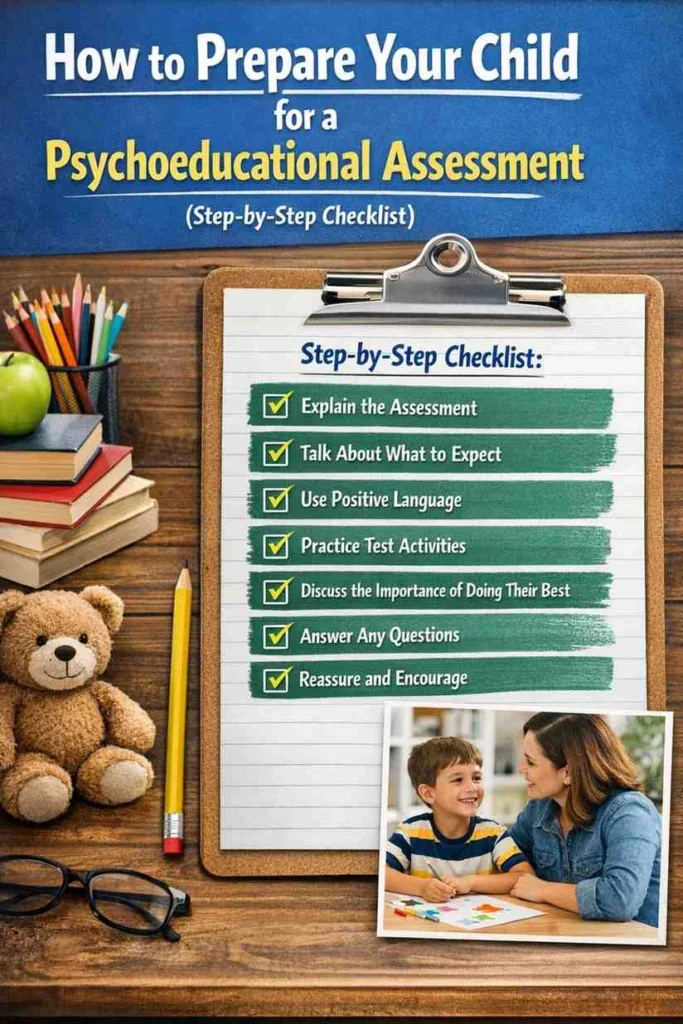
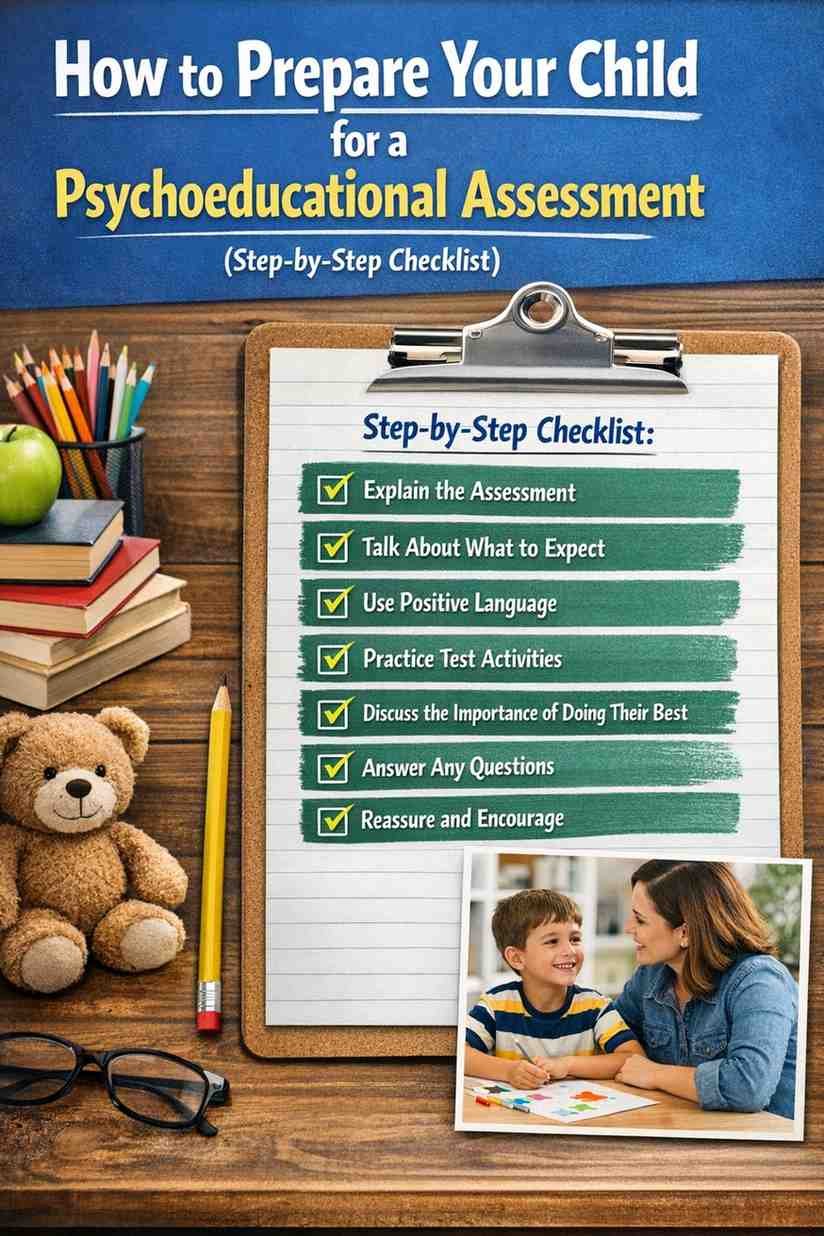
Step-by-Step Checklist: How to Prepare for a Psychoeducational Assessment
Use this psychoeducational assessment checklist to guide you from the week before all the way through the day of testing.
Step 1: Gather Helpful Background Information
Before the assessment, spend a little time gathering:
- Recent report cards and progress reports
- Standardized test scores, if available
- Any previous evaluations (speech/language, OT, school psych reports)
- IEP or 504 plans, if your child has them
- Work samples that show your concerns (writing, worksheets, tests)
- Notes or emails from teachers about what they see at school
You don’t have to organize everything perfectly—just collect what tells the story of your child’s learning over time.
At Wonderkind, we review this background carefully before testing so the evaluation is focused on the right questions, not just a generic list of tests.
Step 2: Talk About the Assessment in a Calm, Honest Way
A big part of preparing your child for testing is how you describe it.
You can say things like:
- “You’re going to meet with someone whose job is to help kids and teens understand how they learn best.”
- “You’ll do puzzles, school-type activities, and answer questions. Some will feel easy, some might feel tricky. That’s okay—that’s how we learn what feels hard for you.”
- “There is no passing or failing. We just want to see how your brain works so school can fit you better.”
Try to avoid:
- “This is a really important test.”
- “If you don’t do well, you might not get help.”
- “You need to show them you’re trying or they won’t believe us.”
Those messages can increase pressure and make anxiety worse.
At Wonderkind, we match this language when we greet children in person, so your explanation at home lines up with how we talk about the assessment in the office.
Step 3: Reduce Test Anxiety the Day Before
You can’t (and don’t need to) remove all nerves, but you can reduce test anxiety before the assessment by focusing on basics:
- Keep routines familiar. Stick to a typical evening as much as possible.
- Prioritize sleep. Aim for a consistent bedtime rather than staying up late “practicing.”
- Keep activities light. If possible, avoid scheduling a big event (like a late game or party) the night before.
- Normalize nerves. Try: “It’s okay to feel nervous about something new. Feeling nervous doesn’t mean you can’t do it.”
You can also teach a simple calming strategy:
“Let’s try three slow breaths together. Breathe in through your nose… hold for a moment… then slowly out through your mouth.”
Practicing this the night before gives your child a tool they can use during the assessment if they start to feel overwhelmed.
Step 4: Plan the Logistics (So Stress Isn’t About the Morning)
Sometimes the hardest part of testing day is actually the logistics—traffic, parking, finding the office. Planning ahead helps everyone feel calmer.
The day before, make sure you know:
- The exact address, parking, and building details
- How long the appointment will last
- Whether there will be one session or several shorter ones
- Who is expected to come (just your child, or you as well?)
Pack a small bag with:
- A familiar water bottle
- A snack approved by the office (nothing too sticky or messy)
- Glasses, hearing aids, or other essentials
- Any prescribed medications
- A small comfort item (if appropriate), like a favorite fidget or small toy
Build extra time into your travel plan so you’re not rushing. It’s much easier to help your child feel calm when you don’t feel like you’re racing the clock.
Wonderkind’s team will share specific directions and suggestions based on our locations in the San Francisco Bay Area, so you know what to expect before you even leave home.
Step 5: What to Do (and Not Do) on Testing Morning
Here are some simple guidelines for the morning:
Do:
- Offer a familiar breakfast that won’t upset their stomach.
- Keep your tone casual and reassuring:
- “Remember, this is just to learn more about how you learn.”
- “Just do your best and be honest—that’s all anyone needs.”
- Answer last-minute questions honestly but briefly.
Try not to:
- Quiz your child on math facts or spelling in the car.
- Say things like, “If this doesn’t go well, I don’t know what we’ll do.”
- Jump in with your own anxiety (“I’m so nervous about the results”) in front of them.
When you’re thinking about how to prepare for a psychoeducational assessment, think less about “studying” and more about creating a calm, predictable start to the day.
Step 6: Share Medical, Emotional, and Family Context with the Psychologist
Some preparation is just for you, not your child.
Be honest with the psychologist about:
- Recent sleep issues, appetite changes, or physical health concerns
- Any current medications (especially for ADHD, anxiety, or mood) and how consistently they’ve been taken
- Big life changes or stressors (moves, family transitions, bullying, grief, etc.)
- Mental health history, if any, for your child and relevant family patterns
This isn’t about judgment; it’s about getting the full picture.
At Wonderkind, we treat this context as just as important as test scores. A strong psychoeducational assessment combines what happens in the room with what’s happening in your child’s daily life.
Step 7: Debrief Afterwards Without Over-Interpreting
After the assessment, your child may feel tired, proud, frustrated, or a mix of everything.
You can:
- Ask, “How did it feel?” rather than “Did you do well?”
- Reflecting effort: “That sounded like a long day. I’m proud of you for sticking with it.”
- Let them know there’s no instant verdict:
- “The psychologist has a lot to think about. They’ll look at everything carefully and then we’ll meet to talk about what it all means.”
Try to avoid:
- Guessing diagnoses based on how your child describes the day.
- Pushing for details: “What did you say on that part? Did you get it right?”
- Making promises you can’t keep yet (“This will definitely get you extra time on every test”).
At Wonderkind, we schedule a separate feedback session with parents to go over results in depth. You don’t have to decode everything your child says about the day—our job is to integrate the data, behavior, and history into one clear story.
Common Mistakes Parents Make When Preparing for a Psychoeducational Assessment
Most parents are trying their best. But some common missteps can actually make things harder:
- Over-tutoring right before.
Intense last-minute practice can increase anxiety and make it harder to see your child’s natural learning profile. - Telling kids exactly what the tests are measuring.
For example: “They’re trying to see how smart you are” or “They’re checking if you have ADHD.” This can make kids hyper-focused and worried about every response. - Minimizing feelings.
Saying “There’s nothing to be scared of” or “Stop worrying” can shut kids down. It’s more helpful to validate: “It makes sense you feel nervous.” - Downplaying challenges on forms.
Some parents worry about “labeling” and under-report difficulties, which can lead to less precise recommendations. - Focusing only on a label.
It’s natural to wonder, “Is this dyslexia? ADHD? Autism?” But the most helpful outcome is a clear plan, not just a name.
Remember: the best preparing your child for testing is about safety and honesty, not perfection.
Sample Scripts: How to Talk With Your Child (By Age)
Here are some sample phrases you can adapt.
Younger Children (5–8)
- “You’re going to visit a helper who plays brain games with kids to see how their brains like to learn.”
- “You’ll do puzzles, look at pictures, and answer questions. Some will feel easy, some might feel tricky. That’s okay.”
- “There are no grades and no one gets in trouble. We just want to learn more about you.”
Tweens (9–12)
- “You know how school feels extra hard in some ways? This is a way to understand why and what could help.”
- “The psychologist is going to ask you to do some school-like tasks and brain puzzles. It’s not about getting everything right; it’s about seeing what comes naturally and what feels like a slog.”
- “If something is confusing or you need a break, you can say so.”
Teens
- “This assessment is really about giving you data—so that if you need accommodations or a different approach to learning, we have evidence to back that up.”
- “This isn’t about proving something is ‘wrong’ with you. It’s about not fighting against hidden barriers if they’re there.”
- “You can be honest about what feels hard or draining. That honesty helps more than trying to power through everything.”
These scripts help reduce test anxiety before assessment by framing the evaluation as a collaborative process, not a judgment.
Wonderkind’s Approach: Making Assessments Feel Safe and Respectful
At Wonderkind Educational Psychology, our goal is for psychoeducational assessments to feel:
- Kind: Children and teens are treated with warmth, respect, and patience.
- Collaborative: We listen to parents, students, and schools; everyone’s perspective matters.
- Clear: Reports are written in plain language with practical recommendations you can use at home and at school.
- Useful: Evaluations are designed to support IEPs, 504 plans, classroom accommodations, and real-world decisions.
We guide families through how to prepare for a psychoeducational assessment well before testing day, so you’re not guessing alone. From intake to feedback, you have a team walking beside you.
If you’re in the San Francisco Bay Area and considering an assessment, Wonderkind can help you decide whether now is the right time and what kind of evaluation will best fit your child’s needs.