
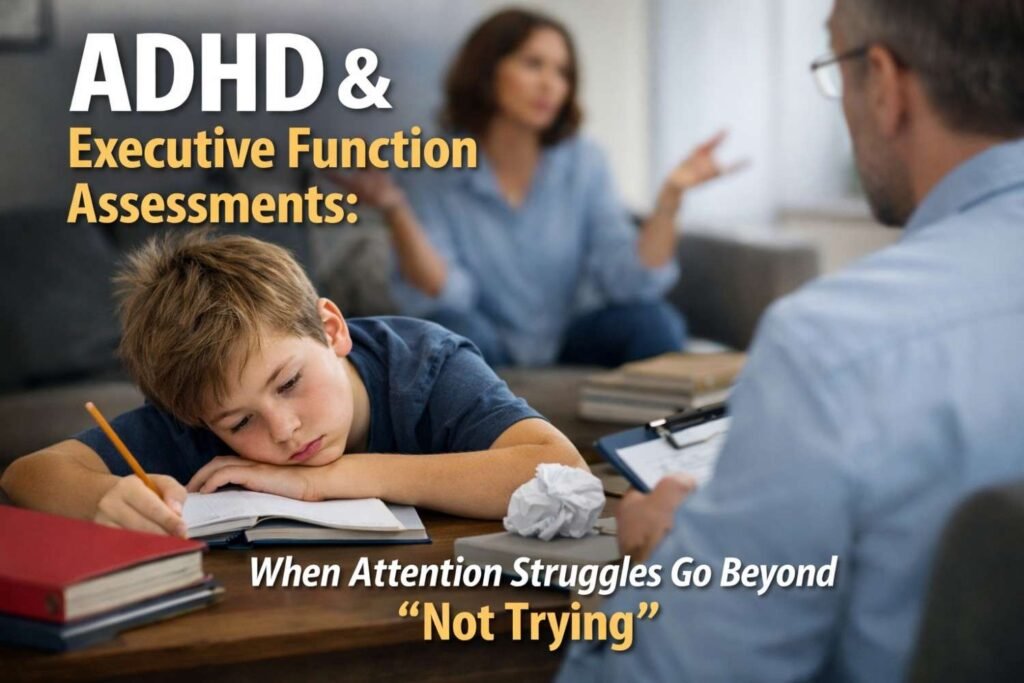
If a child keeps losing homework, melting down over multi-step tasks, zoning out in class, or taking hours to start a 20-minute assignment, it’s tempting for adults to say:
“They’re just not trying hard enough.”
In many cases, that’s not true.
For kids, teens, and even adults with ADHD and executive function challenges, the real problem is not willpower. It’s the brain systems that handle planning, organization, working memory, and self-control — the “air traffic control” of the mind — getting overloaded.
An ADHD and executive function assessment is how you move from “try harder” lectures to a clear picture of:
- What’s actually happening in the brain
- How it shows up at school
- How it shows up at home
- What specific supports will actually help
For a practice like Wonderkind Educational Psychology in San Francisco, those questions are usually answered through:
- Neurodevelopmental assessments (for ADHD, autism, and executive functioning)
- Comprehensive psychoeducational assessments (for learning, attention, and emotional patterns together)
This guide walks you through what those assessments include, what they give you, and when it’s worth booking one.
Read more: How to Prepare Your Child for a Psychoeducational Assessment
ADHD and executive function: what’s really going on (beyond “lazy”)
ADHD in plain language
ADHD is a neurodevelopmental difference, not a character flaw.
It affects how a person:
- Regulates attention
- Manages activity level
- Controls impulses
- Organizes and follows through on tasks
On the outside, ADHD can look like:
- Daydreaming or zoning out
- Constant chatter or fidgeting
- Rushing through work with “careless” mistakes
- Struggling to start or finish tasks, even when they care
On the inside, it often feels like:
“I want to do it. I just can’t get my brain to do it consistently.”
What are executive functions?
Executive functions are the brain skills that help you:
- Plan and prioritize
- Start tasks and keep going
- Hold information in mind (working memory)
- Resist distractions and impulses
- Shift gears when plans change
- Monitor your own behavior and adjust
Think of executive functions as the project manager of the brain. When they’re strong, life runs more smoothly. When they’re underpowered or overloaded, even smart, motivated people can look disorganized or unmotivated.
ADHD and executive function weaknesses go hand-in-hand. That’s why a proper assessment looks directly at both.
Read more: Dyslexia & Learning Differences: Signs Your Child May Need a Psychoeducational Evaluation
Signs attention struggles go beyond “not trying”
You can’t diagnose ADHD from a checklist in a blog post, but there are recurring patterns that suggest it’s time to look deeper.
At school, you might see:
- A big gap between ability and output
- (Teacher says: “They’re so bright… when they actually do the work.”)
- Inconsistent performance — one day brilliant, the next day nothing is turned in
- Chronic missing assignments, lost papers, or forgotten materials
- Trouble following multi-step directions or copying homework accurately
- Difficulty staying seated, staying quiet, or waiting their turn
- Zoning out unless the topic is highly interesting or urgent
At home, you might see:
- Homework that should take 30 minutes stretching into 2–3 hours
- Huge resistance to starting chores or schoolwork (“I’ll do it later”)
- Emotional blowups when tasks feel overwhelming or confusing
- A bedroom, backpack, or digital life that never seems to stay organized
- Constant reminders required to do basic routines (teeth, backpack, lunch, etc.)
When these patterns keep happening across settings and across time — despite consequences, pep talks, or “trying harder” — that’s exactly when ADHD and executive function assessments become useful.
Read more: Comprehensive Psychoeducational Assessments in the SF Bay Area: When School Testing Isn’t Enough
What an ADHD & executive function assessment actually includes
Different clinics use different tools, but a high-quality assessment tends to include the same core ingredients.
1. Detailed history and context
The clinician will collect:
- Developmental history – early milestones, temperament, language, social development
- School history – strengths, struggles, teacher feedback, report cards, interventions tried
- Medical and family history – sleep, health, family patterns of ADHD, learning disorders, or mental health conditions
This usually happens via intake forms and one or more parent/caregiver interviews. The goal is to see patterns over time, not just a bad month or a particular teacher.
2. ADHD symptom rating scales (home + school)
To understand day-to-day behavior, you’ll typically complete standardized rating scales. Teachers often complete them too.
They look at things like:
- Inattention (careless errors, forgetfulness, difficulty sustaining focus)
- Hyperactivity (fidgeting, restlessness, “driven by a motor”)
- Impulsivity (blurting out, difficulty waiting, interrupting)
The key questions:
- Do these behaviours show up in more than one setting (home, school, activities)?
- Are they consistent over time, not just situational?
- Are they outside the typical range for age?
3. Executive function questionnaires
General ADHD checklists are helpful, but they don’t fully describe what’s happening with planning, organization, and self-management.
So many clinicians also use executive-function-focused forms that ask about:
- Forgetting to turn in completed work
- Trouble organizing materials and keeping track of belongings
- Difficulty planning long-term projects or studying for tests
- Struggles with shifting between activities or handling change
- Emotional control and frustration tolerance
These ratings show how executive function challenges play out in real life, not just in a quiet testing room.
4. Cognitive, attention, and executive function tasks
A thorough assessment typically includes standardized, one-on-one testing to look at:
- Cognitive abilities – how the person reasons, solves problems, and understands language
- Working memory – holding and using information in mind (for example, remembering and applying multi-step instructions)
- Processing speed – how quickly and accurately they complete simple tasks
- Sustained attention – staying focused over time during repetitive or low-interest tasks
- Inhibition and cognitive control – stopping automatic responses, choosing a slower but more accurate response
- Cognitive flexibility and planning – shifting between rules, adapting to feedback, and planning steps toward a goal
These tasks help distinguish:
- “Won’t do it” from “can’t consistently do it without support”
- ADHD from other issues that might affect attention (like anxiety, learning disorders, or low overall ability)
5. Academic and emotional screening
Because attention problems are often tangled up with learning difficulties and emotions, good assessments also scan for:
- Reading, writing, and math skills
- Anxiety, low mood, perfectionism, or other emotional patterns
- Behavioural concerns (acting out, withdrawal, social struggles)
This matters because:
- A child who reads well below grade level will absolutely avoid reading tasks
- An anxious or perfectionistic student may procrastinate from fear of failure
- Attention can collapse when someone is overwhelmed emotionally
You want a report that says, “Here’s what ADHD/executive function is contributing — and here’s what’s coming from learning or emotional factors.”
6. Integration, diagnosis, and practical feedback
Once all the pieces are collected, the clinician:
- Compares behaviour and test results to diagnostic criteria
- Identifies strengths (verbal skills, creativity, problem-solving, social skills, etc.)
- Pinpoints specific executive function weaknesses (for example, working memory and organization, but not processing speed)
- Maps out what this means at school and at home
You don’t just get scores; you get a narrative:
- What’s going on
- What it’s not
- What to do next
How ADHD & executive function assessments support school
Turning data into IEPs, 504 Plans, and classroom supports
Schools are more likely to provide accommodations when they have clear, specific documentation.
A strong ADHD and executive function report can:
- Show that attention/executive challenges are real and measurable, not just a personality clash
- Connect those challenges to functional impact (incomplete work, missed deadlines, lost materials, inconsistent performance)
- Suggest concrete accommodations and teaching strategies
Examples of supports that often come from these assessments:
- Extra time on tests and timed tasks
- Breaking large assignments into smaller, check-in milestones
- Written instructions in addition to verbal directions
- Access to organizational tools and weekly planner check-ins
- Preferential seating in a lower-distraction area
- Short, scheduled movement breaks
When those recommendations are spelled out in a comprehensive psychoeducational assessment report, it’s easier for the school to build or adjust an IEP or 504 Plan.
When you disagree with a school evaluation
Sometimes schools conduct their own testing and still decide a student:
- Doesn’t qualify for services, or
- Qualifies, but the support plan still doesn’t fit what you see at home
In those situations, a private ADHD and executive function assessment can serve as a more in-depth second opinion — often as part of an independent educational evaluation process. That gives you more leverage and clarity when you go back to the table with the school team.
How these assessments support home and family life
Reframing the story at home
One of the biggest gifts of a good assessment is a new narrative.
Instead of:
- “They’re lazy.”
- “They just don’t care.”
- “If they really wanted to, they would.”
You can move to:
- “Their brain struggles with starting tasks and holding steps in mind.”
- “They use a lot of energy just keeping up — no wonder they crash at home.”
- “We need to change the system, not just yell louder.”
That shift lowers shame for the child and frustration for the adults.
Designing ADHD-friendly systems
Assessment results help you design supports that actually match your child’s brain:
- Externalize steps: checklists on the wall, sticky notes, written routines instead of long verbal reminders
- Simplify instructions: one step at a time, then check-in
- Use visual timers: help them see how long tasks will last, not just feel it
- Create consistent “launch routines”: same sequence before school, homework, and bedtime
- Plan transitions: warnings before switching tasks, clear expectations about “what’s next”
You’re not doing the work for them; you’re building the scaffolding they need to succeed.
When it’s time to consider an ADHD & executive function assessment
It may be worth pursuing a formal assessment when:
- You keep hearing, “They’re smart but not working up to potential.”
- Behaviour charts, reward systems, and consequences are not changing the pattern.
- Teachers describe your child as “scattered,” “disengaged,” or “in their own world” — even when you know they care.
- Homework has become the daily battleground and is harming your relationship.
- You suspect there’s more going on than just “motivation” but don’t know where to start.
If attention struggles are chronic, cross-situational, and out of proportion to effort, an ADHD and executive function assessment can finally give you clear answers and a plan.
FAQs about ADHD & executive function assessments
Q1. Is every distractible or disorganized child “ADHD”?
- No. All kids have off days and developmental quirks. ADHD is about persistent, impairing patterns of inattention and/or hyperactivity-impulsivity across settings. A good assessment looks at history, behaviour, testing, and environment before making that call.
Q2. Can’t we just try strategies without an assessment?
- You can absolutely start using supportive strategies at home and school without a diagnosis. But an assessment tells you which executive functions are most affected and whether other factors (anxiety, learning disorders, autism, etc.) are also in play. That prevents months or years of trial-and-error on the wrong problem.
Q3. Does an assessment mean my child has to start medication?
- No. An assessment provides information, not a mandatory treatment plan. Some families consider medication with their doctor; others focus on accommodations, coaching, therapy, or lifestyle changes. The key is having solid data instead of guessing.
Q4. Are ADHD & executive function assessments only for kids?
- No. Teens and adults often seek assessments when school, college, or work demands ramp up and old coping strategies no longer work. Understanding your profile can help with accommodations, career planning, and targeted coaching at any age.
Q5. How do I explain testing to my child without scaring them?
- Keep it simple and strengths-focused:
- “We’re going to meet someone whose job is to understand how your brain works and what helps you learn best. There will be puzzles, questions, and activities — it’s not a test you pass or fail.”
Avoid fear-based language and emphasize that you are on their team.
Bringing it together
When attention struggles go beyond “not trying,” you don’t need more lectures or stricter consequences. You need clarity:
- What’s happening in the brain
- How it impacts school and home
- What specific supports will actually help
That’s what a well-done ADHD and executive function assessment delivers — so you can stop fighting the same battles and start building systems that match how your child (or you) really think and work.