
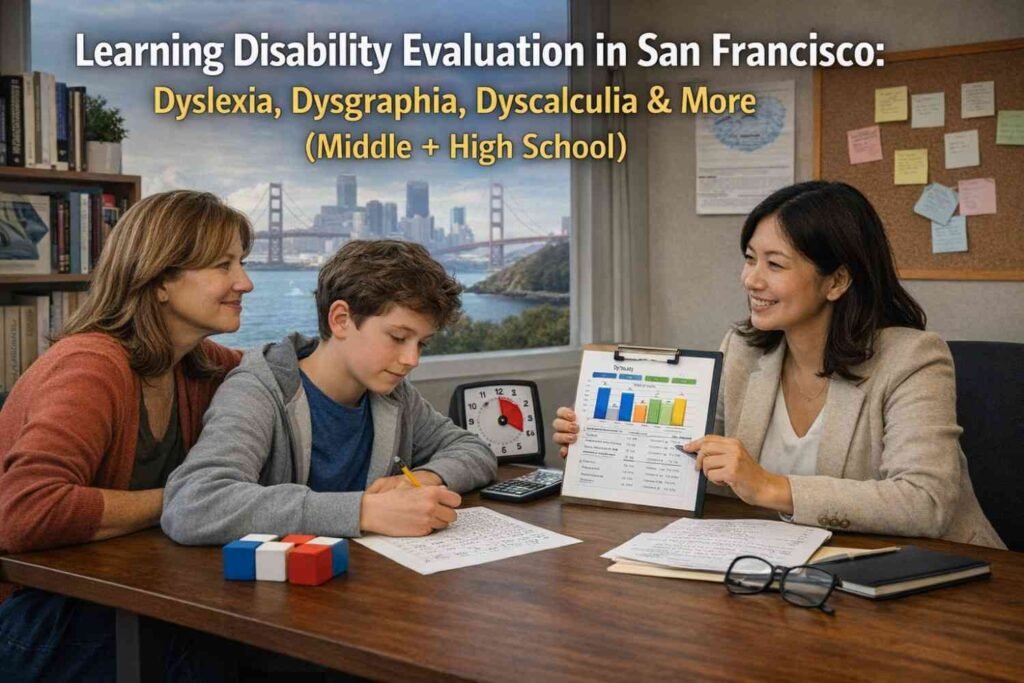
If your middle or high schooler is bright but school is getting harder—reading is slow, writing takes hours, or math breaks down in multi-step work—a learning disability evaluation can clarify what’s happening and what supports will actually help.
Here’s the core idea:
- “Learning disability” often refers to Specific Learning Disorder, which involves persistent difficulty in reading, written expression, and/or math.
- Middle/high school is a common turning point because the demands spike: longer texts, faster pace, heavier writing, more organization, and timed tests.
- A strong evaluation doesn’t just label. It produces a clear profile + practical recommendations you can bring into IEP/504 meetings and classroom conversations.
If you’re exploring evaluation options, Wonderkind’s Comprehensive Psychoeducational Assessments page is the service hub this article connects to.
what a learning disability evaluation is for teens
A middle/high school learning disability evaluation is typically a psychoeducational assessment that:
- clarifies whether reading/writing/math struggles align with a learning disorder profile,
- identifies why the struggle is happening (skill gaps vs processing/efficiency vs attention/executive functioning vs emotional factors), and
- turns results into a school-ready plan: instructional targets, accommodations, and next steps.
Most important: your outcome isn’t “a number.” Your outcome is a usable plan.
What “learning disability” means (and what it doesn’t)
What it means
“Specific Learning Disorder” is defined by persistent impairment in at least one major academic area: reading, written expression, and/or math.
Common terms families use:
- Dyslexia → primarily reading (often decoding/fluency/spelling patterns)
- Dysgraphia → written expression (output, organization, mechanics)
- Dyscalculia → math (number sense, calculation, reasoning)
What it does not mean
It’s not:
- laziness
- “not trying”
- low intelligence
In middle/high school especially, many students have strong reasoning and insight but still struggle because the academic demands overload a bottleneck (speed, working memory, writing fluency, reading efficiency).
Why problems often show up more in middle and high school
A student can “get by” in elementary school because:
- reading volume is lower
- writing assignments are shorter
- math is less abstract
- teachers provide more structure
Then middle/high school hits:
- longer reading (textbooks, novels, dense articles)
- more writing (multi-paragraph responses, essays, timed writing)
- more abstract math (fractions → algebra → geometry → word problems)
- more independence (multi-teacher planning, deadlines, executive functioning)
That’s why a teen can look “fine” for years and suddenly feel like school is impossible.
Teen signs to watch (by domain)
Dyslexia-type signs in middle/high school
Common patterns:
- reading is accurate but slow and exhausting
- avoids reading-heavy classes or assignments
- struggles with timed reading and comprehension checks
- spelling remains weak compared with verbal ability
The International Dyslexia Association describes evaluation as a process to identify factors contributing to difficulty with reading/spelling and to build a roadmap for intervention.
Dysgraphia / written expression signs in middle/high school
Common patterns:
- essays take hours and still don’t match verbal insight
- poor organization (ideas are there, structure isn’t)
- slow output, incomplete timed writing
- spelling/grammar/mechanics keep dragging grades down
Dyscalculia-type signs in middle/high school
Common patterns:
- math facts don’t “stick” and calculation is slow
- multi-step problems break down (especially algebra sequencing)
- word problems are disproportionately hard
- math anxiety develops after repeated struggle
A useful rule: if the struggle is persistent and creates real academic impact (grades, avoidance, anxiety, missing work, tutoring not closing gaps), evaluation becomes high-value.
What testing includes (what actually happens in a strong evaluation)
A high-quality learning disability evaluation for teens typically includes:
- Intake + history + school context
Developmental history, educational history, current concerns, teacher input, and prior supports. - Cognitive testing (how the brain processes information)
This helps identify strengths and bottlenecks that affect learning efficiency (e.g., working memory, processing speed). - Academic achievement testing (what your teen can do in reading/writing/math)
This is essential because learning disorders are defined by academic skill impact, not just cognitive style. - Targeted reading/writing/math measures based on the referral question
For dyslexia-specific questions, evaluation often examines foundational reading skills (phonological skills, decoding, fluency, spelling). - Attention/executive functioning + social-emotional screening when relevant
Middle/high school concerns often involve attention, planning, anxiety, or burnout that changes how school performance looks.
A simple “what’s tested and why” table
| Concern area | What testing often probes | Why it matters in middle/high school |
| Dyslexia | phonological skills, decoding, fluency, spelling | reading load + timed tests + content classes |
| Dysgraphia / written expression | writing mechanics, writing fluency, organization | essays, note-taking, written exams |
| Dyscalculia | number sense, calculation, math reasoning | algebra sequencing + multi-step problems |
Internal link (service hub): This is exactly the scope described under Comprehensive Psychoeducational Assessments.
School evaluation vs private evaluation vs IEE (which path fits a teen?)
Parents usually need a decision framework, not a lecture.
School evaluation (IDEA)
Under federal special education regulations, states must not require a “severe discrepancy” model and must permit a process based on response to scientific, research-based intervention (and may permit other alternative procedures).
In plain English: schools can use multiple approaches to determine learning disability eligibility; it’s not automatically “IQ-achievement gap or nothing.”
Private psychoeducational evaluation
Often chosen when:
- you want faster clarity
- you want deeper detail and specific recommendations
- you want an independent profile that translates to practical instruction + accommodations
IEE (Independent Educational Evaluation)
Best fit when:
- the school evaluated your teen and you disagree
- you believe something was missed (wrong focus, incomplete testing, conclusions don’t match functioning)
Wonderkind’s Independent Educational Evaluations (IEE) page is the relevant route when “second opinion on the school evaluation” is the core need.
Extra practical resource: How to Request an Independent Educational Evaluation from Your School District
What you should walk away with after teen testing
A strong middle/high school evaluation should produce:
- a clear explanation of strengths + bottlenecks
- diagnostic conclusions (when appropriate)
- targeted recommendations that include BOTH:
- instruction/intervention targets (what skills need direct teaching)
- accommodations (what reduces barriers so your teen can show knowledge)
- a school-usable summary you can bring to 504/IEP conversations
- practical home strategies that reduce conflict and wasted time
If a report only gives scores without translating them into “what to do,” it’s not doing its job.
Turning results into real school support (IEP/504 + classroom moves)
This is the difference between “we got tested” and “things changed.”
Step 1: Pick the two biggest school pain points
For middle/high school, these are often:
- timed tests and reading speed
- writing output (essays, short answers, note-taking)
- math sequencing and multi-step work
- organization and missed assignments
Step 2: Match accommodations to the functional barrier
Here are examples of “barrier → support” thinking (not a guarantee—your team decides what fits):
| Barrier | What it looks like | Supports to discuss |
| Slow reading/fluency | teen reads accurately but can’t finish | extended time when appropriate; reduced reading load; access to audio/preview notes |
| Writing bottleneck | essays take hours; timed writing collapses | speech-to-text; typing; reduced copying; writing templates; extended time for written output |
| Math sequencing | loses steps in algebra | step cards; worked examples; calculator policy when appropriate; reduced problem sets when mastery is shown |
| Executive function overload | missing work, late projects | chunking, check-ins, assignment trackers, reduced simultaneous deadlines |
Step 3: Add one intervention target (not just accommodations)
Accommodations reduce barriers. Intervention teaches skills.
For dyslexia-related concerns, IDA guidelines emphasize assessing the foundational skills that drive decoding and fluent reading so intervention can be targeted.
Step 4: Track progress in 8–12 weeks
Agree on something measurable:
- reading rate/fluency improvement
- writing output time reduction
- math accuracy under multi-step demands
- assignment completion rate
High school note: SAT/AP/College Board extended time (important but misunderstood)
If you’re thinking ahead to standardized testing, one key point from College Board documentation guidance:
Low processing speed alone does not usually indicate the need for testing accommodations. Documentation should show how it affects academic abilities under timed conditions.
Translation: if the goal is extended time, your documentation has to demonstrate functional impact under timed demands, not just a score.
This is where a comprehensive psychoeducational evaluation can be more helpful than “single-domain” testing, because it links cognitive profile to academic performance under real constraints.
How to prepare your middle/high schooler for evaluation
Teens do best when they understand the purpose and feel respected.
Use this framing:
- “This isn’t a pass/fail. It’s to understand how you learn and what would make school fairer.”
- “Some tasks will feel easy, some hard. That’s the point.”
- “We want honest effort, not perfection.”
Practical prep:
- normal sleep
- solid breakfast
- bring glasses/meds if applicable
- let the evaluator know about anxiety, sensory issues, or fatigue patterns
Read more: How to Prepare Your Child for a Psychoeducational Assessment
Where Wonderkind fits (internal linking included)
If you’re reading this because you’re considering evaluation options in San Francisco/Bay Area, here’s the clean routing:
- Comprehensive Psychoeducational Assessments → best match for dyslexia/dysgraphia/dyscalculia questions where you need cognition + academic skills + school recommendations
- Neurodevelopmental Assessments → best match when ADHD/autism/executive functioning is the primary driver
- Independent Educational Evaluations (IEE) → best match when you disagree with the district evaluation and need an independent second opinion
- Optional related service: IQ Testing → best match when the question is primarily cognitive profile (gifted/admissions/career planning), not learning disorder diagnosis
Soft CTA line (keep it calm):
If you’re unsure which evaluation route fits your teen, a brief consult can help you choose the right pathway before you commit to testing.
FAQ
What’s the difference between dyslexia and a “specific learning disorder”?
- “Specific Learning Disorder” is the broader diagnostic category that can involve persistent impairment in reading, written expression, and/or math. Dyslexia is commonly used to describe a reading-based learning disorder profile.
What does a dyslexia evaluation test in middle/high school?
- It typically includes achievement measures plus reading-related skills such as decoding, fluency, spelling, and underlying phonological skills, along with history and educational context to guide intervention recommendations.
Can a teen be gifted and still have dyslexia, dysgraphia, or dyscalculia?
- Yes. Some students have strong reasoning and verbal skills while still having specific, persistent weaknesses in reading, writing, or math that affect output and grades—especially as workload increases in middle/high school.
What’s included in a psychoeducational assessment?
- A psychoeducational assessment typically includes history, cognitive testing, academic achievement testing (reading/writing/math), and additional measures (like attention/executive functioning and social-emotional factors) when relevant, plus recommendations for school support.
How do schools determine learning disability eligibility under IDEA?
- Federal regulations state states must not require a severe discrepancy model, must permit a response-to-intervention process, and may permit other research-based procedures for identifying specific learning disabilities.
What’s the difference between school testing and a private evaluation?
- School testing focuses on eligibility and services within the school system. Private evaluations are often more flexible in scope and may provide deeper analysis and recommendations. Either way, the goal should be practical support—not just scores.
What is an IEE and when should we request one?
- An IEE is an independent educational evaluation typically pursued when parents disagree with the school district’s evaluation or believe key areas were missed. It can provide a second opinion and additional documentation for school planning.
How do evaluation results support an IEP or 504 plan?
- A good report describes the student’s learning profile, the functional impact in school, and recommendations for accommodations and instruction. This helps teams select supports tied to real barriers (timed tests, writing output, math sequencing, organization).
How should I prepare my middle/high schooler for testing?
- Explain that it’s not pass/fail and that the purpose is to understand learning style and supports. Prioritize sleep, food, and transparency about anxiety, attention, or fatigue. Use simple framing and avoid pressure.
Does low processing speed automatically qualify for extended time (SAT/AP)?
- Not usually by itself. College Board documentation guidance states low processing speed alone does not usually indicate the need for testing accommodations; documentation should show how it affects academic abilities under timed conditions.