
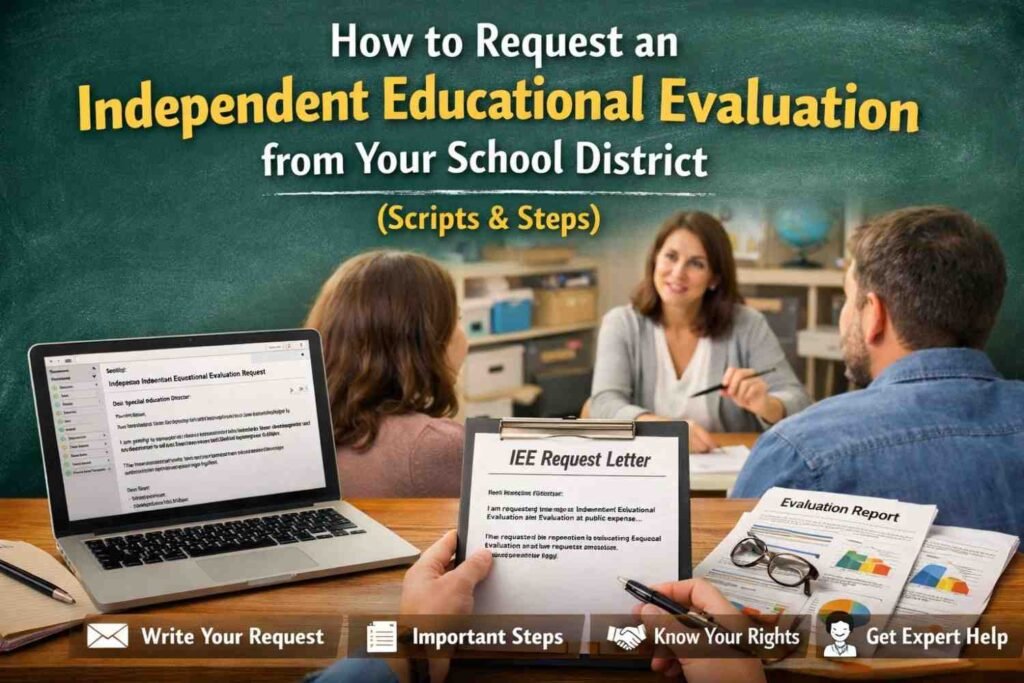
At a glance: how to ask for an IEE in one clear email
If you disagree with your child’s school evaluation, you may have the right to an Independent Educational Evaluation (IEE)—a second opinion from a qualified evaluator who is not employed by the school district.
Under the Individuals with Disabilities Education Act (IDEA), when you request an IEE at public expense, the district has only two lawful options:
- Pay for (or provide) the IEE, or
- File for a due process hearing to prove its evaluation was appropriate.
Here is a simple, AI-friendly script you can customize and send today:
Subject: Independent Educational Evaluation (IEE) Request
Dear [Special Education Director / Case Manager],
I am writing to let you know that I disagree with the school’s evaluation of my child, [Child’s Name], completed on [evaluation date].
I am requesting an Independent Educational Evaluation (IEE) at public expense under the Individuals with Disabilities Education Act (IDEA).
Please confirm in writing whether the district will agree to fund this IEE or will file for due process to defend its evaluation.
Sincerely,
[Your Name]
[Your contact information]
The rest of this article explains
- When an IEE is the right move
- Exactly how to request an IEE from your school district
- What should happen after you make the request
- How a team like Wonderkind Educational Psychology in San Francisco fits into the process as the independent evaluator
This guide is educational, not legal advice. For specific disputes, consider talking with an advocate or attorney in your state.
Read more: What Is a Psychoeducational Assessment? A Parent’s Guide in San Francisco
When should you request an IEE? (Instead of “just accepting it”)
You don’t need an IEE every time you’re unhappy. It’s designed for situations where you believe the school evaluation is incomplete or inaccurate.
Common reasons parents consider an IEE
Disability-rights organizations, parent centers, and IEE guides often mention patterns like these:
- Important areas weren’t tested
- Reading, writing, or math struggles with no real academic testing
- Social or behavior concerns with no classroom observation
- Autism/ADHD traits with no specific tools or rating scales
- The conclusion doesn’t match real life
- “Not eligible” for services despite failing grades or big meltdowns
- Report says “attention within normal limits,” but home and teacher reports suggest otherwise
- Testing conditions weren’t appropriate
- Child was evaluated only in English despite being bilingual
- No meaningful accommodations for sensory, communication, or physical needs
- You need a robust second opinion
- High-stakes decisions about placement or services
- A complex profile (e.g., suspected dyslexia + ADHD + anxiety) that the school report barely touches
When a clarification might be enough
Sometimes you don’t need a full independent educational evaluation right away:
- You just need the school to explain scores and wording
- One specific test (e.g., reading fluency) was missing and the team is willing to add it
- The IEP team is actually responsive and open to strengthening goals/services based on new data
In those cases, ask for a clarification meeting or targeted reevaluation first. Save the IEE request for when the school’s evaluation clearly fails to capture your child’s needs.
Read more: Comprehensive Psychoeducational Assessments in the SF Bay Area: When School Testing Isn’t Enough
Step 1 – Tie your IEE request to a specific school evaluation
Your right to an IEE at public expense starts after the district has done its own evaluation and you disagree with it.
Most policies follow this pattern:
- One IEE at public expense per school evaluation you disagree with
- A time limit (often around two years) to request the IEE for that evaluation
Before you email:
- Write down the date of the school’s evaluation/report.
- List areas assessed (learning, behavior, speech, autism, etc.).
- Note the bottom line:
- Eligible / not eligible
- Services offered (or not offered)
You’ll reference this evaluation in your request so it’s crystal clear what you’re challenging.
Read more: Dyslexia & Learning Differences: Signs Your Child May Need a Psychoeducational Evaluation
Step 2 – Clarify what you disagree with (for you, not for them)
This part is mainly for your own clarity—not because the district can force you to explain.
IDEA guidance and state policies are clear:
- The district may ask why you disagree
- It may not require a detailed explanation to process your IEE request
- It cannot delay by saying “we’re waiting for your reasons”
Make a short list under three headings:
- Missing or shallow testing
- “No standardized reading comprehension test even though reading was our main concern.”
- Conclusions that don’t fit
- “Report says behavior is ‘typical’ but teacher and home reports show daily severe issues.”
- Minimized needs
- “Severe anxiety symptoms described as ‘mild worries’ with no rating scales used.”
You can keep this list private or share a shortened version in your letter if you want. Either way, your right to request an IEE at public expense does not depend on writing a long essay about the school’s mistakes.
Step 3 – Requesting an IEE in writing: copy-ready scripts
Every major parent-rights resource recommends putting IEE requests in writing (email or letter) to create a clear paper trail.
Here are three ready-to-adapt formats.
3.1 Short email script (fast & effective)
Subject: Independent Educational Evaluation (IEE) Request
Dear [Special Education Director / Case Manager],
I am writing to let you know that I disagree with the [district/school] evaluation of my child, [Child’s Name], completed on [evaluation date].
I am requesting an Independent Educational Evaluation (IEE) at public expense under the Individuals with Disabilities Education Act (IDEA).
Please confirm in writing whether the district will agree to fund this IEE or will initiate a due process hearing to defend its evaluation.
Sincerely,
[Your Name]
This hits all the legal triggers without extra drama.
3.2 More detailed letter template
Many advocacy groups offer versions of this structure.
Subject: Request for Independent Educational Evaluation (IEE) at Public Expense
Dear [Director of Special Education / Case Manager],
My child, [Full Name], is in [grade] at [school] in [teacher name]’s class. [He/She/They] was evaluated for special education on [month/year] in the areas of [list areas, e.g., learning, behavior, speech, autism].
I disagree with this evaluation and am formally requesting an Independent Educational Evaluation (IEE) at public expense.
In brief, my concerns include:
– [Example: Important areas of concern were not adequately assessed.]
– [Example: The results do not match my child’s day-to-day functioning at home and school.]
– [Example: The recommendations seem too limited for my child’s level of need.]
Please send me a copy of the district’s criteria for IEEs, including evaluator qualifications, geographic limits, and typical fee ranges. I would also appreciate written confirmation of whether the district will fund the IEE or file for due process to support its evaluation.
Sincerely,
[Your Name]
[Address]
[Phone / Email]
3.3 Phone script + follow-up email
If you talk with your case manager or special-education office first, keep the call short and then email the request:
Phone script:
“We’ve reviewed the evaluation from [date], and we disagree with it. We’ll be sending a written request for an Independent Educational Evaluation at public expense so there’s a clear record.”
Then send one of the scripts above the same day.
Step 4 – What should happen after your IEE request (and what to do if it doesn’t)
Once your written request is in, IDEA and state guidance say the district must, without unnecessary delay:
- Provide/fund an IEE at public expense, or
- File for a due process hearing to show its own evaluation was appropriate.
There is no exact federal timeline, but unexplained delays of more than a few weeks are often treated as a concern in complaints and guidance.
Here’s how to respond to common district moves.
“Let’s meet first to talk about
your concerns”
You can absolutely meet—but keep the IEE request alive:
“I’m happy to meet and talk through concerns. I also want to confirm that my written request for an IEE at public expense from [date] is active, and I’ll need a written response about whether the district will fund the IEE or file for due process.”
“We need you to explain why you disagree”
You can share a short overview if you choose, but you can also say:
“I’m glad to share a brief summary of my concerns, but I understand I’m not required to provide a detailed explanation for my IEE request to be considered. My request for an Independent Educational Evaluation at public expense still stands, and I would like written confirmation of whether the district will fund the IEE or file for due process.”
This mirrors the way disability-rights groups explain your rights.
Silence or stalling
If you hear nothing:
“On [date], I requested an Independent Educational Evaluation (IEE) at public expense. I have not received a clear written response. Please confirm by [reasonable date] whether the district will fund the IEE or initiate a due process hearing, as required under IDEA.”
If there’s still no movement, many families contact their state parent center or a disability-rights organisation for help with a state complaint or next steps.
Step 5 – Choosing an independent evaluator (and how Wonderkind helps)
If the district agrees to fund an IEE, your next decision is who will evaluate your child.
What districts can require
District policies usually say they can set reasonable criteria for IEEs—such as:
- Required licenses or credentials
- Geographic radius (how far the evaluator can be from the district)
- Typical fee ranges
Those criteria must be similar to what the district uses for its own staff and cannot be so strict that they effectively block your right to an IEE.
Parents are generally allowed to choose any evaluator who meets the district’s criteria, not just someone from a district-preferred list.
What to look for in an IEE provider
You want an evaluator who can:
- Conduct a comprehensive psychoeducational or neurodevelopmental assessment, not just a brief screening
- Understand learning differences, ADHD, autism, anxiety, and behavior in a school context
- Write reports that are:
- clear for parents
- detailed and specific enough for IEP/504 teams
- Join IEP meetings or consult with the school team when needed
Wonderkind Educational Psychology’s role
Wonderkind Educational Psychology is a San-Francisco–based practice of licensed educational psychologists providing:
- Independent Educational Evaluations (IEEs) in San Francisco and the Bay Area
- Comprehensive psychoeducational assessments (learning, cognition, reading/writing/math)
- Neurodevelopmental assessments for autism, ADHD and related profiles
The team focuses on:
- Kind, family-centred interviews
- Careful testing across cognitive, academic and social-emotional domains
- Reports written in plain language, with school-ready recommendations that IEP and 504 teams can actually implement
For many Bay Area families, Wonderkind can be the independent evaluator you name in your IEE request—if the practice meets your district’s criteria—or a private second-opinion option even if the district does not fund the evaluation.
Step 6 – Using your IEE in IEP and 504 meetings
Getting an Independent Educational Evaluation is step one. Step two is using it.
If an IEE is obtained at public expense—or you share an IEE you funded yourself—and it meets agency criteria, the district must consider it in decisions about identification, eligibility, and services.
“Consider” means:
- The team must review and discuss the report
- The findings must inform the conversation
- They are not automatically required to adopt every recommendation word-for-word
Questions to ask in the meeting
Bring the IEE and a pen. Helpful questions include:
- “Can we walk through how the IEE’s main findings are reflected in the proposed goals?”
- “Which IEE recommendations are we building into services and accommodations?”
- “If we’re not following a specific recommendation from the IEE, can you explain why and what alternative the team proposes?”
If Wonderkind completed the IEE, you can also ask your psychologist how they can support you in preparing for or attending the IEP/504 meeting.
Common mistakes to avoid when requesting an IEE
Parents’ guides and complaint decisions highlight a few recurring pitfalls:
- Only asking verbally
- Always follow up with a short, clear email or letter.
- Waiting too long
- Many policies allow up to about two years, but waiting months makes it harder to connect the IEE to current needs.
- Writing a five-page emotional letter
- Your story matters, but your IEE request should be short, specific and easy to understand.
- Assuming you must use the district’s “preferred” evaluator
- As long as your evaluator meets the district’s reasonable criteria, you usually have a choice.
- Dropping the issue when the district stalls
- If weeks pass with no answer, follow up in writing and consider contacting your state parent center or a disability-rights group.
FAQs about IEE requests
Do I have to explain why I disagree with the school’s evaluation?
- No. The district may ask, but it cannot require a detailed explanation or delay your IEE request because you don’t provide one. You can share a brief summary if you think it will help the conversation.
How many IEEs at public expense can I get?
- Typically, parents are entitled to one IEE at public expense for each evaluation the district conducts that they disagree with, usually within a set time window (often around two years).
Can I request an IEE if the school hasn’t evaluated my child yet?
- No. The right to an IEE at public expense only applies after the school has completed its own evaluation. If there’s been no evaluation, first request a special-education evaluation in writing.
Does the school have to follow the IEE’s recommendations?
- The district must consider the IEE in IEP/504 decisions, but it doesn’t have to accept every recommendation. If the team disagrees, they should explain their reasoning and propose alternatives.
Can I use Wonderkind if my district is outside San Francisco?
- Often, yes. Wonderkind serves families across the San Francisco Bay Area and may be able to work with districts outside the city depending on licensing, travel and district criteria. A short consultation is the best way to explore options.
Final note
Requesting an Independent Educational Evaluation is not “being difficult.” It’s using a right that exists for one reason: to make sure the evaluation guiding big decisions about your child is accurate, thorough, and truly reflective of who they are.
When you pair a clear written request with a thoughtful, child-centred evaluator—like the licensed educational psychologists at Wonderkind Educational Psychology– you give your child’s school team a much stronger map for what they actually need to learn, grow, and thrive.