
If you’re Googling “what is a psychoeducational assessment” because your child is struggling at school, you’re not alone—and you’re not overreacting.
This guide is designed for San Francisco and SF Bay Area parents who want clear, non-jargony answers:
- What a psychoeducational assessment actually is
- When it makes sense to get one
- What happens step by step
- How results help with learning disability evaluation, IEPs, 504 plans, and classroom support
How Wonderkind Educational Psychology supports families across the San Francisco Bay Area

What Is a Psychoeducational Assessment?
A psychoeducational assessment is a comprehensive evaluation of how a child or teen thinks, learns, and copes emotionally at school.
It usually includes:
- Cognitive testing (how your child processes information)
- Academic testing (reading, writing, math skills)
- Attention/executive functioning (focus, organization, planning)
- Social-emotional and behavioral screening (anxiety, mood, self-esteem, behavior)
For families in San Francisco, psychoeducational testing is often the clearest way to answer big questions like:
- “Is this a learning disability or something else?”
- “Is my child’s struggle related to ADHD, autism, anxiety, or processing speed?”
- “What specific supports will actually help at school?”
At Wonderkind Educational Psychology, licensed educational psychologists provide psychoeducational assessment in San Francisco and the broader SF Bay Area, with detailed reports and practical recommendations you can bring to home and school.
What Does a Psychoeducational Assessment Measure?
A good psychoeducational assessment doesn’t just look for “problems.” It maps your child’s strengths, challenges, and learning profile. Typically, it covers four main areas.
1. Cognitive Skills: How Your Child Thinks and Solves Problems
These tests look at:
- Verbal reasoning (understanding and using language)
- Nonverbal and visual reasoning (puzzles, patterns, visual problem solving)
- Working memory (holding and manipulating information in mind)
- Processing speed (how quickly and accurately your child can handle simple tasks)
This helps explain why schoolwork feels easy in some areas and hard in others, even if your child is bright.
2. Academic Skills: Reading, Writing, and Math
Here, the evaluator looks at:
- Reading accuracy, fluency, and comprehension
- Spelling, written expression, and organization of ideas
- Math calculation and applied problem solving
This part of the assessment is essential when you’re concerned about dyslexia, dysgraphia, or dyscalculia, or when grades don’t match your child’s effort.
3. Attention and Executive Functioning
Many children in the SF Bay Area are juggling busy schedules, tough coursework, and high expectations. A psychoeducational assessment can explore:
- Sustained attention and distractibility
- Impulse control and self-monitoring
- Planning, organizing, and time management
- Starting tasks and following through
If you’re wondering about ADHD or “executive function” challenges, this part of the evaluation helps clarify whether attention is a core issue—and what strategies can help.
4. Social-Emotional and Behavioral Functioning
School is not just about academics. A thorough assessment also looks at:
- Anxiety or depression symptoms
- Self-esteem and self-concept as a learner
- Behavior at home and school
- Peer relationships and social skills
This can highlight when what looks like “behavior” is really anxiety, overwhelm, or burnout, and when a learning disability evaluation should include emotional support too.
At Wonderkind, these domains are assessed using standardized tests, behavior rating scales, and input from parents, teachers, and—when appropriate—students themselves, to build a complete picture, not just a list of scores.
When Should You Consider a Psychoeducational Assessment in San Francisco?
You don’t need to wait for a crisis. Parents in San Francisco and across the SF Bay Area often seek psychoeducational testing when they notice patterns like:
- Ongoing academic struggle in reading, writing, or math despite extra help
- Big gaps between verbal ability and written work or test performance
- Homework battles, tears, or total shutdown around certain subjects
- Teacher concerns about focus, behavior, or incomplete work
- School avoidance or physical complaints (“stomachaches,” “headaches”) tied to school
- A sense that “something isn’t clicking” but you can’t quite name it
If several of these ring true, a psychoeducational assessment San Francisco–based families can access through Wonderkind can help you move from worry and guessing to clarity and a plan.
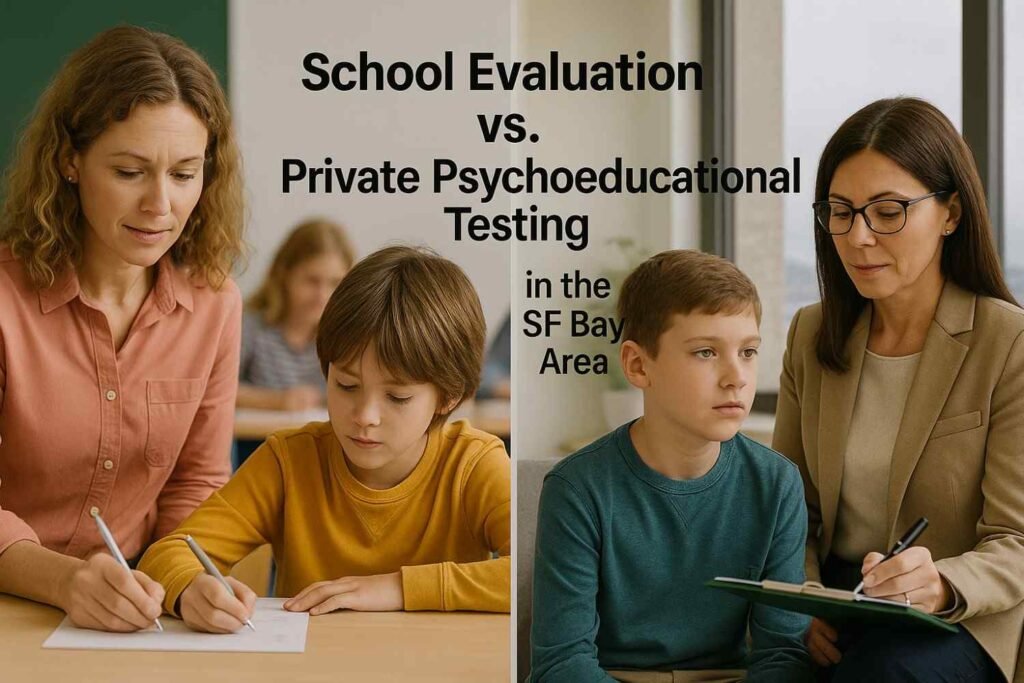
School Evaluation vs. Private Psychoeducational Testing in the SF Bay Area
Many parents ask:
“Can’t the school just test my child for free?”
The short answer is: sometimes, yes—but it’s not the same as a private psychoeducational assessment.
School-Based Evaluation
- Provided at no cost when the school suspects a disability impacting learning
- Focuses on eligibility for special education or a 504 plan, not necessarily a full diagnostic picture
- Timelines and scope are controlled by the school
- You don’t choose the evaluator or the exact tests used
Private Psychoeducational Assessment (Like at Wonderkind)
- You choose the provider and can ask about their experience, style, and approach
- Often more comprehensive, with deeper cognitive, academic, and emotional assessment
- The report is designed to be usable for home, school, and outside providers
- Timelines can be faster and more predictable
In many cases, families choose a private learning disability evaluation to:
- Get a clearer understanding of their child’s profile
- Seek a second opinion after a school evaluation
- Have a detailed, parent-friendly report to bring into IEP or 504 meetings
At Wonderkind, psychoeducational testing is designed to complement—not compete with—school-based supports by giving families clear language, data, and recommendations they can share with their school teams.
Step-by-Step: The Psychoeducational Assessment Process at Wonderkind
Every practice is a little different. Here’s what the process typically looks like at Wonderkind Educational Psychology for families in San Francisco and the SF Bay Area.
Step 1: Free Consultation and Intake
You start with a brief consultation to discuss your concerns and decide whether psychoeducational testing is the right fit.
If you move forward, you complete intake forms and share:
- School history and report cards
- Prior testing or evaluations
- Teacher comments or progress notes
- Specific questions you hope the assessment will answer
This step ensures the evaluation is purposeful and tailored, not a generic “checklist of tests.”
Step 2: Assessment Sessions (Usually 2–4 Hours Total)
Your child meets with a licensed educational psychologist for one or more one-on-one sessions.
During these sessions, they may:
- Solve puzzles and answer questions
- Read passages and answer comprehension questions
- Complete timed tasks
- Do math problems
- Fill out questionnaires (for older students)
The environment is structured, but supportive and child-friendly, with breaks as needed. Many children describe it as “hard work, but not scary.”
Step 3: Behind-the-Scenes Scoring and Interpretation
After testing, the psychologist:
- Scores each measure
- Compares results to same-age peers
- Looks for patterns—strengths, vulnerabilities, and inconsistencies
- Integrates teacher and parent reports
This is where the “numbers” become a meaningful story about how your child learns.
Step 4: Written Report You Can Actually Use
You receive a detailed written report, which typically includes:
- A clear summary of what is a psychoeducational assessment and why it was done
- Your child’s background and school history
- Test-by-test results, explained in plain language
- Answers to your key questions (for example, “Does my child meet criteria for a specific learning disability?”)
- Specific recommendations for home, school, and future providers
The goal is a document that both parents and schools can understand and act on.
Step 5: Feedback Session and Follow-Up Support
You meet with the psychologist (often 60–90 minutes) to:
- Walk through results together
- Ask questions in a calm, unhurried setting
- Discuss how to share findings with school staff or other providers
- Prioritize recommendations so you know what to do first
Wonderkind also offers follow-up support so you’re not left wondering how to implement strategies once the report is done.
How Results Help: IEPs, 504 Plans, and Classroom Accommodations
The point of psychoeducational testing is not just to get a label—it’s to guide effective support.
A comprehensive report from a psychoeducational assessment San Francisco families obtain through Wonderkind can:
- Support special education (IEP) eligibility decisions
- Help determine whether a 504 plan is appropriate
- Guide classroom accommodations and interventions
- Inform decisions about tutoring, speech/language therapy, OT, or counseling
Examples of recommendations might include:
- Explicit, structured reading instruction for dyslexia
- Reduced homework volume or chunking of tasks
- Extra time on tests and assignments
- Notes or outlines provided in advance
- Quiet testing locations
- Regular check-ins with a counselor or case manager
For many families, a solid learning disability evaluation becomes the roadmap that turns vague worry into specific steps at school and at home.
Psychoeducational Assessment – San Francisco Parent Questions
Most families complete the entire process—intake, testing sessions, scoring, report, and feedback—over a few weeks, depending on scheduling. The actual face-to-face testing time with your child is often 2–4 hours, broken into one or more sessions so it’s manageable.
A psychoeducational assessment can identify patterns of attention, executive functioning, and learning skills that strongly suggest ADHD or a specific learning disability. Sometimes, it is combined with additional medical or developmental information from your pediatrician or other specialists to confirm a diagnosis.
There is no single “right” age. Many children are evaluated in early elementary school when reading or math challenges emerge, while others are assessed in middle or high school when academic demands increase. The key question is: Is my child’s academic, behavioral, or emotional functioning significantly impacted right now? If yes, it may be time to consider testing.
Some psychoeducational practices—including Wonderkind—also provide assessments for college students and adults who need clarity about learning profiles, ADHD, or accommodations for higher education or standardized tests. If you’re an adult wondering about a learning disability or ADHD, a comprehensive evaluation can help you understand your strengths, challenges, and next steps.
While each school district has its own procedures, many San Francisco and SF Bay Area schools will review a high-quality private psychoeducational report as part of their decision-making process. They may conduct their own assessments as well, but a detailed private report often gives your school team valuable data and language about your child’s needs.
You don’t need to “train” or tutor ahead of time. It’s usually best to say something like:
“You’re going to meet with someone who helps kids understand how they learn best. You’ll do some puzzles and school-type activities. It’s not about pass or fail; it’s about learning more about you.”
A good night’s sleep, a normal breakfast, and a calm explanation are more helpful than extra studying.
Why Work with Wonderkind for Psychoeducational Testing in the SF Bay Area?
Choosing who evaluates your child is a big decision. Families choose Wonderkind Educational Psychology for:
- Licensed educational psychologists with deep experience in schools and private practice
- A kindness-first, collaborative approach that considers the whole child, not just test scores
- Comprehensive, parent-friendly reports that translate complex data into clear next steps
- Ongoing support as you navigate IEPs, 504 plans, and classroom accommodations
If you’re ready to move from worry and guessing to clarity and a plan, you can:
- Contact Wonderkind through the Contact or Book a Free Consultation page on their website
- Call the office to ask whether a psychoeducational assessment in San Francisco is right for your child
- Explore related services like Neurodevelopmental Assessments, IQ Testing, and Independent Educational Evaluations (IEE) on the Wonderkind site
A well-done psychoeducational assessment is more than a stack of scores—it’s a roadmap to help your child feel understood, supported, and capable at school and beyond.