

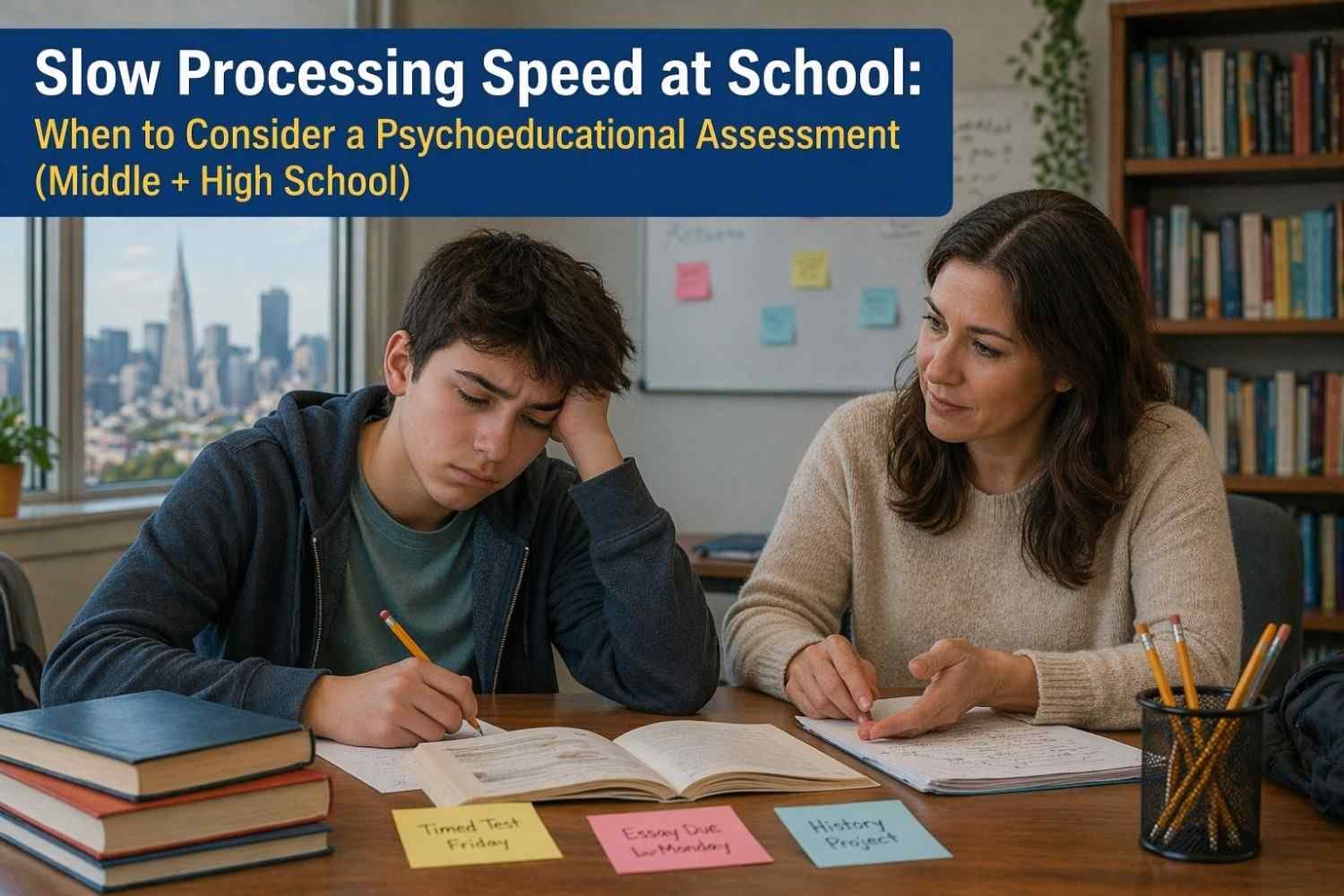
If your middle or high schooler seems to understand the material but can’t finish—tests, essays, homework, or note-taking—slow processing speed may be part of the picture. The key is that “slow” usually shows up as slow output, not low intelligence.
Here’s what to know upfront:
- Slow processing speed often looks like accuracy without completion (they know it, but time runs out).
- It can be a standalone profile or a sign of something else (ADHD/executive function overload, reading fluency strain, anxiety/perfectionism, writing/graphomotor demands, sleep/fatigue).
- Supports typically start with accommodations and output changes. Testing is most useful when you need clarity + school-ready recommendations for a 504/IEP plan.
If you want the “what this includes and how it works” overview first, start here: What Is a Psychoeducational Assessment?
What processing speed is (and what it isn’t)
Processing speed is the pace at which a student can take in simple information, make quick decisions, and produce accurate output—especially under time pressure.
Processing speed is not:
- a measure of motivation
- a measure of creativity
- a measure of “how smart” someone is overall
A student can have strong reasoning and deep understanding while still being slow to:
- write down answers
- copy notes
- complete timed tasks
- finish worksheets, quizzes, or essays in the allotted time
This is why processing speed is often the hidden driver behind the “bright but slow” pattern.
If you want a parent-friendly breakdown of how cognitive areas show up in real life, this related post helps: Understanding Your Child’s IQ Report
What slow processing speed looks like in middle/high school
Middle and high school make processing speed challenges harder to hide because demands ramp up across every subject.
In class
- Copying from the board or slides is slow
- They start tasks late because it takes longer to “get going”
- They need instructions repeated or written down because they’re still finishing the last step
On tests and quizzes
- They know the content but leave items blank
- They do well on untimed tasks, then tank on timed tests
- They spend too long on early questions and can’t finish
Homework and studying
- Homework takes 2–3× longer than peers
- They’re exhausted, irritable, or emotionally flooded after school
- They avoid work because it feels endless
Writing (a very common bottleneck)
- Strong ideas, weak output
- Essays take hours
- Timed writing is disproportionately hard
- They can explain it verbally but can’t get it onto the page quickly
Math (especially in algebra and beyond)
- They understand steps, but multi-step problems take too long
- Errors increase when forced to move quickly
- They lose points from incomplete work, not concept misunderstanding
A pattern to watch: when grades drop mainly because of completion, not understanding, it’s a signal to investigate efficiency barriers.
Don’t mislabel it: what can look like “slow processing speed”
This is where many families lose months: they see slowness and assume the fix is just “more time.” Sometimes it is. Often it isn’t.
1) ADHD / executive functioning overload
Slowness can come from:
- difficulty initiating tasks
- distractibility and “start-stop” effort
- poor planning/organization
- inefficient strategies
If the primary story is focus, follow-through, and organization across settings, you may need a broader neurodevelopmental lens. Start here: Neurodevelopmental Assessments
2) Reading fluency strain (especially in middle/high school)
A teen may read accurately but slowly because decoding/fluency is effortful. In content classes, that becomes a major throughput problem (history/science/English).
If reading volume is the main pain point, the right question is: “Is this a fluency/decoding bottleneck?” That’s where a full academic profile matters most—see Comprehensive Psychoeducational Assessments.
3) Anxiety or perfectionism
Some students are slow because they:
- over-check
- fear mistakes
- freeze on timed tasks
- get stuck “making it perfect” instead of finishing
In those cases, accommodations may help, but the plan often also needs anxiety-aware strategies and pacing supports.
4) Writing/graphomotor load
If handwriting is slow or fatiguing, everything becomes slower: notes, tests, homework, essays. The bottleneck may be output method, not thinking. Often the win is switching from handwriting to typing or speech-to-text and adjusting workload expectations.
5) Sleep, health, or burnout
Chronic fatigue will mimic processing speed issues. If sleep is consistently poor or burnout is severe, address that alongside school supports.
Why this section matters: a psychoeducational evaluation helps distinguish processing speed as a core profile from slowness caused by other drivers.
What helps now: supports you can try before testing
You don’t need to wait for a full evaluation to start reducing harm. Start with supports that protect learning and mental health.
Tier 1: Immediate classroom supports
- Written directions + teacher check-ins (“Here’s step 1; show me when done.”)
- Chunking: fewer problems at a time; break long assignments into sections
- Reduced repetitive work when mastery is clear (quality over quantity)
- Preferential seating to reduce transition time and distractions
- Preview materials (notes/slides ahead of time) so class isn’t a copying race
Tier 2: Output supports (high ROI)
These are often the biggest wins in middle/high school:
- typing instead of handwriting when possible
- speech-to-text for longer writing
- structured writing templates (claim → evidence → explanation)
- teacher-provided outlines or guided notes
Tier 3: Testing supports
- extended time when the task is truly time-bound and speed is the barrier
- reduced-distraction testing location
- breaking a test into sections (shorter sprints)
Important: accommodations should reduce barriers without lowering learning expectations. The goal is access—so the work reflects what your student knows.
When to consider a psychoeducational assessment
A psychoeducational evaluation becomes high-value when slowness is persistent, impairing, and confusing.
The 5 decision triggers (middle/high school)
Consider evaluation when:
- Slow output is persistent across classes or across multiple grading periods
- Grades don’t match understanding (especially when accuracy is strong but completion is low)
- Homework time is unsustainable (family life collapses into nightly battles)
- Anxiety/avoidance is rising (school refusal, shutdowns, perfectionism, panic)
- You need formal documentation and recommendations for a 504/IEP plan, especially as demands increase
If you want the service overview for what the evaluation includes, here’s the direct hub: Comprehensive Psychoeducational Assessments
What a psychoeducational assessment includes (and why it helps with slow output)
A strong psychoeducational assessment doesn’t just say “processing speed is low.” It answers:
- Is this primarily a speed/efficiency profile—or is it attention, reading fluency, writing mechanics, anxiety, or executive functioning?
- How does the bottleneck affect real academic tasks: reading volume, writing output, timed tests, note-taking, multi-step math?
- What accommodations and instructional targets are most likely to change outcomes?
Typical components include:
- cognitive profile (including processing efficiency factors like working memory/processing speed)
- academic achievement (reading, writing, math)
- attention/executive functioning measures when relevant
- social-emotional/behavioral screening when relevant
- school-ready recommendations
If you want the plain-language explanation of “what this is,” link parents here: What Is a Psychoeducational Assessment?
Standardized testing and “extended time”: set expectations early
For high schoolers, processing speed questions often show up right before SAT/AP/college admissions pressure.
A practical reality: extended time is not automatic just because a student has a low processing speed score. Most programs look for a clear story of functional impact under timed academic conditions, plus aligned history and supports.
So if your family is thinking “this is for standardized testing,” the better approach is:
- build the school support plan first (504/IEP or consistent accommodations)
- document the functional impact in real settings
- use evaluation results to link needs → supports
This is one reason comprehensive testing (cognitive + academic + functional interpretation) is often more useful than a single “speed score.”
Related reading for families who are new to cognitive profiles: IQ Testing in San Francisco: What an IQ Test Really Measures (and What It Doesn’t)
How to explain slow processing speed to a teen (without making it an identity)
You want your teen to feel understood, not labeled.
Try this script:
- “Your brain may process and produce work more slowly under time pressure.”
- “That doesn’t mean you’re less capable.”
- “We’re going to change the conditions so your work reflects what you know.”
Then reinforce a value shift:
- the goal is learning and progress, not speed trophies
- speed can be supported with tools, time, and smarter workload design
If the school evaluated your child and you disagree
Sometimes families come to this topic because the school is already tested and the results don’t match daily reality. If you believe something was missed, you may want an independent second opinion.
- Step-by-step guide: How to Request an Independent Educational Evaluation from Your School District
If you’re exploring next steps in the Bay Area, here’s the clean routing:
- Comprehensive Psychoeducational Assessments → best fit when slow output affects grades, wellbeing, or school access and you need actionable recommendations
- Neurodevelopmental Assessments → best fit when ADHD/autism/executive functioning profile is central
- Independent Educational Evaluations (IEE) → best fit when you disagree with a district evaluation
- Optional: Assessment Services for K–12 → best fit when school coordination and timeline support are part of what you need
Preparation resource to reduce teen anxiety and improve validity:
If you’re unsure which evaluation pathway fits your student’s pattern, start with a brief consult so you don’t book the wrong type of testing.
FAQ
What is the processing speed in school?
- Processing speed is how quickly and accurately a student can take in simple information, make decisions, and produce output—especially under time pressure. Slow processing speed often shows up as slow work completion, not low understanding.
Does slow processing speed mean low intelligence?
- No. Many students with slow processing speed have strong reasoning and comprehension. The challenge is efficiency and output pace, especially in timed settings or heavy writing demands.
What’s the difference between slow processing speed and ADHD?
- Slow processing speed is about efficiency and output pace. ADHD-related slowness often comes from initiation, sustained attention, distractibility, and inconsistent effort. A psychoeducational or neurodevelopmental evaluation can help clarify which pattern fits.
What are common school signs of slow processing speed in teens?
- Common signs include incomplete timed tests, slow note-taking, homework taking much longer than peers, and strong verbal explanations that don’t match written output—especially in middle/high school when demands increase.
What accommodations help slow processing speed?
- Helpful supports can include extended time when appropriate, reduced repetitive work, written directions, chunked assignments, reduced-distraction testing, guided notes, typing, and speech-to-text for longer writing.
Can dyslexia look like slow processing speed?
- Yes. If reading is slow because decoding/fluency is effortful, it can look like “processing speed” in real life. That’s why achievement testing and reading-specific measures matter when reading volume is a major barrier.
When should we consider a psychoeducational assessment?
- Consider testing when slow output is persistent, grades don’t match understanding, homework time is unsustainable, anxiety/avoidance is rising, or you need documentation and recommendations for a 504/IEP plan.
What does a psychoeducational assessment include?
- It typically includes cognitive testing, academic achievement testing (reading/writing/math), and additional measures like attention/executive functioning or social-emotional factors when relevant—plus school-ready recommendations.
Will a low processing speed score automatically qualify my teen for extended time?
- Not automatically. Standardized testing and school systems often require evidence of functional impact under timed academic conditions and a clear rationale linking the accommodation to that impact.
How do we explain slow processing speed to a teen?
- Frame it as a learning profile: “Your brain may need more time to produce work under pressure.” Emphasize that it’s not a measure of worth or intelligence—and that supports can change the conditions so their work reflects what they know.