

If you’re considering IQ testing in San Francisco, here’s the simplest truth:
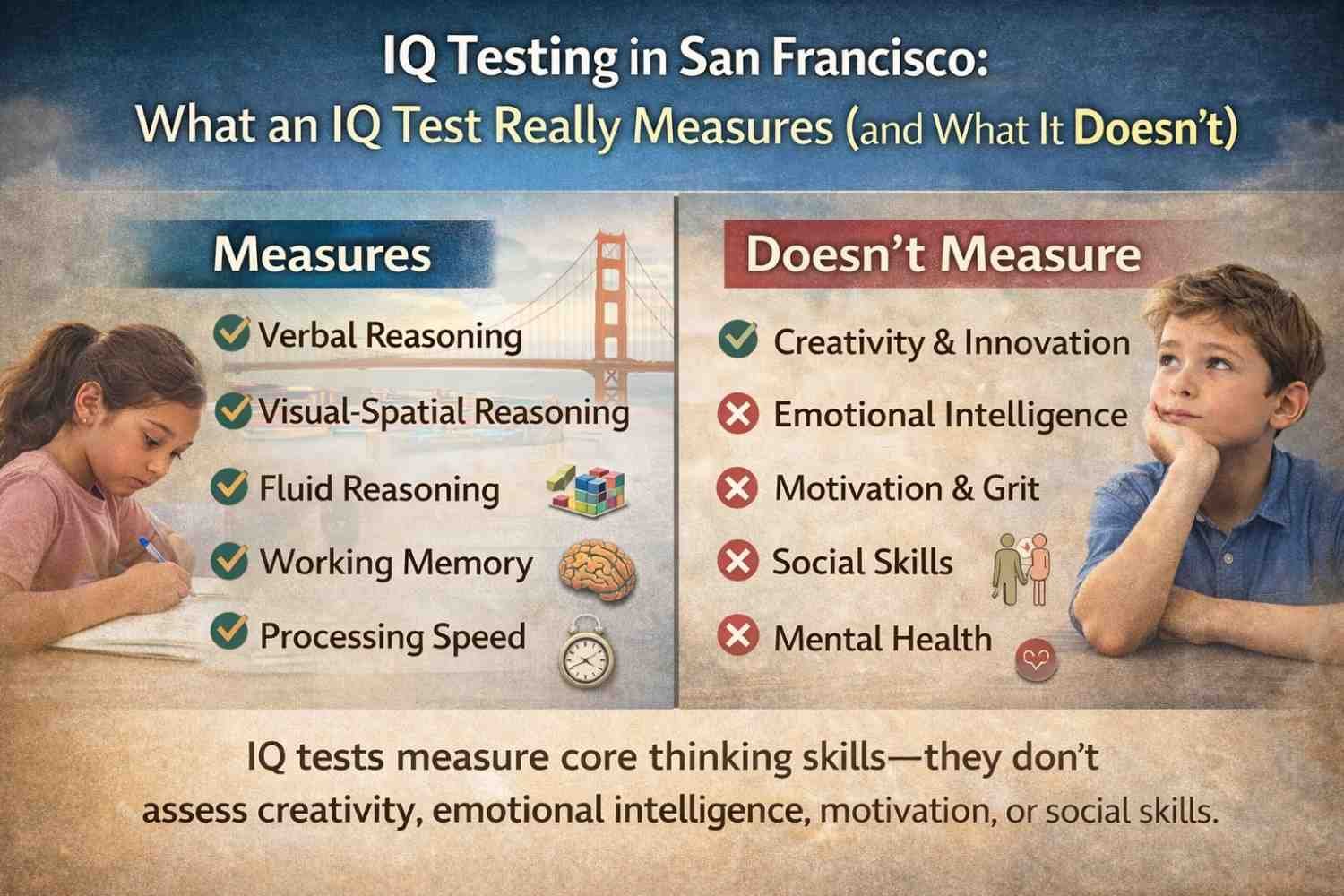
- A modern IQ test measures specific thinking skills—especially verbal reasoning, visual-spatial reasoning, fluid reasoning, working memory, and processing speed.
- It does not directly measure creativity, emotional intelligence, motivation, or social skills—those require different tools and contexts.
- IQ results are most useful when they’re interpreted as a learning profile (strengths + bottlenecks), not a single number that predicts your child’s future.
This guide explains what IQ tests actually measure, why scores sometimes surprise families, and how to use results to make better decisions at school and at home.
Read more: How to Prepare Your Child for a Psychoeducational Assessment
What an IQ score really means (and what “100” is)
An IQ score is a standardized score from a cognitive assessment. “Standardized” means your child is compared to others the same age in a large norm group, and scores are scaled so the population average is typically 100, with most scores falling within about ±15 points.
A key parent mindset shift:
- IQ isn’t a “you are smart / you are not smart” label.
- It’s a snapshot of how a child performed on a specific set of tasks, on a specific day, under specific conditions.
What modern IQ tests actually measure
Most widely used IQ tests today (especially Wechsler scales) are built around several core domains. For children, the WISC-V’s primary index scores come from five areas of cognitive ability: verbal comprehension, visual-spatial, fluid reasoning, working memory, and processing speed.
Below is a parent-friendly map of what those domains are and what they can look like at school.
1) Verbal comprehension
What it measures: Accessing and using word knowledge, verbal reasoning, explaining concepts with language.
School “tells”:
- Strong class discussions, rich vocabulary, great storytelling
- May “sound advanced,” even when written output is messy or slow
2) Visual-spatial reasoning
What it measures: Solving puzzles, understanding visual patterns, building and organizing visual information.
School “tells”:
- Strength in geometry, diagrams, building projects
- May do better with visual instructions than verbal-only explanations
3) Fluid reasoning
What it measures: Solving new problems, pattern detection, reasoning when the task is unfamiliar.
School “tells”:
- Quick “aha!” moments
- Strong math reasoning or logic, even if memorization is weak
4) Working memory
What it measures: Holding and manipulating information in mind—multi-step directions, mental math, keeping track of rules while working.
School “tells”:
- Trouble remembering multi-step instructions
- Losing track mid-problem, forgetting what they were doing
- Big gap between “knows it” and “can show it consistently”
5) Processing speed
What it measures: Speed + accuracy on simple visual tasks under time limits (it’s not “intelligence,” it’s efficiency).
School “tells”:
- Slow handwriting, slow worksheets, slow test completion
- “Underperforms” on timed tasks despite strong reasoning
- Fatigue and frustration during longer written assignments
Why this matters: Two students can have the same Full Scale IQ (FSIQ) but radically different profiles. The profile is what helps you choose supports.
Read more: Dyslexia & Learning Differences: Signs Your Child May Need a Psychoeducational Evaluation
Which IQ tests are used (and why age matters)
Different tests are designed for different ages and developmental stages.
Wonderkind’s IQ testing page lists the primary tools they use:
- WPPSI-IV for preschool-aged children
- WISC-V for ages ~6–16
- WAIS-IV for older teens and adults
- KABC-II as an accommodation option for culturally diverse populations
On the research side, the WISC-V is widely used to assess intellectual functioning and is commonly part of evaluations for giftedness, specific learning disabilities, and sometimes broader batteries related to ADHD/ASD profiles.
- IQ Testing
- Comprehensive psychoeducational assessments
- Neurodevelopmental assessments (when ADHD/autism/executive functioning is central)
Read more: Comprehensive Psychoeducational Assessments in the SF Bay Area: When School Testing Isn’t Enough
What IQ tests do NOT measure (and why families misinterpret scores)
This section is where you build trust and avoid harm.
IQ tests do not directly measure creativity
Creativity is a meaningful human capacity, but even when creativity is part of broad theories of intelligence, standard IQ tests don’t actually measure it well.
Implication: A child can be deeply creative and innovative while scoring average on an IQ test—or score high on IQ tasks and still struggle to generate original ideas.
IQ tests do not directly measure emotional intelligence or social skills
Emotional intelligence (EI) is studied and measured using its own methods and instruments; it’s not the same construct as cognitive ability.
Implication: IQ testing alone won’t tell you whether a child can handle frustration, read social cues, repair conflicts, or manage anxiety. Those need different assessment approaches and often real-world observation.
IQ tests do not measure motivation, grit, or “how hard your child tries”
Even Pearson’s interpretive materials emphasize that a child’s score can be influenced by factors not captured in the report, and interpretation should consider additional sources of information.
Implication: Don’t use IQ scores to tell a child they’re “lazy” or “not trying.” Low output can be driven by anxiety, ADHD, depression, sleep, perfectionism, or learning differences.
Read more: ADHD & Executive Function Assessments: When Attention Struggles Go Beyond “Not Trying”
Why IQ scores sometimes surprise families
Most parent stress around IQ testing comes from one of two surprises:
- “My child is clearly bright—why isn’t the score higher?”
- “My child struggles in school—why is the score high?”
Here are the most common reasons.
1) Test-day and context factors
Even strong tests are still human performance tasks. Scores can be influenced by:
- sleep, illness, hunger
- anxiety, perfectionism
- attention and hyperactivity
- fatigue across tasks
- rapport and comfort with the examiner
The MGH Clay Center notes that IQ tests are built from subtests and have limitations; interpretation matters.
Pearson’s WISC-V interpretive report explicitly notes that scores can be influenced by factors not captured in the report.
2) “FSIQ hides the story” when index scores are far apart
A Full Scale IQ can be less representative when a child has large differences across indices (for example: extremely high reasoning but low processing speed).
To handle this, Wechsler systems include additional interpretive concepts:
- GAI (General Ability Index): an estimate of general intelligence that is less impacted by working memory and processing speed than FSIQ.
- CPI (Cognitive Proficiency Index): an index drawn from working memory and processing speed that reflects cognitive efficiency.
This matters because a child can have:
- High reasoning ability (GAI)
- But lower efficiency (CPI)
…which often shows up as slow output, timed-test struggles, or “I know it but can’t finish.”
3) Language and cultural factors
Even well-designed tests are administered through language and culturally shaped expectations. Interpretation should be careful—especially for multilingual children or culturally diverse families—so the score isn’t treated as a pure measure of “potential.”
Wonderkind explicitly lists KABC-II as an accommodation option for culturally diverse populations, which signals attention to this issue in clinical practice.
Read more: Using an IEE Report in IEP and 504 Meetings: Turning Data into Real Support
When IQ testing is genuinely useful
IQ testing is most helpful when you have a concrete decision to make.
Common high-value use cases
Wonderkind’s IQ page outlines several common reasons families pursue testing: gifted programs, school planning, and private school admissions.
In real terms, IQ testing can help when you’re asking:
- Gifted/enrichment: Is my child ready for advanced placement, and what profile do they have (verbal vs visual reasoning, etc.)?
- Mismatch questions: Why is school performance not matching what we see in conversation and real-world reasoning?
- Admissions: Some private schools request standardized cognitive testing.
- Planning: For teens and adults, cognitive profiles can support educational or career planning.
When IQ testing alone is not enough
IQ testing answers “how does my child reason and process information?” It does not answer “what have they learned?” or “why are they failing math?”
If your primary concern is academic progress, you often need a comprehensive psychoeducational assessment that includes:
- achievement testing (reading, writing, math) alongside cognitive testing
If your primary concern is autism/ADHD/executive functioning, a neurodevelopmental assessment path may fit better.
Internal link suggestions (Wonderkind):
- Comprehensive psychoeducational assessments
- Neurodevelopmental assessments (autism/ADHD/executive functioning)
What the IQ testing experience looks like at Wonderkind
If you want to describe the process in your blog without sounding salesy, mirror Wonderkind’s own structure:
- Pre-test consultation to clarify goals
- 1–2 hour one-on-one testing session
- Comprehensive report explaining index scores and interpretations
- Feedback session focused on how to apply results in real life
That language sets expectations and builds confidence.
Online IQ tests: are they accurate?
Short version: online “IQ tests” can be entertaining, but they aren’t a substitute for standardized, professionally administered assessments.
Mensa’s own U.S. practice test page explicitly says the online practice test will not qualify you for membership and cannot be used as qualifying evidence.
Practical takeaway: If you need results for school placement, admissions, accommodations, or clinical understanding, use a standardized test administered by qualified professionals—not an online quiz.
How to use IQ results for real school support
This is where your blog becomes actionable.
If working memory is weak
Possible supports:
- written directions + visual checklists
- breaking multi-step tasks into short chunks
- reducing working memory load (one instruction at a time)
If processing speed is low
Possible supports:
- extended time for tests or reduced timed output
- fewer repetitive items when mastery is shown
- assistive technology for writing (when appropriate)
If reasoning is high but output is inconsistent
This is common in:
- ADHD/executive function challenges
- anxiety/perfectionism
- learning differences that affect written expression
In these cases, the best next step is often linking cognitive findings to achievement data and executive function support through a broader evaluation pathway.
FAQ
What does an IQ test measure?
- Modern IQ tests measure several core thinking skills, typically including verbal comprehension, visual-spatial reasoning, fluid reasoning, working memory, and processing speed. Different tests and ages emphasize different subtests, but the goal is a structured cognitive profile.
What does an IQ test not measure?
- IQ tests do not directly measure creativity, emotional intelligence, motivation, social skills, or resilience. These are real abilities, but they require different tools and contexts than standard cognitive testing.
What does an IQ score of 100 mean?
- An IQ score is standardized so that the average is typically 100, and most people fall within about 15 points above or below that mean. It reflects performance compared to same-age peers in the test’s norm group.
What’s the difference between IQ testing and a psychoeducational assessment?
- IQ testing measures cognitive processes (how someone thinks). A psychoeducational assessment typically includes IQ testing plus academic achievement testing (reading, writing, math) and often attention/executive function and social-emotional screening to explain school performance.
What age is appropriate for IQ testing?
- It depends on the question and the test. Tools like WPPSI-IV are used for preschool ages, WISC-V for most school-aged children, and WAIS-IV for older teens and adults.
Can anxiety or ADHD affect IQ test results?
- Yes. Scores can be influenced by factors not captured in the score report, including attention, anxiety, fatigue, and language demands. That’s why interpretation should consider context and other information sources.
Are online IQ tests accurate?
- They can be fun, but they aren’t equivalent to standardized, professionally administered testing. Even Mensa’s online practice test states it won’t qualify for membership and can’t be used as official evidence.
What should I bring to an IQ testing appointment?
- Bring any relevant school concerns, previous reports if you have them, and a short list of the decisions you’re trying to make (gifted placement, admissions, learning profile clarity). Make sure your child is rested and fed.