

If you’ve paid for an independent evaluation—or requested an Independent Educational Evaluation (IEE) through your district—your next challenge is rarely “understanding the report.”
It’s getting the school team to turn the data into real supports: goals, services, accommodations, and a plan you can actually monitor.
Under IDEA, when a parent shares an independent evaluation (including an IEE at public expense), the results must be considered by the public agency if the evaluation meets agency criteria in any decision about providing FAPE. That doesn’t mean the school must adopt every recommendation—but it does mean the IEE can’t be ignored.
This guide gives you:
- A “before / during / after” meeting playbook
- A 1-page IEE brief template
- Scripts that force implementation decisions
- A tracker so you can tell whether supports are actually happening
(Educational information only; not legal advice.)
Read more: How to Prepare Your Child for a Psychoeducational Assessment
Quick answer: the 4 moves that change outcomes
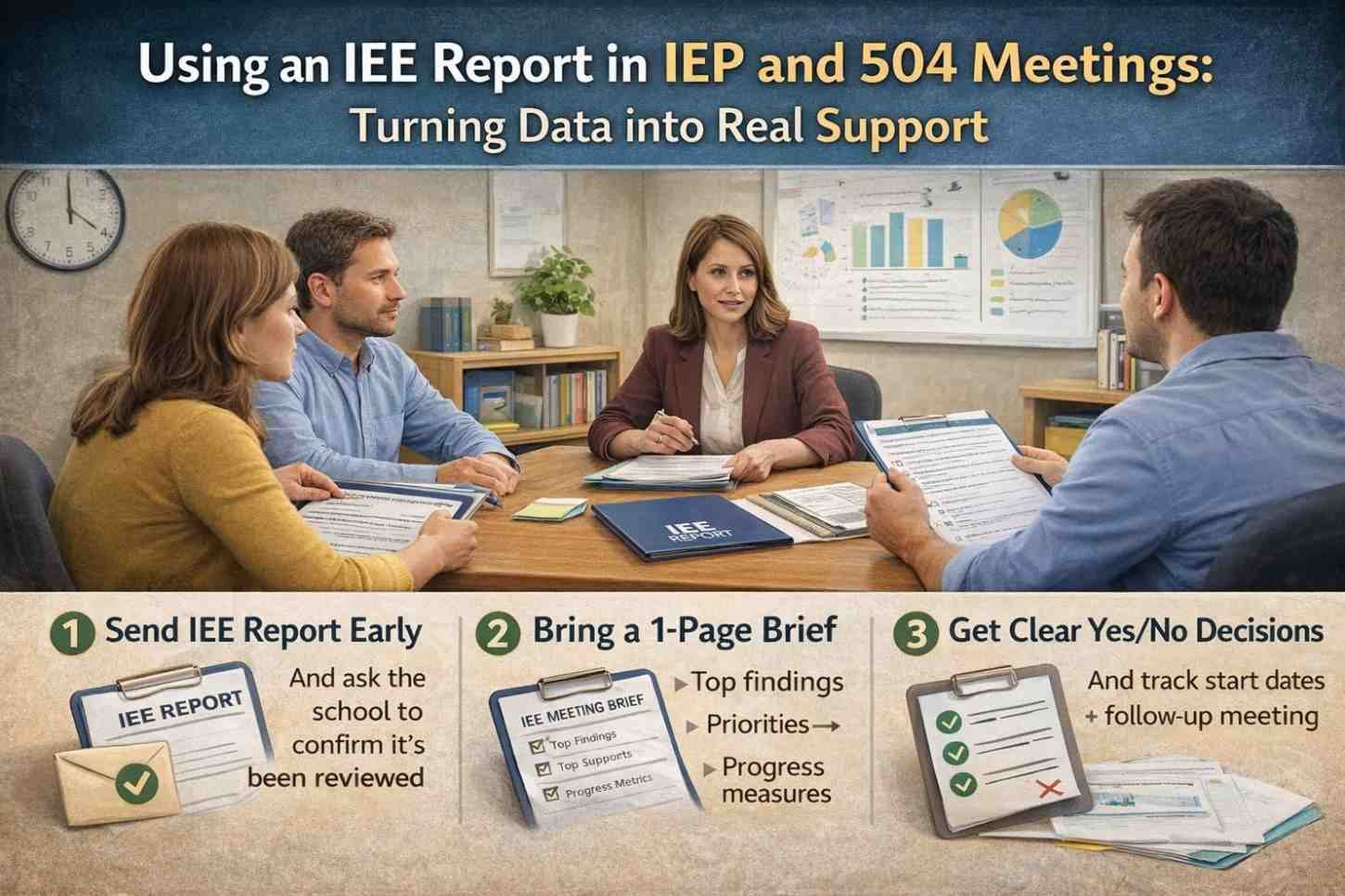
- Send the IEE early and request a meeting specifically to review it.
- Bring a 1-page IEE Meeting Brief: top findings → top supports → success metrics.
- In the meeting, get yes/no decisions on your top priorities and document what the school will do instead if they decline a recommendation.
- Leave with an implementation tracker and a follow-up date (typically 6–8 weeks).
Step 0: Know what “the school must consider it” actually means
Here’s the essential IDEA language in plain English:
- If you obtain an IEE at public expense or share an independent evaluation you paid for privately, the results must be considered by the public agency if it meets agency criteria, in decisions about FAPE.
- “Considered” does not mean “automatically accepted.” Schools can disagree—but they should still review and discuss the evaluation and then make an informed decision.
Practical translation:
Your job isn’t to demand the school “follow the report.” Your job is to make it impossible for the team to avoid these questions:
- Which findings are we treating as real today?
- Which supports are starting now?
- How will we measure whether they work?
Read more: Dyslexia & Learning Differences: Signs Your Child May Need a Psychoeducational Evaluation
IEP vs 504: where an IEE report fits
This article focuses on both meeting types because families often bounce between them.
IEP meeting
An IEP is under IDEA. IEE rules and “must consider” language are directly relevant here.
504 meeting
A 504 plan is under Section 504 (civil rights). The mechanics of an IEE “at public expense” are IDEA-specific, but outside evaluation data can still be strong evidence to support accommodations and school planning. Understood’s guidance on using outside evaluations is especially helpful for this “how do I get the school to use it” situation.
Bottom line: The meeting strategy below works for both: advance sharing + 1-page brief + prioritized supports + measurable follow-through.
Before the meeting: the 48-hour setup that prevents “we need to reconvene”
Many families lose momentum because the report arrives the day of the meeting and the team says, “We haven’t reviewed it.”
1) Request a meeting specifically to review the IEE
Use a short email/letter requesting a meeting to review and revise the plan. Parent Center Hub provides a model letter for requesting an IEP meeting to review/revise the IEP—your request can follow the same structure.
Copy-ready script
Subject: Request for IEP/504 Meeting to Review Independent Evaluation
Dear [Case Manager / 504 Coordinator / Special Ed Director],
I’m requesting an IEP/504 meeting to review and discuss the independent evaluation report for [Child Name] dated [date]. Please schedule sufficient time for the team to review the findings and discuss how they will be reflected in eligibility, accommodations/services, and progress monitoring.
Thank you,
[Your name]
2) Send the report early and ask for confirmation
Understood recommends working with the school to use outside evaluation results—starting with communication and planning, not surprise handoffs.
Practical move: Email the report and ask:
- “Can you confirm the team has received it?”
- “Can you confirm it will be reviewed before our meeting?”
3) Attach a 1-page IEE Meeting Brief
This is the single most important tool in this whole post.
Why it works: IEE reports are long. Schools will cherry-pick one line unless you define what matters.
One-page IEE Meeting Brief template (copy/paste)
A) Top 3 findings (plain English + impact)
- Finding 1: __________ → School impact: __________
- Finding 2: __________ → School impact: __________
- Finding 3: __________ → School impact: __________
- B) Top 5 supports requested (ranked)
- C) What success looks like in 6–8 weeks
- Metric 1: __________ (baseline → target)
- Metric 2: __________ (baseline → target)
- Metric 3: __________ (baseline → target)
4) Pre-wire the agenda
Send a simple agenda in advance:
- Review IEE findings
- Eligibility implications (IEP/504)
- Accommodations/services and start dates
- Progress monitoring plan
- Follow-up meeting date
Read more: Comprehensive Psychoeducational Assessments in the SF Bay Area: When School Testing Isn’t Enough
During the meeting: turn data into decisions
Here’s how meetings fail:
- Everyone “discusses” the report
- Nobody commits to action
- You leave with vague promises
Your job is to convert discussion into decisions.
The 5 questions that force implementation
Use these verbatim:
- “Which IEE findings are we accepting as the team’s working understanding today?”
- “Which three recommendations are we implementing this month, and what are the start dates?”
- “If we’re not implementing a recommendation, what’s the alternative support the school will provide instead?”
- “What data will we track weekly to confirm this is working?”
- “When are we reconvening to review progress and adjust?”
This aligns with the reality that schools must consider IEEs, but don’t have to adopt every recommendation—so you pivot to alternatives and metrics.
The translation table: map findings to supports
This is the “data → support” bridge schools respond to.
Copy this table into your notes (or your 1-page brief). Fill it in before the meeting.
| IEE Finding | Functional impact at school | Support request | Progress metric |
| e.g., slow processing speed | tests incomplete, homework overload | extended time + reduced timed load | % tests completed; time-on-task |
| e.g., decoding/fluency deficit | avoids reading; low comprehension | structured literacy intervention | ORF/fluency probes; reading level |
| e.g., EF/working memory weakness | forgets steps, loses work | checklists + teacher check-in | missing work count; planner accuracy |
| e.g., anxiety/avoidance | school refusal, nurse visits | exposure plan + calm space | attendance; nurse visits; self-rating |
If the team disputes a support, you can ask:
“Which part of this chain do you disagree with—the finding, the impact, or the support?”
What “consideration” should look like on the record
Wrightslaw summarizes the key point many parents miss: the team must consider the IEE, but isn’t required to accept it—so you want to see it discussed and reflected in decisions.
In practice, you want at least one of these outcomes documented:
- The IEP/504 includes new supports aligned to the IEE, or
- The team documents what they will do instead and why
You can calmly ask:
“Can we document how the IEE was considered and how today’s plan reflects its findings?”
After the meeting: lock in implementation (not just paper compliance)
A plan that isn’t implemented is just a document.
1) Ask for the finalized IEP/504 and start dates
Request written confirmation of:
- Services (frequency, provider, start date)
- Accommodations (what, where, who is responsible, start date)
2) Create an implementation tracker
Here’s a simple tracker you can use at home:
Implementation tracker (copy/paste)
- Accommodation/service: ______
- Where it should happen: ______
- Who provides it: ______
- Start date: ______
- Evidence it’s happening (what you’ll see): ______
- Weekly metric: ______
- Review date: ______
3) Set a review date (6–8 weeks)
A short review window forces accountability and prevents “wait until next year.”
You’re not being difficult; you’re building a feedback loop.
Read more: ADHD & Executive Function Assessments: When Attention Struggles Go Beyond “Not Trying”
If the school declines key recommendations: the calm escalation script
Under the IEE rule, the agency must consider the evaluation if it meets criteria. If they decline major supports, respond like this:
Script
“Thank you. Please document how the team considered the IEE findings and the rationale for declining those recommendations. Also please confirm which alternative supports the school will provide instead, and what progress data we’ll review at our next meeting.”
This keeps you in “problem-solving” mode while still protecting your child.
Where Wonderkind fits
Wonderkind Educational Psychology provides Independent Educational Evaluations (IEEs) and writes reports intended to be usable in school decision-making—clear findings, practical recommendations, and collaboration with families and educators.
- Independent Educational Evaluations (IEE)
- Comprehensive Psychoeducational Assessments
- Neurodevelopmental Assessments (Autism & ADHD)
- Assessment Services for K–12 (signals you “speak district”)
If you want this post to convert without sounding salesy, keep the CTA simple:
- “If you’re preparing for an IEP/504 meeting and want help turning an evaluation into a concrete plan, schedule a consultation.”
FAQ
Does the school have to consider an IEE report?
- Yes. If a parent obtains an IEE at public expense or shares an independent evaluation, IDEA says the results must be considered by the public agency—if the evaluation meets agency criteria—in decisions about providing FAPE.
Does “consider” mean the school must follow every recommendation?
- No. Schools must consider the evaluation, but they are not required to adopt every recommendation. If they decline a recommendation, you can ask what supports they will provide instead and how progress will be measured.
What does “meets agency criteria” mean?
- Districts may have criteria for evaluator qualifications, location, and typical fees. If an evaluation meets those criteria, it must be considered in decision-making. Parents can request the district’s criteria in writing.
Should I send the report before the IEP/504 meeting?
- Yes. Sending the report in advance increases the chance the team reviews it and makes decisions in the meeting. It also helps to send a 1-page summary of your priorities to keep discussion focused.
Can an IEE help with a 504 plan?
- Often, yes. While “IEE at public expense” is an IDEA mechanism, outside evaluation data can still support 504 accommodations by documenting functional impact and the need for supports.
What if the team says they need more time to review the report?
- Ask to schedule a follow-up meeting with enough time allocated for IEE discussion, and send a 1-page brief to clarify which findings and recommendations you want addressed first.
How do I request a meeting specifically to review the IEE?
- Request the meeting in writing (email is fine), stating you want to review the independent evaluation and discuss how it will be reflected in eligibility, services, accommodations, and progress monitoring. Model letters exist for requesting IEP review meetings.
Should the independent evaluator attend the IEP/504 meeting?
- It can help, especially when the team has questions about the findings or recommended supports. Whether and how the evaluator participates can depend on district practices and scheduling.
What if the school refuses to discuss the IEE?
- Calmly request written documentation of how the IEE was considered and ask what alternative supports the school will provide instead. IDEA requires consideration of qualifying independent evaluations in FAPE decisions.
What should I bring to the meeting?
- Bring the full report, your 1-page IEE meeting brief, your prioritized list of supports, and a simple tracker for start dates and progress metrics. This keeps the meeting focused and implementation-oriented