
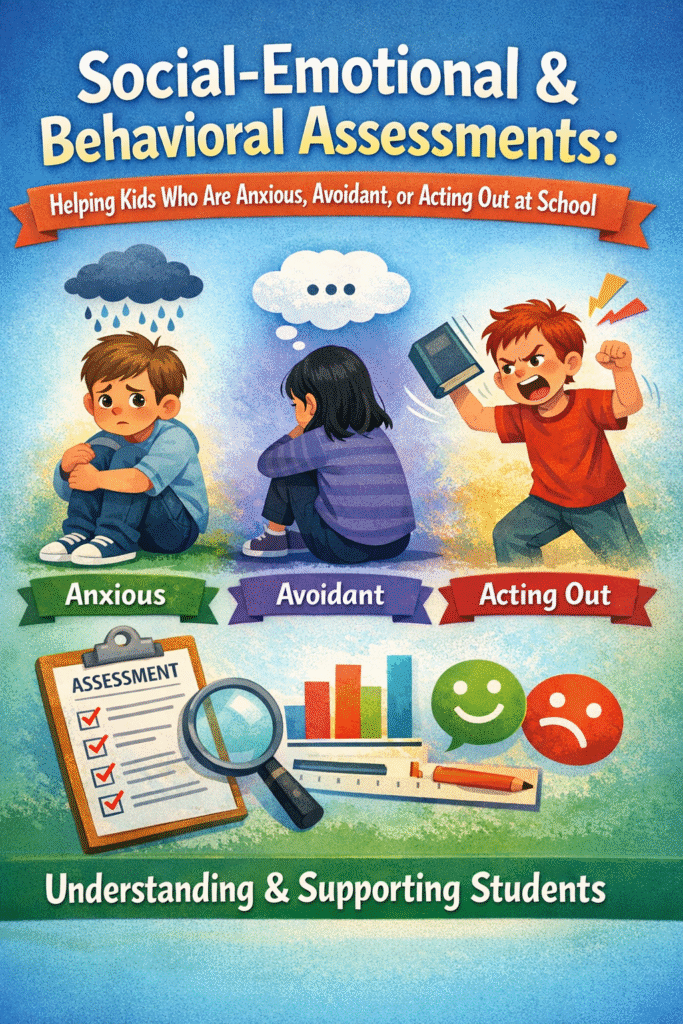
When a child is anxious, shutting down, or acting out at school, adults usually see the behaviour first:
- “She cries every morning before school.”
- “He says he doesn’t care and refuses to do anything.”
- “They’re constantly in trouble for talking back or disrupting the class.”
What’s less visible is why it’s happening.
A social-emotional and behavioral (SEB) assessment is a structured way to answer that “why.” Instead of guessing, you get a clear picture of:
- What your child is feeling and experiencing internally
- How those emotions show up as anxiety, avoidance, or acting out
- Which skills are missing vs which environments are overwhelming
- What schools and families can do differently tomorrow
At Wonderkind Educational Psychology in San Francisco, social-emotional and behavioral questions are usually addressed as part of:
- Comprehensive psychoeducational assessments (learning + attention + emotions + behaviour), and
- Neurodevelopmental assessments (autism, ADHD, executive functioning + social-emotional profile)
This article walks through what SEB assessments are, how they help kids who are anxious, avoidant, or acting out, and when it might make sense to seek this kind of support for your child.
Read more: What Is a Psychoeducational Assessment? A Parent’s Guide in San Francisco
What is a social-emotional & behavioral assessment?
A social-emotional & behavioral assessment is a systematic evaluation of how a child or teen:
- Manages emotions (worry, sadness, anger, frustration)
- Relates to peers and adults
- Copes with stress and transitions
- Behaves in structured settings like classrooms and unstructured settings like recess or home
It’s not just “talking about feelings.” A good SEB assessment combines:
- Interviews with parents/caregivers (and sometimes students)
- Teacher input and school records
- Standardized questionnaires and rating scales
- Observations in clinic or school settings
- Often, a cognitive and learning lens, so behaviour is understood in context (for example, anxiety because reading is hard, or acting out because attention is overloaded)
The point is not to slap a label on a child or blame families. The goal is to understand the pattern well enough that school and home can respond with the right support instead of generic consequences or advice to “just try harder.”
Read more: Comprehensive Psychoeducational Assessments in the SF Bay Area: When School Testing Isn’t Enough
Three common school patterns: anxious, avoidant, and acting out
Every child is different, but many struggling students fall (at least partly) into one of these patterns.
1. The anxious student
You might notice:
- Frequent stomach aches or headaches on school mornings
- Tears or panic before tests, presentations, or social situations
- Perfectionism and fear of making mistakes
- Clinging to adults, avoiding new activities, or constantly seeking reassurance
On paper, anxious students can look “fine” or even high-achieving, but inside they’re running at 120% effort just to keep it together. Eventually, that shows up as burnout, school refusal, or growing depression.
An SEB assessment helps clarify:
- Is this generalised anxiety, social anxiety, separation anxiety, perfectionism, or something else?
- Are there specific school triggers (presentations, group work, transitions)?
- How much is personality and how much is impairing, treatable anxiety?
2. The avoidant or shut-down student
You might see:
- School refusal, frequent absences, late arrivals
- Shrugging, “I don’t care,” or total disengagement from work
- Incomplete assignments, missing homework, lots of zeros
- Zoning out in class and doing the bare minimum to slide by
On the surface, this can look like apathy or laziness. Underneath, it’s often:
- Fear of failing or looking “stupid”
- Overwhelm from learning differences or executive function challenges
- Depression, burnout, or feeling unsafe in the school environment
A social-emotional and behavioral assessment helps separate:
- “Can’t do this yet” from
- “Won’t do this at all”,
so adults can respond with scaffolding and support instead of only consequences.
3. The acting-out student
You might be hearing:
- “They’re defiant.”
- “They’re always in trouble.”
- “They can’t sit still / won’t stop talking / keep arguing.”
Behaviours might include:
- Talking back, refusing to follow directions, getting into power struggles
- Frequent office referrals, detentions, or suspensions
- Physical or verbal disputes with peers
- “Clowning around” to get laughs or attention
Acting out can be driven by poor choices, but often it’s a mix of:
- ADHD and executive function challenges (impulsivity, low frustration tolerance)
- Skills gaps in social problem-solving
- Trauma, anxiety, or depression showing up as irritability, anger, or control-seeking
- Mismatch between student needs and classroom structure
A good SEB assessment helps everyone see that behaviour is communication. The child isn’t the “problem”; the behaviour is a signal that something isn’t working.
Read more: Dyslexia & Learning Differences: Signs Your Child May Need a Psychoeducational Evaluation
What happens during a social-emotional & behavioral assessment?
Exact steps vary by clinic, but here’s what most families can expect with a comprehensive approach like Wonderkind’s.
1. Intake: listening to the full story
The process usually starts with a detailed parent/caregiver interview. You’ll talk through:
- Pregnancy, birth, and early development
- Temperament and milestones
- Social relationships and play
- Mental health history in the family
- School history – academic performance, friendships, behaviour reports
- What you’ve already tried (therapy, accommodations, behaviour plans, etc.)
This conversation sets the context. It stops the assessment from being “one morning’s behaviour” and instead builds a timeline of what’s been going on over months and years.
2. Getting input from school
Because so much of the concern is at school, SEB assessments almost always incorporate school data, such as:
- Teacher questionnaires and narrative comments
- Report cards and progress reports
- Attendance data, discipline records, existing IEP/504 plans
- In some cases, direct classroom observations or communication with the school psych/counselor
This is crucial, because many kids present very differently at home vs at school. A child who explodes at home may stay tightly controlled at school; another may hold it together at home and fall apart in the classroom. The assessment needs both versions of the story.
3. Standardized SEB questionnaires
Parents, teachers, and (for older students) the students themselves may complete standardized rating scales that measure:
- Symptoms of anxiety, depression, and related mood issues
- Behaviour patterns (defiance, aggression, rule-breaking, withdrawal)
- Social skills and peer relationships
- Attention, impulse control, and emotional regulation
- Executive functioning (planning, organization, flexibility)
These don’t replace professional judgment, but they help compare your child’s behaviour to typical patterns for their age and identify areas that are significantly elevated.
4. Observation and student interview
The clinician will often:
- Talk directly with the child or teen about school, friends, stress, and strengths
- Observe how they communicate, play, think, and handle mild frustration in-session
- Sometimes, collaborate with school staff for a classroom observation
The goal is to hear the student’s voice:
- How do they understand the problem?
- What do they say helps or makes things worse?
- How do they describe teachers, peers, and school expectations?
This avoids writing a report that only reflects adult perspectives.
5. Cognitive and learning lens (when appropriate)
Many social-emotional and behavioral assessments are intertwined with:
- Cognitive testing – to understand reasoning, memory, processing speed, and problem-solving
- Academic testing – to see whether reading, writing, or math difficulties are driving school stress and behaviour
This is where a comprehensive psychoeducational assessment becomes especially helpful. A child who is “acting out” in reading group may actually be hiding significant reading difficulties. A teen who is “lazy” with homework may be overwhelmed by undiagnosed ADHD or slow processing speed.
Understanding the whole profile prevents adults from treating a skill problem as a motivation problem.
6. Integration, diagnosis (when relevant), and feedback
After gathering all of this, the psychologist:
- Looks for patterns across home, school, questionnaires, and testing
- Determines whether criteria are met for conditions like anxiety disorders, depression, ADHD, autism, or disruptive behaviour disorders
- Identifies strengths — social, cognitive, creative, or leadership skills that can be built on
- Writes a clear, jargon-reduced report and schedules a feedback session
The feedback session should leave you with:
- A plain-language explanation of what’s going on
- A better understanding of your child’s internal experience
- A roadmap for school supports and home strategies
You’re not left alone to “figure it out” from a packet of scores.
Read more: What Is a Neurodevelopmental Assessment? ASD, ADHD & More Explained for Families
How SEB assessments support school teams
From discipline to data-driven support
Schools are increasingly expected to support mental health and behaviour, not just academics. But teachers and administrators need good information.
A social-emotional and behavioral assessment gives schools:
- Evidence that behaviour is linked to specific emotional or skill-based needs
- Clarity about whether supports should be academic, social-emotional, behavioural, or all three
- Guidance on which Tier 2/Tier 3 interventions (in an MTSS framework) are most likely to help
Supporting IEPs, 504 Plans, and behaviour plans
Assessment findings can inform:
- IEPs (when behaviour or emotional needs significantly affect learning)
- 504 Plans (for accommodations tied to anxiety, ADHD, or other mental health conditions)
- Behaviour Intervention Plans (BIPs) for students with frequent incidents
Recommendations might include:
- Quiet or reduced-stimulation test environments for anxious students
- Gradual exposure to feared tasks (like presentations) with support
- Check-in/check-out systems or mentoring for avoidant/withdrawn students
- Structured movement breaks, visual schedules, and positive reinforcement systems for acting-out students
- Referrals for school-based counseling or social skills groups
Because Wonderkind’s reports are written with educators in mind, they can be handed straight into IEP/504 meetings as a road map rather than a mystery.
Read more: ADHD & Executive Function Assessments: When Attention Struggles Go Beyond “Not Trying”
How SEB assessments support families at home
Rewriting the story
Many parents come into the process feeling:
- Guilty (“What did we do wrong?”)
- Defensive (“The school only sees one side of them.”)
- Exhausted (“We’ve tried everything.”)
A good social-emotional and behavioral assessment can shift the story from:
“My child is the problem.”
to:
“My child has a problem that we can understand and support.”
That alone changes how families relate to their child and to each other.
Practical strategies you can actually use
Assessment feedback should include home strategies such as:
- Predictable routines for mornings, homework, and bedtime
- Visual supports (calendars, checklists, “if–then” options)
- Ways to respond to anxiety that reduce avoidance instead of strengthening it
- Language for de-escalating conflicts and validating emotions without reinforcing unhelpful behaviour
- Ideas for coordinating with school so everyone is on the same page
Families often report that, after an assessment, they feel:
- More compassionate toward their child
- More confident in IEP/504 meetings
- More hopeful that things can improve with the right supports
When to consider a social-emotional & behavioral assessment
It might be time to explore an SEB assessment if you’re seeing patterns like:
- Frequent school refusal, somatic complaints, or tears about school
- Sudden or ongoing drop in grades tied to mood or stress
- Multiple suspensions, detentions, or office referrals without real change
- Big discrepancy between how your child behaves at home vs at school
- Teacher or pediatrician repeatedly raising concerns about anxiety, mood, trauma, or behaviour
- A sense that “something deeper is going on” beyond typical developmental bumps
If these issues have lasted for months, are disrupting learning or relationships, and aren’t improving with basic strategies, a structured assessment can help everyone stop guessing.
Where Wonderkind fits for San Francisco families
For families in San Francisco and the wider Bay Area, Wonderkind Educational Psychology focuses on evaluations that bring together:
- Learning,
- Attention and executive functioning, and
- Social-emotional & behavioral functioning
under one roof.
That often looks like:
- Comprehensive Psychoeducational Assessments – when you need to understand how learning, emotions, and behaviour all fit together.
- Neurodevelopmental Assessments – when questions about autism, ADHD, or complex behaviour patterns are front and centre.
- Independent Educational Evaluations (IEEs) – when you disagree with a school evaluation and need a second opinion that schools will take seriously.
The goal isn’t just to name problems. It’s to give you:
- A clearer, kinder story about your child
- A report that actually works in IEP and 504 meetings
- Practical tools for both school and home
FAQs about social-emotional & behavioral assessments
Is a social-emotional & behavioral assessment the same as therapy?
- No. Assessment is about understanding; therapy is about ongoing treatment and skill-building. Many families choose to start or adjust therapy after they have assessment results, because they have a clearer sense of what to focus on.
Can this kind of assessment help with IEP or 504 decisions?
- Yes. SEB assessments often provide the data schools need to determine whether a child qualifies for special education or accommodations, and what types of supports are appropriate. Schools aren’t required to follow every recommendation, but they are expected to consider them.
What if my child behaves well at school but explodes at home (or the opposite)?
- That difference is actually important information. An SEB assessment looks at both environments to understand what’s driving the pattern—stress, masking, sensory overload, perfectionism, or something else—so that support can be tailored.
Do social-emotional & behavioral assessments diagnose anxiety, depression, or trauma?
- They can contribute to those diagnoses when conducted by a qualified psychologist, especially when combined with clinical interviews and standardized tools. In many cases, the evaluation will either provide a diagnosis or a clear description of concerns that can guide further treatment.
How do we prepare our child for this kind of assessment?
- Keep it simple and reassuring. You might say:
- “We’re going to meet someone whose job is to understand how your brain and feelings work at school and at home, so adults know how to help you better.”
Emphasize that it’s not a test you pass or fail. Make sure they are rested, fed, and bring glasses/medications they normally use.
- “We’re going to meet someone whose job is to understand how your brain and feelings work at school and at home, so adults know how to help you better.”
Final thoughts
When a child is anxious, avoidant, or acting out at school, it’s tempting to focus on the behaviour alone. A social-emotional & behavioral assessment zooms out and asks:
- What is this behaviour trying to tell us?
- What is this child feeling and experiencing?
- What skills and supports are missing?
For San Francisco families working with Wonderkind Educational Psychology, the aim is always the same: move from blame and guesswork to clarity, compassion, and a concrete plan — at school and at home.