
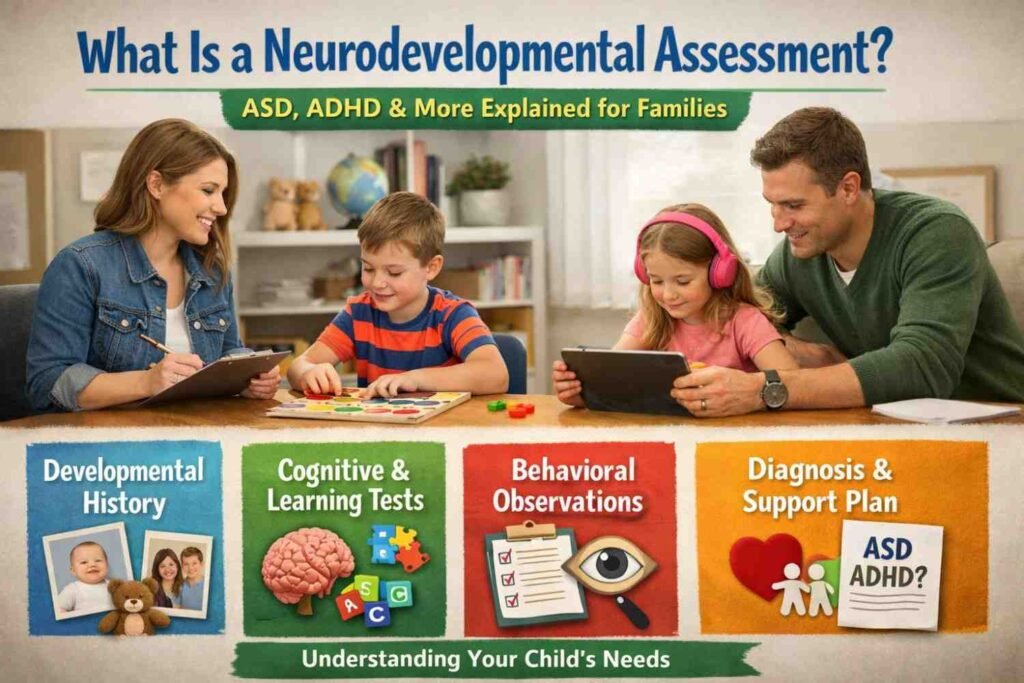
If a teacher, pediatrician, or therapist has recently said, “You might want a neurodevelopmental assessment,” it can feel big and vague at the same time.
- Is this just for autism?
- Does it mean my child “has something wrong” with their brain?
- What actually happens in this kind of evaluation?
This guide is for families asking exactly those questions.
We’ll walk through:
- What a neurodevelopmental assessment actually is
- How it relates to ASD, ADHD, learning differences, and other conditions
- What happens step by step
- How it differs from psychoeducational and neuropsychological testing
- How a good assessment can help you move from worry to a clear plan
- How Wonderkind Educational Psychology supports families in the San Francisco Bay Area
Read more: How to Prepare Your Child for a Psychoeducational Assessment
What Is a Neurodevelopmental Assessment?
A neurodevelopmental assessment is a comprehensive evaluation of how a child’s brain development is affecting their thinking, communication, movement, social skills, behavior, and daily life.
In practical terms, that means:
- Taking a detailed developmental history (early milestones, medical history, family patterns)
- Using standardized tests, observations, and rating scales to look at:
- Learning and problem-solving
- Speech and language
- Motor skills and coordination
- Social communication and play
- Attention, behavior, and emotional regulation
- Pulling everything together to see whether your child meets criteria for conditions like autism spectrum disorder (ASD), ADHD, learning disabilities, or other neurodevelopmental differences
At Wonderkind Educational Psychology, neurodevelopmental assessments are used to understand how variations in brain development may be impacting everyday life—especially in learning, attention, behavior, and social interaction—and to give families a clear, practical roadmap forward.
Read more: Dyslexia & Learning Differences: Signs Your Child May Need a Psychoeducational Evaluation
Which Conditions Can a Neurodevelopmental Assessment Help Identify?
“Neurodevelopmental disorders” is a medical category that covers a range of conditions where brain development affects learning, behavior, and daily functioning. In DSM-5-TR, this includes ASD, ADHD, intellectual and learning disorders, communication disorders, motor disorders, tic disorders, and more.
A neurodevelopmental assessment can help identify or rule out:
Autism Spectrum Disorder (ASD)
- Social communication differences (e.g., difficulty with back-and-forth conversation, reading social cues)
- Differences in play, interests, or routines
- Sensory sensitivities (sound, texture, lights)
Attention-Deficit/Hyperactivity Disorder (ADHD)
- Persistent inattention, distractibility, or forgetfulness
- Hyperactivity or impulsivity
- Executive function challenges (planning, starting tasks, staying organized)
Learning and Intellectual Differences
- Specific learning disorders (e.g., dyslexia, dyscalculia)
- Global developmental delay or intellectual disability
- Uneven profiles where some skills are very strong and others are unexpectedly hard
Other Developmental and Related Conditions
- Speech and language disorders
- Developmental coordination or motor-planning difficulties
- Tic disorders, sensory processing differences, or other complex profiles
Importantly, many children have overlapping profiles (for example, ASD + ADHD + anxiety). Research shows ADHD and autism frequently co-occur—one study notes up to about half of autistic individuals may also meet criteria for ADHD.
A neurodevelopmental assessment looks at the whole picture, not just one label.
Read more: Comprehensive Psychoeducational Assessments in the SF Bay Area: When School Testing Isn’t Enough
Why Might a Family Be Referred for a Neurodevelopmental Assessment?
Most parents don’t wake up one day and think, “Let’s pursue a neurodevelopmental assessment.” It usually follows a pattern of concerns, such as:
- Delays in early milestones: speech, language, motor skills, social engagement
- Big behavior swings or meltdowns that seem more intense than peers
- Chronic attention, focus, or impulse-control challenges at home and school
- School struggles that don’t match effort or apparent intelligence
- Strong sensory sensitivities (sound, textures, clothing, food)
- Feedback from pediatricians, teachers, or preschool staff that something feels “different” and they recommend a closer look
In the San Francisco Bay Area, families often come to Wonderkind when:
- They’ve heard terms like “autism,” “ADHD,” or “executive functioning issues” but don’t have a clear explanation
- They’re on a long waitlist elsewhere and need an evaluation in a more predictable time frame
- Their child’s challenges don’t fit neatly into a single box, and they want a nuanced, strengths-based understanding rather than just a yes/no answer
What Happens During a Neurodevelopmental Assessment? (Step-by-Step)
While every clinic has its own style, most neurodevelopmental assessments follow a similar core structure.
Step 1: Intake and Developmental History
The process usually starts with a parent or caregiver interview:
- Pregnancy and birth history
- Early milestones (sitting, walking, first words)
- Medical history (hearing/vision, illness, sleep, feeding)
- Family history of neurodevelopmental or mental health conditions
- Current concerns at home, school, and in friendships
At Wonderkind, this intake conversation is also where you share your biggest questions:
“Are we looking at autism, ADHD, something else—or just temperament and anxiety?”
That question shapes the evaluation plan.
Step 2: Questionnaires and Rating Scales
Next, parents (and often teachers) complete standardized questionnaires to capture:
- ADHD symptoms
- Autism traits
- Anxiety, mood, and behavior patterns
- Everyday skills (self-care, communication, social skills)
These tools help the clinician see patterns across settings and observers—for example, whether behavior shows up only at school, only at home, or everywhere.
Step 3: Direct Assessment With Your Child
This is the part most people picture when they imagine “testing.”
Depending on age and referral question, it might include:
- Play-based observation (especially for younger children) to see how they communicate, play, and respond socially
- Autism-focused tools (structured interaction tasks, social communication probes) when ASD is a question
- Cognitive and language tests to understand problem-solving, memory, and verbal skills
- Tasks that tap attention and executive functioning (sustained focus, working memory, inhibition)
Assessments are typically split into multiple sessions and include breaks and flexible pacing so kids don’t burn out. Services like Great Ormond Street Hospital and other specialty centers describe multiple sessions combining formal and play-based tasks, with questionnaires sent to home and school, and Wonderkind’s approach is similar in spirit—structured but child-centered.
Step 4: Team Formulation and Diagnostic Decision-Making
After testing, clinicians:
- Score and interpret standardized tools
- Compare findings with developmental history and rating scales
- Look for patterns and inconsistencies
- Consider alternative explanations (sleep, trauma, anxiety, language differences, etc.)
The goal is not to “check a box” as quickly as possible, but to understand why your child functions the way they do and whether they meet criteria for ASD, ADHD, learning disabilities, or other developmental conditions.
Step 5: Feedback Session and Written Report
Finally, you meet with the clinician for a feedback session:
- Clear explanation of what the assessment found
- Whether a diagnosis (or multiple) is supported and what that means in plain language
- Discussion of your child’s strengths and growth areas
- Specific recommendations for:
- School (accommodations, services, communication tips)
- Home (strategies, routines, parenting supports)
- Therapies (speech, OT, behavioral therapy, counseling, etc.)
At Wonderkind, the written report is designed to be usable—for parents, schools, and other providers—rather than something that sits unread in a folder.
Read more: What Is a Psychoeducational Assessment? A Parent’s Guide in San Francisco
How Is a Neurodevelopmental Assessment Different From Other Evaluations?
The terminology can get confusing fast, so here’s a simple comparison.
Neurodevelopmental Assessment
Focuses on how brain development is affecting overall functioning, especially:
- Social communication
- Behavior and self-regulation
- Motor coordination
- Adaptive skills (daily living)
- Core conditions like ASD, ADHD, and global developmental concerns
Psychoeducational Assessment
Focuses more on learning in school, especially:
- Cognitive abilities (reasoning, memory, processing speed)
- Academic skills (reading, writing, math)
- Social-emotional functioning in educational contexts
It’s often used for learning disabilities, IEP/504 planning, and academic accommodations.
Neuropsychological Assessment
Often used in medical or hospital settings to understand the impact of neurological conditions (epilepsy, brain injury, complex medical histories). It may explore additional domains like visual-spatial processing, fine motor speed, and memory systems in detail.
You don’t need to become an expert in the labels. What matters most is:
What question are we trying to answer about my child?
At Wonderkind, families sometimes need primarily a neurodevelopmental assessment (for ASD/ADHD questions), sometimes a psychoeducational assessment, and sometimes a combined approach. Part of the initial conversation is choosing the right tool for the job.
How a Neurodevelopmental Assessment Helps—Beyond Just a Label
A diagnosis can open doors, but a good neurodevelopmental assessment does more than assign a name.
1. Earlier Access to Services and Supports
Research consistently shows that earlier identification and intervention are associated with better outcomes for children with neurodevelopmental conditions, especially ASD and language-related delays.
An assessment can help you access:
- Speech and language therapy
- Occupational therapy (sensory, motor, daily skills)
- Behavioral and parent-coaching programs
- Social skills groups and other supports
2. Better School Planning
With a detailed picture of your child’s profile, it’s easier to:
- Request appropriate school accommodations
- Guide IEP or 504 planning with specific, data-backed needs
- Help teachers understand what’s actually going on (e.g., “not lazy—this is working memory, sensory overload, or language processing”).
3. Clearer Understanding for You and Your Child
A thoughtful neurodevelopmental assessment:
- Reduces self-blame (“This isn’t bad parenting; this is how their brain is wired.”)
- Gives children language to understand themselves (“My brain needs more help staying on one track; that’s ADHD.”)
- Highlights strengths and interests, not just difficulties, which can be used to motivate and support growth
4. A Roadmap, Not a Verdict
Instead of “Your child is autistic/ADHD, good luck,” the goal is:
- “Here’s where they’re thriving.”
- “Here’s what’s getting in their way.”
- “Here’s what we can do—at home, at school, and in therapy—to support them.”
That roadmap evolves as your child grows; the assessment is a starting point, not the final word.
FAQs: Neurodevelopmental Assessment for ASD, ADHD & More
Is a neurodevelopmental assessment only for autism?
- No. Neurodevelopmental assessments are commonly used for autism and ADHD, but also for broader developmental concerns—communication delays, coordination issues, learning difficulties, and complex profiles that don’t fit neatly into one category.
What’s the best age to get a neurodevelopmental assessment?
- There’s no single “perfect” age. Many children are evaluated in preschool or early elementary years when developmental differences or social/behavioral patterns become clear, while others are assessed later as academic and social demands increase. The key question is: Are these concerns significantly affecting daily life right now? If yes, it may be time to consider assessment.
Can one assessment look at ASD, ADHD, and learning issues together?
- Often, yes. Many services—including Wonderkind—design evaluations to look at multiple possibilities at once, because ASD, ADHD, learning differences, and anxiety often overlap. The clinician will clarify which domains will be covered so you know whether additional testing (like a full psychoeducational evaluation) is recommended.
How long does the whole process take?
- Timeframes vary by provider and waiting lists, but the active assessment usually takes multiple sessions for testing and observation, followed by a period of scoring and analysis, and then a feedback meeting. Specialty services describe the process as taking place over “a number of sessions depending on the age and needs of your child,” and Wonderkind’s timing is similar—structured but tailored to your child.
Will my child find the assessment overwhelming?
- Clinics that specialize in neurodevelopmental differences emphasize using child-friendly, play-based tasks, breaks, and pacing to keep assessments manageable.
At Wonderkind, we adjust the length of sessions, build in movement breaks, and work hard to create an environment that feels safe and respectful—not like an exam they can fail.
Why Work With Wonderkind for Neurodevelopmental Assessment?
You have options—hospital clinics, large centers, and private practices. Here’s what sets Wonderkind Educational Psychology apart:
- Specialized focus on neurodevelopmental and psychoeducational assessments for children, teens, and adults in the San Francisco Bay Area
- Licensed educational psychologists with deep experience in schools and private practice, used to collaborating with IEP teams and community providers
- A kindness-first, neurodiversity-affirming approach that sees differences as part of human variation, not defects to be fixed
- Reports written in clear, parent-friendly language with recommendations that teachers, therapists, and families can actually implement
- A process that includes intake, testing, a collaborative report, and a feedback meeting, not just a one-time appointment
If you’re in the San Francisco Bay Area and wondering whether your child might be autistic, ADHD, “twice exceptional,” or simply wired differently from peers, a neurodevelopmental assessment with Wonderkind can help you move from worry and guesswork to clarity and next steps.