
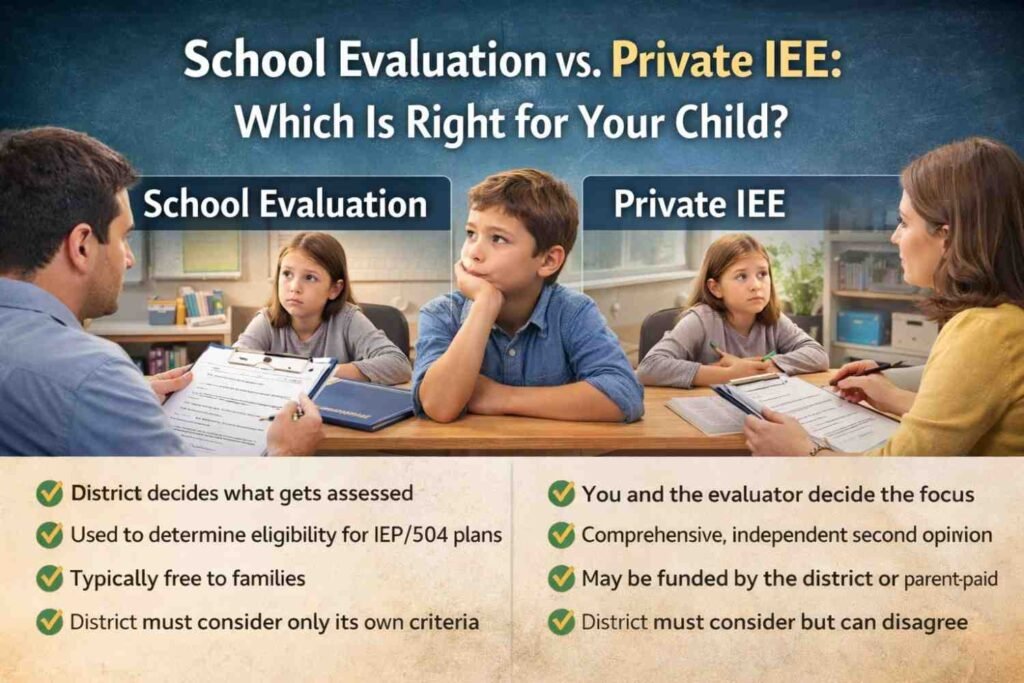
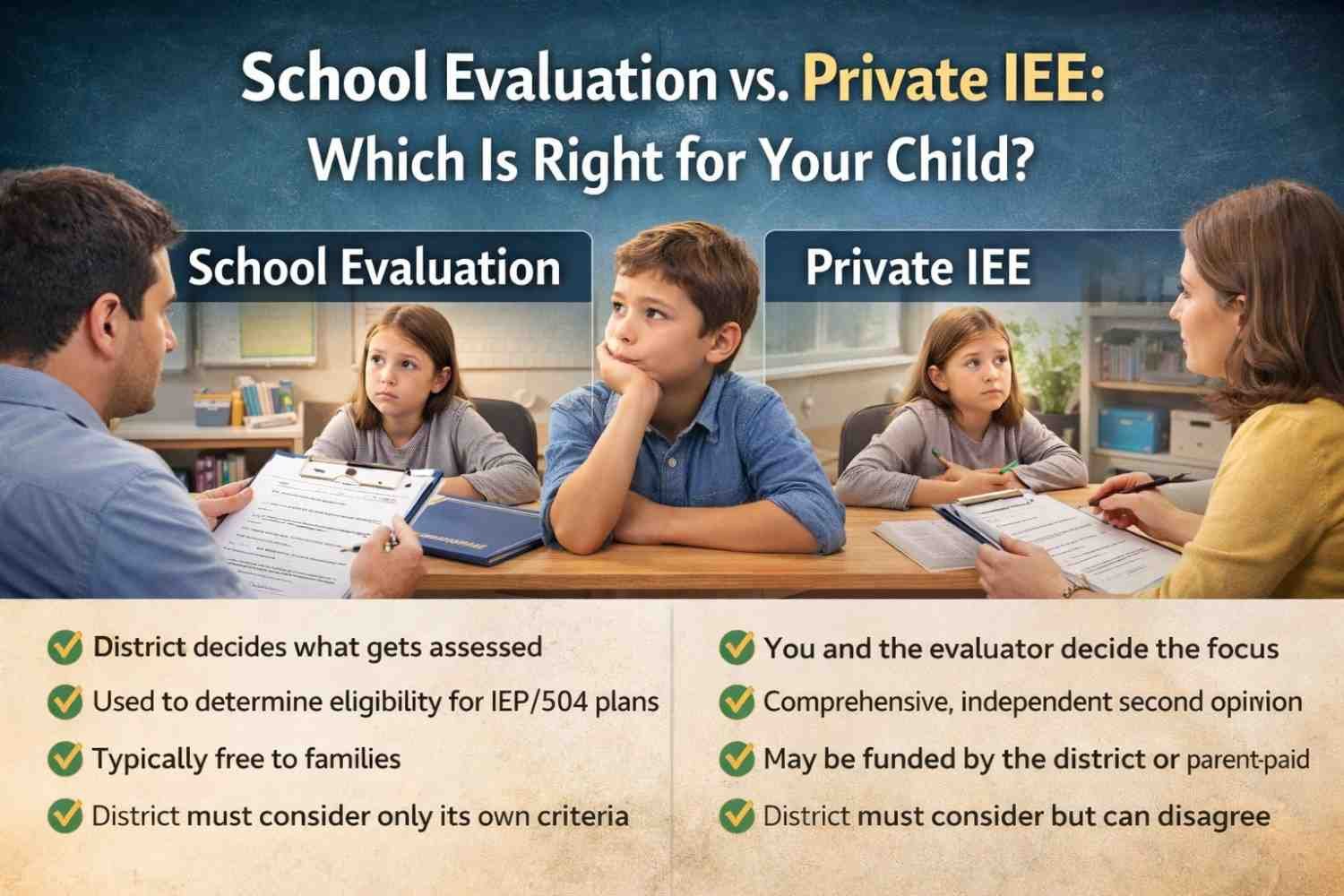
If you’re trying to get your child real support at school, the “right” evaluation depends on what decision you need to change.
- Choose a school evaluation when the goal is IEP/504 eligibility and school-delivered services.
- Choose a private evaluation when you need speed, depth, and control over what gets assessed.
- Choose an IEE at public expense when the school already evaluated your child and you disagree with their results—because that’s the formal “second opinion” pathway.
This guide compares all three routes, gives you a decision framework, and shows how to make the results actually usable in school meetings.
Read more: What Is a Psychoeducational Assessment? A Parent’s Guide in San Francisco
The core difference in one sentence
A school evaluation is built to help the district decide eligibility; a private evaluation is built to answer your questions in depth; an IEE is the structured second-opinion process when you dispute the district’s evaluation.
What each evaluation type is
1) School evaluation
A school evaluation is conducted (or arranged) by your child’s school district to determine whether your child qualifies for an IEP (special education) or a 504 plan (accommodations), and what supports the school believes are educationally necessary.
What parents often miss: school evaluations can be narrower than you expect, because their primary job is eligibility and educational need—not always the full “why is this happening?” picture.
2) Private evaluation
A private evaluation is conducted by an independent clinician or clinic that you choose and pay for (sometimes with partial insurance reimbursement, depending on your plan and the evaluation type).
Why parents choose private:
- You control the referral question (dyslexia? ADHD? Autism? anxiety? twice-exceptional?)
- You control scope and pacing
- You can often move faster than a district timeline
3) Independent Educational Evaluation (IEE)
An IEE is an evaluation by a qualified examiner who is not employed by the school district.
Important distinction:
- “IEE” describes who conducts it (independent from the district).
- “At public expense” describes who pays (the district pays if your request meets the requirements and the district doesn’t prevail in due process).
Read more: Comprehensive Psychoeducational Assessments in the SF Bay Area: When School Testing Isn’t Enough
Quick decision guide (use this before you do anything else)
Choose a school evaluation when…
- You need the school to make an eligibility decision (IEP/504) and start services.
- There hasn’t been a district evaluation yet.
- You want support initiated through school systems and data.
Choose a private evaluation when…
- You need answers quickly and can’t wait for school timelines.
- You want a full profile (learning + attention/executive function + social-emotional + processing).
- You want testing that’s tailored to complex profiles (2e, masked anxiety, “smart but struggling,” etc.).
Choose an IEE (often at public expense) when…
- The school already evaluated your child and you disagree with the results.
- The school’s evaluation missed key areas, minimized concerns, or doesn’t fit what you see at home/school.
- You need a second opinion that has procedural weight in school decision-making.
Read more: Dyslexia & Learning Differences: Signs Your Child May Need a Psychoeducational Evaluation
The comparison that matters (not the marketing version)
| Factor | School evaluation | Private evaluation | IEE (independent) |
| Primary purpose | Eligibility/services decision | Deep understanding + tailored recommendations | Second opinion vs district eval |
| Who controls scope | District | Parent + clinician | Typically parent + clinician (within district criteria if publicly funded) |
| Timeline control | Often slower, procedural | Often faster (varies) | Can be fast or slow depending on district response and criteria |
| Cost | Usually no direct cost | Usually parent-paid | May be district-paid if at public expense |
| Depth | Often eligibility-focused | Often broader + integrated | Often comparable to private depth (varies by provider) |
| School use | Directly drives eligibility | Must be considered, but implementation still requires meetings | Must be considered; may carry extra weight when tied to dispute |
| Best for | Getting school action started | Getting clarity fast + detailed plan | Correcting/increasing accuracy of school decision-making |
The 7 questions that determine the “right” path
Most families waste months because they skip this step.
1) What decision are you trying to change?
Be brutally specific:
- “We need reading support services.”
- “We need testing accommodations.”
- “We need an IEP, not a 504.”
- “We need the school to acknowledge autism/ADHD impact.”
If you can’t name the decision, you’ll end up with a report that’s “interesting” but not actionable.
2) What’s the core domain of concern?
Pick the primary driver:
- Learning/academic (reading, writing, math)
- Attention/executive functioning
- Autism/social communication/sensory profile
- Social-emotional/behavior (anxiety, avoidance, meltdowns)
- Gifted/2e mismatch
This determines what tests and observations matter.
3) Has the school already evaluated your child?
- No → start by requesting a school evaluation in writing.
- Yes → ask: do you agree with it?
If you don’t agree, you’re now in IEE territory.
4) Is time your biggest constraint?
If your child is melting down daily or failing right now, a private evaluation may get you answers sooner—especially if you’re using it to push for interim supports while the school does its process.
5) Do you need the report to be “school-ready”?
A school-ready report does not just list scores. It translates findings into:
- specific accommodations
- intervention targets
- measurable supports
- school-language recommendations
6) Is disagreement the real bottleneck?
If the school is already resisting the problem definition, a private evaluation alone may not move them. The IEE route exists precisely because disagreement happens and the system needs a mechanism to resolve it.
7) What’s your realistic budget and process tolerance?
- Private route: often simpler, faster, parent-funded.
- IEE route: potentially district-funded, but can involve criteria lists, rate caps, and procedural friction.
Your best choice is the one you can execute cleanly, not the “ideal” one you can’t sustain.
Read more: How to Request an Independent Educational Evaluation from Your School District (Scripts & Steps)
When a school evaluation is the smartest first move
A school evaluation is the right first step when:
- You need school-based eligibility and services.
- You want support initiated through official educational systems.
- You haven’t triggered the district’s formal evaluation pathway yet.
How to make a school evaluation stronger (without becoming adversarial)
Your goal is clarity, not conflict.
Ask for evaluation in specific areas.
Instead of “evaluate my child,” write:
- “Evaluate reading (decoding, fluency, comprehension), writing, math, attention/executive functioning, and social-emotional functioning.”
Provide data the school can’t ignore.
- teacher concerns (email summaries count)
- work samples
- grades and test scores
- behavior logs
- attendance issues
- outside therapy notes (if relevant)
Ask what instruments were used.
If the report is vague, request:
- the names of tests, scales, observation methods
- who administered them
- how conclusions were reached
This is how you prevent “we looked at it” without evidence.
When a private evaluation is the most efficient path
Private evaluations are the right move when:
- you need speed and control
- the profile is complex
- the school’s current supports don’t match the severity of impact
- you suspect multiple interacting issues (e.g., anxiety + ADHD + learning difference)
How to make a private evaluation actually influence school supports
Most private reports fail in schools for one reason: they don’t translate into school action.
A school-usable private report should include:
- clear summary of strengths/needs in plain language
- functional impact (how this affects classroom learning, homework, tests, peer relationships)
- accommodations list (specific and prioritized)
- instructional recommendations (what interventions and how often)
- measurable targets (what progress looks like)
- school meeting plan (what to bring to IEP/504)
If the report can’t be implemented without a second meeting to decode it, it’s not school-ready.
When an IEE becomes the right move (and why it matters)
If the school already evaluated your child and you disagree, the IEE is not “extra.” It’s the formal second-opinion tool built into special education systems.
Common triggers:
- key areas weren’t assessed
- conclusions don’t match real functioning
- eligibility denied despite strong impairment
- recommendations are minimal relative to the data
Micro-script: requesting an IEE (short and clean)
Use this when you disagree with the district evaluation:
Subject: Request for Independent Educational Evaluation (IEE)
“Dear [Name], I disagree with the district’s evaluation dated [date]. I am requesting an Independent Educational Evaluation (IEE) at public expense. Please provide the district’s IEE criteria and confirm next steps in writing.”
That’s it. Short beats emotional. Precision beats persuasion.
What to do if you’re stuck between options (the hybrid approach)
Many families get the best outcome with a hybrid strategy:
- Request the school evaluation to trigger eligibility timelines and interim support.
- Do a private evaluation if you need faster clarity or broader scope.
- If the school evaluation is inadequate or you disagree with it, request an IEE.
This sequence reduces downtime and increases leverage. It also prevents the “we waited 9 months and now we’re starting over” problem.
If you want evaluation results that are both parent-readable and school-usable, Wonderkind Educational Psychology typically supports families through:
- Independent Educational Evaluations (IEE) — when there’s disagreement with a district evaluation
- Comprehensive psychoeducational assessments — when the question is learning profile + academic skills + attention + social-emotional functioning
- Neurodevelopmental assessments — when autism/ADHD/executive functioning and broader neurodevelopmental profile are central
- IQ testing — when cognitive profile or gifted/2e questions are key
Best practice: include these links once each, in the “how to choose” section and in the “next step” section, so the blog supports your service pages without competing with them.
Frequently asked questions
Is a school evaluation the same as an IEE?
- No. A school evaluation is conducted by the district for eligibility and services decisions. An IEE is conducted by an independent evaluator who is not employed by the district, usually as a second opinion—often after disagreement with a district evaluation.
Is an IEE the same as a private evaluation?
- Not always. “Private evaluation” usually means parent-funded. “IEE” describes an evaluation by an independent evaluator; it may be parent-funded or district-funded “at public expense,” depending on the process and circumstances.
Can I request an IEE before the school evaluates my child?
- Typically, an IEE request is connected to disagreement with a district evaluation. If the school has not evaluated your child yet, the more direct first step is usually to request a school evaluation in writing.
What does “IEE at public expense” mean?
- It means the school district pays for the independent evaluation (or arranges it at no cost to you) when you request an IEE following disagreement with the district evaluation, unless the district successfully defends its evaluation through due process.
Does the school have to accept a private evaluation?
- Schools generally must consider outside evaluation information in decision-making, but they may not adopt every recommendation automatically. The most effective reports translate findings into school-ready accommodations, goals, and service recommendations.
Can the district limit which evaluator I use for an IEE?
- Districts often have criteria such as licensure requirements, geographic limits, and typical fee ranges. The key is whether criteria are reasonable and don’t effectively block access to an independent evaluation.
Which route is better for dyslexia concerns?
- If the school hasn’t been evaluated yet and you need services, a school evaluation is often step one. If you need deeper reading testing quickly or the school’s testing is incomplete, a private evaluation or IEE may be more effective—depending on timing and disagreement.
Which route is better for ADHD/executive functioning?
- If the issue is functional impact at school (organization, sustained attention, work completion), the best evaluation is the one that measures executive functioning and translates it into specific accommodations and support plans. Private evaluation can be faster; IEE may be appropriate after disagreement.
Which route is better for autism questions?
- If the school’s evaluation doesn’t capture real-world communication, sensory, and regulation patterns—or you disagree with conclusions—an independent pathway (private or IEE) can provide a clearer profile and more precise supports.
What should I bring to any evaluator?
- Bring prior school reports, work samples, teacher concerns, IEP/504 documents (if any), medical or therapy notes (if relevant), and a short list of the top 3 concerns you want answered—plus what “success” would look like at school.